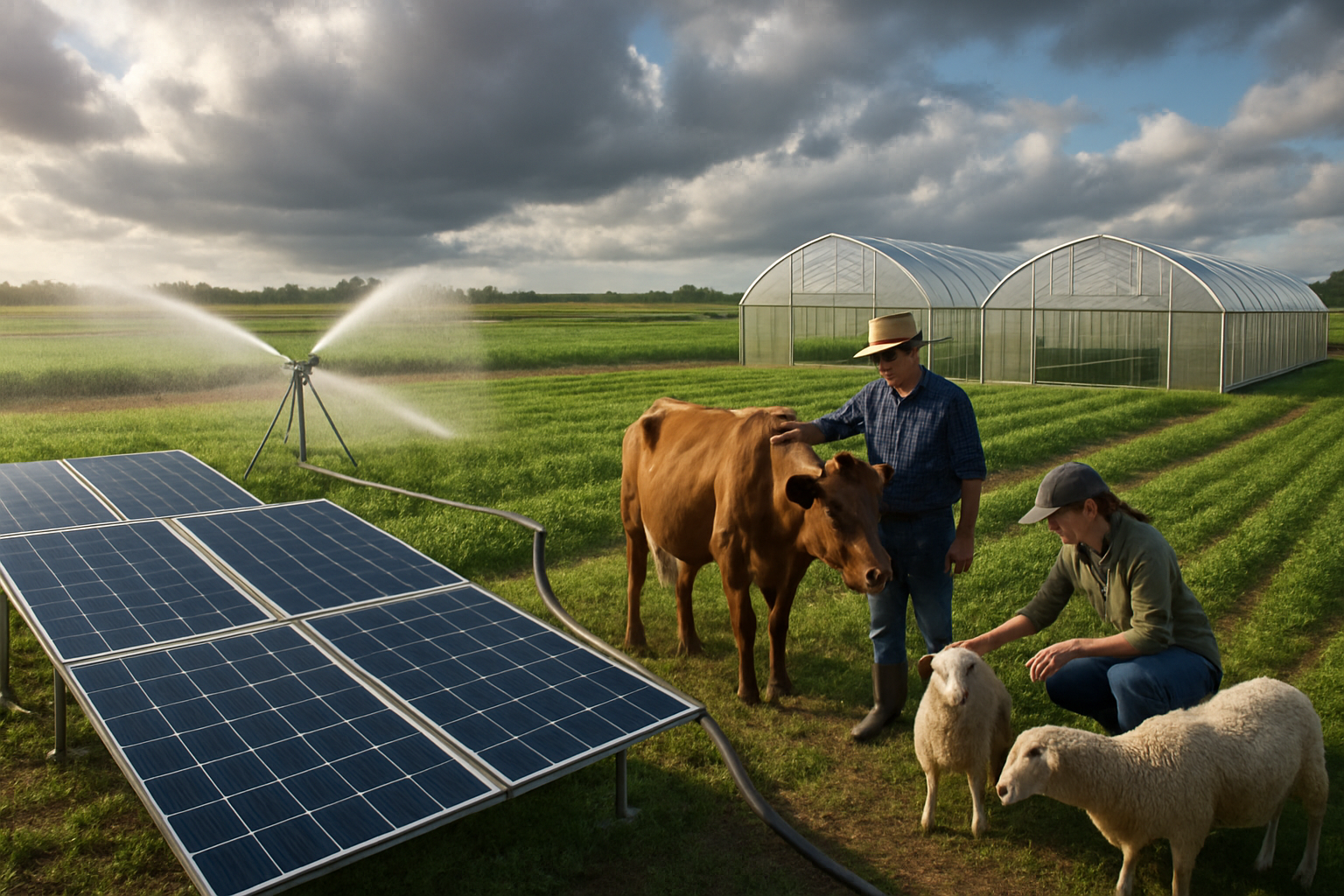
As global temperatures continue to exceed 1.5°C above pre-industrial levels for the twentieth consecutive month, three nations across three continents are demonstrating remarkable innovation in addressing mounting food security challenges through dramatically different approaches.
From Algeria's strategic livestock importation to Canada's revolutionary solar-powered agriculture in Africa, and Guyana's young farming entrepreneurs, these developments represent a broader agricultural renaissance occurring during one of the most challenging climate periods in human history.
Algeria's Strategic Food Security Response
Algeria has embarked on an ambitious livestock importation program as part of its comprehensive food security strategy. The arrival of 9,400 sheep from Romania at Skikda port represents a fraction of the government's ordered one million sheep imports, a directive issued by President Abdelmadjid Tebboune in preparation for Eid al-Adha celebrations.
The operation demonstrates sophisticated logistics coordination, with 17 veterinarians deployed to inspect the livestock and ensure health compliance. The Agricultural Services Directorate, under gubernatorial oversight and coordination with relevant authorities, has implemented comprehensive organizational and field procedures to ensure smooth operations.
This initiative reflects Algeria's broader agricultural transformation, building on earlier successes including the "Tamr Al-Aghanm" program that converts date waste into livestock feed, representing innovative circular economy approaches to food production. The country's agricultural sector has shown remarkable resilience amid climate pressures, with strategic imports complementing domestic production capabilities.
Canada's Solar Agriculture Revolution in Africa
Canadian company JCM Power has pioneered an unexpected agricultural innovation in Malawi, where African bird's eye chili peppers grow beneath solar panels in a groundbreaking agrovoltaics system. The company invests revenues paid in Malawian kwachas for its solar power into community farming, creating a sustainable economic cycle that benefits both energy and food security.
This dual-use approach addresses multiple challenges simultaneously: providing clean energy infrastructure while supporting agricultural production and creating local employment opportunities. The chili peppers, known for their intense heat and high market value, are sold in U.S. dollars, providing valuable foreign currency for the local economy.
The innovation represents a sophisticated synthesis of technology and community development, where energy infrastructure investment directly supports food production. This model has attracted international attention as a template for sustainable development that addresses energy poverty and food security through integrated approaches.
Guyana's Young Farming Entrepreneurs
In Guyana's West Coast Berbice region, 22-year-old Shakeem McCalmon of Bel Air Village exemplifies a new generation of agricultural entrepreneurs confidently expanding livestock operations with innovation and determination. While many young men his age pursue other careers, McCalmon has embraced cattle farming with a level of expertise that comes from years of early mornings, hands-on experience, and watching life grow under his care.
McCalmon's approach represents the quiet confidence that emerges from practical agricultural knowledge rather than academic training or corporate experience. His steadily expanding herd demonstrates how traditional farming wisdom, when combined with youthful energy and modern techniques, can create sustainable agricultural enterprises that support rural communities.
This youth engagement in agriculture is crucial for Guyana's continued leadership in Caribbean food security, building on Minister Zulfikar Mustapha's successful transformation of the country from food-import dependent to the region's leading food security provider since 2020.
Climate Context and Global Implications
These agricultural innovations occur against the backdrop of unprecedented climate challenges. January 2026 marked the hottest month in recorded history, extending an extraordinary streak of twenty consecutive months with global temperatures exceeding 1.5°C above pre-industrial levels. This sustained warming has fundamentally altered traditional farming cycles, water availability, and pest management patterns worldwide.
The success of these diverse approaches demonstrates that effective agricultural adaptation requires sophisticated integration of cutting-edge technology with traditional ecological knowledge and community-based management systems. Algeria's strategic livestock coordination combines modern veterinary science with traditional animal husbandry practices. Canada's solar agriculture merges renewable energy technology with indigenous farming techniques. Guyana's young farmers blend generations of agricultural wisdom with contemporary business practices.
Technology-Traditional Knowledge Integration
The most successful agricultural adaptations emerging globally demonstrate a common pattern: sophisticated synthesis of modern technology with traditional farming knowledge rather than purely technological solutions that ignore local traditions and community structures.
This integration approach has proven superior across multiple contexts. In Algeria, biosecurity protocols combine advanced veterinary science with established livestock management practices. Canada's agrovoltaics project respects local farming traditions while introducing beneficial technological innovations. Guyana's agricultural success maintains traditional ecological knowledge while incorporating precision agriculture and modern market access.
These examples reflect broader patterns observed in agricultural development worldwide, where community ownership and transparent governance create more sustainable outcomes than top-down technology transfer approaches.
Economic Development and Food Security
Agricultural innovations function as comprehensive economic engines extending far beyond farm-level improvements. Algeria's livestock program creates employment in transportation, processing, and veterinary services while reducing import costs and supporting rural economic stability. Canada's solar agriculture generates sustainable employment while providing both energy and agricultural products. Guyana's young farmers contribute to rural employment creation while building the country's food security leadership.
These economic multiplier effects include infrastructure development, market access enhancement, and sustainable rural employment opportunities that help maintain population in agricultural areas rather than driving migration to urban centers.
International Cooperation and South-South Partnerships
The three cases demonstrate evolving patterns of international cooperation, with developing nations increasingly sharing expertise through peer partnerships rather than traditional North-South aid dependencies. Algeria's Romanian livestock partnership combines European agricultural expertise with North African market knowledge. Canada's African operations represent North-South cooperation focused on mutual benefit rather than dependency. Guyana's success has attracted attention from other Caribbean nations seeking similar agricultural transformation.
These approaches have proven more culturally appropriate and economically sustainable than conventional development assistance, emphasizing mutual benefit, technology sharing, and capacity building while maintaining local autonomy and decision-making authority.
Implementation Challenges and Success Factors
Despite their successes, these agricultural initiatives face common challenges that affect agricultural development worldwide. Funding sustainability remains critical for developing nations where immediate economic pressures often override long-term environmental considerations. Technical capacity building requires sustained investment in education, training, and institutional development beyond initial technology deployment.
Climate change disrupts project timelines and requires adaptive management capabilities to respond to rapidly changing conditions. Success factors consistently include community ownership of development processes, transparent governance preventing corruption, sustained political commitment transcending electoral cycles, and international cooperation that respects local autonomy while providing technical and financial support.
Future Implications for Global Food Security
The window for building resilient and equitable food systems is narrowing rapidly as environmental pressures intensify and population growth increases agricultural resource demands. However, the innovations demonstrated by Algeria, Canada, and Guyana provide templates for scaling successful interventions globally while maintaining effectiveness principles that ensure community benefit and environmental sustainability.
Success in agricultural transformation requires coordination of immediate crisis response with long-term resilience building, recognition that food security is a global public good requiring unprecedented international cooperation, and understanding that the tools and knowledge exist for comprehensive responses to feeding growing populations amid accelerating environmental change.
The human dimension remains central to all agricultural success stories. Whether it's Algerian veterinarians ensuring livestock health, Canadian engineers designing agrovoltaic systems, or young Guyanese farmers building sustainable enterprises, millions of farmers, food workers, and vulnerable communities depend on stable and fair global food systems.
The choices made during this critical climate action decade may determine food security trajectories for decades ahead, making coordinated international action more urgent than ever before. The innovative approaches demonstrated across these three nations offer hope that human ingenuity and cooperation can meet the practical challenges of feeding the world while protecting the environmental systems that all life depends upon.