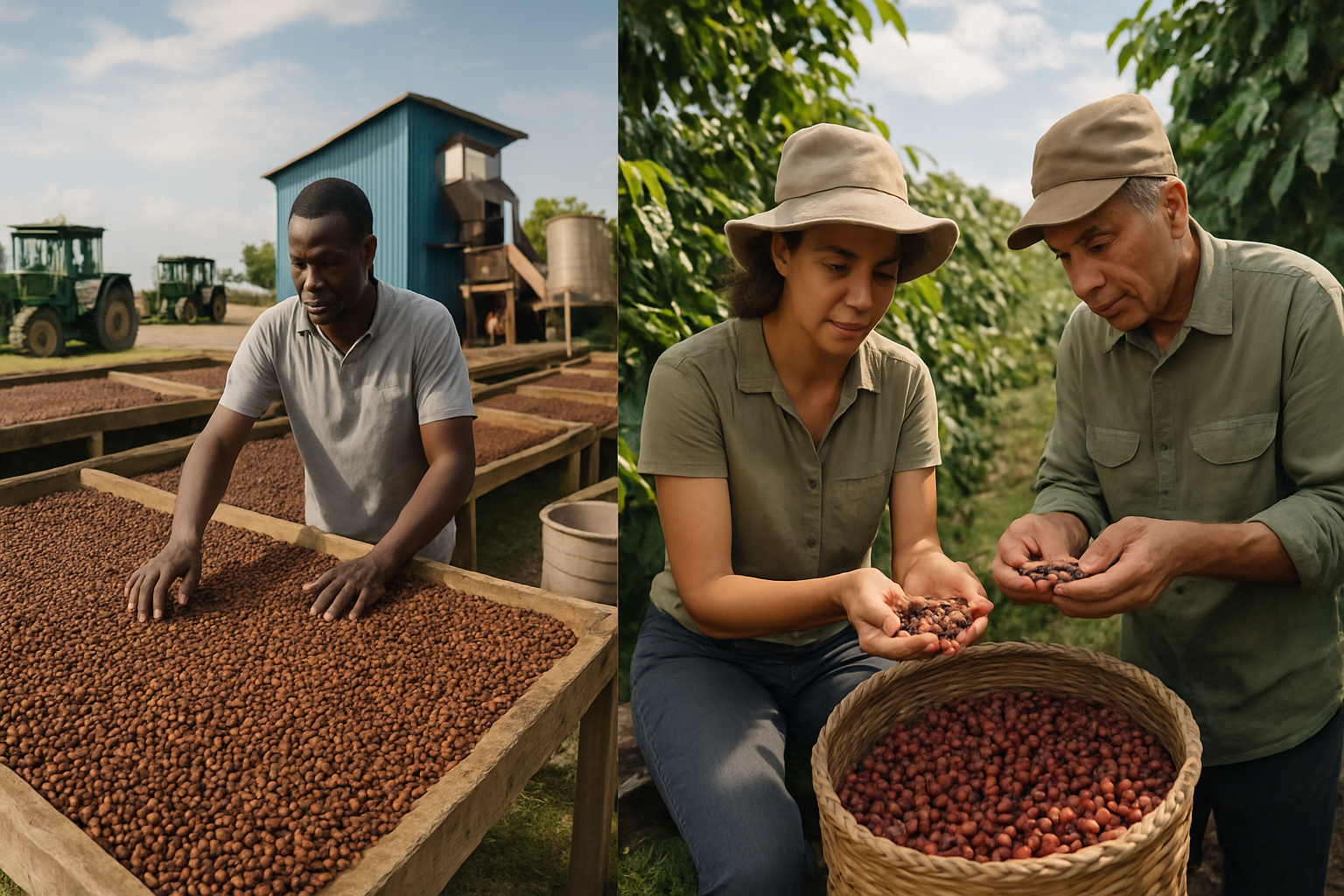
Agricultural sectors across four continents demonstrate unprecedented adaptation and innovation as global food systems navigate policy reforms, economic pressures, and climate challenges during February 2026, revealing both vulnerabilities and resilience in international food security frameworks.
A comprehensive investigation spanning Bulgaria, Ghana, Jamaica, and Uzbekistan reveals how agricultural communities worldwide are transforming their approaches to production, regulation, and market access. These developments occur as global temperatures maintain their record-breaking streak, with January 2026 marking the 18th consecutive month exceeding 1.5°C above pre-industrial levels, forcing rapid adaptation across all agricultural sectors.
Bulgaria Revolutionizes Agricultural Subsidies Through Digital Innovation
The Bulgarian Parliament achieved a landmark milestone on February 20, 2026, passing comprehensive amendments to the Law on Support of Agricultural Producers that fundamentally modernize how farmers access government assistance. The legislation, introduced by Tsveta Karayancheva (GERB-SDS) and a coalition of parliamentarians, addresses critical bottlenecks in agricultural support delivery that have hampered farming operations nationwide.
The revolutionary aspect of these amendments centers on eliminating the requirement for qualified electronic signatures when submitting applications for agricultural support during the 2026 and 2027 campaigns. This seemingly technical change represents a paradigm shift toward accessible digital governance, removing barriers that previously prevented thousands of farmers from accessing crucial financial assistance.
Under the new framework, agricultural producers can now submit direct support applications to the State Fund "Agriculture" through simplified digital processes, dramatically expanding participation in government support programs. The legislation specifically targets interventions for direct support, recognizing that bureaucratic complexity has historically excluded smaller farming operations from essential government backing.
Bulgarian agricultural policy experts describe this as the most significant digitalization advance in the country's agricultural sector since EU accession. The reforms align with broader European Union initiatives promoting digital transformation in rural areas while maintaining rigorous oversight and fraud prevention mechanisms.
Ghana's Construction Sector Crisis Threatens Agricultural Infrastructure
Ghana's agricultural sector faces an indirect but potentially devastating challenge as the Ghana Real Estate Developers Association (GREDA) raises urgent concerns about persistently high building material costs despite the Ghanaian cedi's recent strengthening against the US dollar. This crisis has profound implications for agricultural infrastructure development and rural housing construction essential for farming community stability.
Executive Secretary Samuel Amegayibor told Adom News that suppliers of cement, iron rods, and other essential construction materials continue pricing based on outdated or inflated dollar exchange rates, refusing to adjust prices downward despite improved currency conditions. This practice creates artificial barriers to agricultural infrastructure development, threatening expansion of processing facilities, storage systems, and rural housing projects.
The construction materials pricing crisis affects agricultural development through multiple channels. Modern farming operations require substantial infrastructure investments including processing facilities, cold storage systems, irrigation infrastructure, and worker housing. When building materials remain artificially expensive, agricultural modernization projects become economically unfeasible, trapping farming communities in less productive traditional systems.
GREDA's analysis reveals that construction costs have remained elevated despite the cedi's appreciation, creating a disconnect between macroeconomic improvements and ground-level investment conditions. This phenomenon illustrates how agricultural development depends not only on direct farming policies but also on broader economic conditions affecting infrastructure creation.
"This behaviour not only distorts the market but also makes construction projects more expensive and threatens the viability of agricultural infrastructure projects essential for food security."
— Samuel Amegayibor, Executive Secretary, GREDA
Jamaica Pioneers Coffee Market Transparency Through Farmer Education
The Jamaica Agricultural Commodities Regulatory Authority (JACRA) announced on February 19, 2026, a groundbreaking national education campaign designed to provide coffee farmers with unprecedented transparency about pricing mechanisms. This initiative addresses longstanding frustrations among coffee producers who have struggled to understand how global market forces translate into local pricing structures.
Director General Wayne Hunter emphasized that neither JACRA nor government ministers can directly determine coffee box prices, which are established through complex interactions between global benchmarks, quality standards, and supply-demand dynamics. The education campaign represents a shift from paternalistic agricultural policy toward empowering farmers with market knowledge, enabling more informed production and marketing decisions.
Jamaica's approach reflects growing international recognition that sustainable agricultural development requires farmer education alongside direct financial support. The campaign will detail the complete coffee value chain, from international commodity markets to local processing and export logistics, providing farmers with tools to optimize their participation in global markets.
The initiative gains particular significance given Jamaica's reputation for producing some of the world's highest-quality coffee, particularly Blue Mountain varieties that command premium prices in international markets. By understanding pricing mechanisms, farmers can better align production practices with market demand, potentially improving both quality and profitability.
This transparency initiative emerges from broader recognition that information asymmetries between producers and markets represent a fundamental challenge in agricultural development. When farmers lack understanding of pricing mechanisms, they cannot make strategic decisions about crop selection, quality improvement, or market timing that maximize their economic returns.
Uzbekistan Demonstrates Agricultural Diversification Success
Uzbekistan's agricultural sector achievements in 2025 demonstrate successful diversification strategies that enhance food security while building export capacity. According to the National Statistics Committee, the country imported over 422,000 tons of wheat flour valued at $124.6 million, indicating sophisticated supply chain management balancing domestic production with strategic imports.
Simultaneously, Uzbekistan's fishing industry achieved remarkable growth with total fish catch reaching 206,200 tons in 2025, representing a 3.4% increase from 2024 levels. This expansion reflects successful aquaculture development programs that diversify protein sources while reducing dependence on traditional livestock production systems.
The combination of strategic wheat flour imports and expanding fish production illustrates modern agricultural planning that optimizes comparative advantages while ensuring food security. Rather than pursuing complete self-sufficiency in all categories, Uzbekistan's approach focuses on developing sectors where the country has natural advantages while efficiently importing products where international markets offer better value.
This strategy has particular relevance given Uzbekistan's position in Central Asia, where climate conditions favor certain agricultural activities over others. The successful expansion of aquaculture demonstrates how countries can develop alternative protein sources that may be more climate-resilient than traditional livestock operations.
The wheat flour imports, valued at substantial levels, indicate that Uzbekistan maintains food security through diversified supply sources rather than relying exclusively on domestic production. This approach provides resilience against crop failures or extreme weather events that could threaten food availability.
Technology-Tradition Integration Drives Global Agricultural Innovation
Across all four countries examined, successful agricultural development emerges from sophisticated integration of traditional farming knowledge with modern technology and policy frameworks. Bulgaria's digital signature elimination respects farming communities' technological capabilities while introducing beneficial innovations. Ghana's infrastructure challenges require solutions that combine traditional construction knowledge with modern materials science.
Jamaica's farmer education campaign honors traditional coffee cultivation expertise while introducing contemporary market analysis tools. Uzbekistan's diversification strategy builds on traditional Central Asian trading practices while leveraging modern agricultural science and international market access.
This synthesis approach reflects lessons learned from earlier agricultural development programs where top-down technology transfer failed without considering local knowledge systems and community structures. Contemporary successful agricultural development requires community ownership combined with technological advancement, respecting cultural practices while introducing beneficial innovations.

Climate Adaptation Strategies Across Diverse Agricultural Systems
The agricultural developments documented across Bulgaria, Ghana, Jamaica, and Uzbekistan occur during unprecedented climate challenges, with January 2026 representing the hottest month in recorded history. Each country's agricultural strategies reflect adaptation to changing environmental conditions while maintaining production capacity and food security.
Bulgaria's digital governance improvements enable more responsive agricultural support delivery, crucial during climate unpredictability when farmers need rapid access to assistance programs. Ghana's infrastructure development challenges become more urgent as climate change requires enhanced storage and processing capabilities to reduce post-harvest losses during extreme weather events.
Jamaica's market transparency initiatives help farmers adapt to climate-induced price volatility by understanding how weather patterns in different growing regions affect global coffee markets. Uzbekistan's diversification strategy provides resilience through multiple protein sources and supply chains that can compensate when climate conditions affect specific sectors.
These adaptations demonstrate how agricultural policy must evolve beyond traditional production support toward comprehensive resilience building. Climate adaptation requires not only drought-resistant crops or improved irrigation but also governance systems, market access, infrastructure development, and farmer education that enable rapid response to changing conditions.
International Cooperation and Knowledge Transfer
The agricultural innovations documented in February 2026 reflect increasing South-South cooperation and peer-to-peer learning rather than traditional North-South aid relationships. Countries share experiences with digital governance, infrastructure development, market transparency, and diversification strategies through regional organizations and international agricultural forums.
Bulgaria's digital signature elimination provides a template for other Eastern European countries seeking to modernize agricultural support delivery. Ghana's infrastructure challenges offer lessons for other African nations balancing economic development with agricultural needs. Jamaica's transparency initiative demonstrates approaches to farmer empowerment relevant across Caribbean and coffee-producing regions.
Uzbekistan's successful diversification strategy provides insights for other Central Asian countries seeking to optimize agricultural development given similar climate conditions and economic structures. These cross-border learning opportunities increasingly supplement traditional technical assistance programs.
International cooperation also appears in addressing shared challenges like climate adaptation, where individual countries' experiences contribute to global knowledge about resilient agricultural systems. The diversity of approaches demonstrated across these four countries provides multiple pathways for agricultural development rather than one-size-fits-all solutions.
Economic Development Beyond Farm-Level Production
Contemporary agricultural development extends beyond individual farm productivity to encompass rural economic ecosystems including infrastructure, governance, market access, and community development. Bulgaria's policy reforms support not only individual farmers but entire rural communities dependent on agricultural success.
Ghana's construction sector challenges affect agricultural development through infrastructure limitations that constrain processing, storage, and transportation capabilities essential for modern farming operations. Jamaica's market education initiative creates informed farming communities capable of strategic decision-making that improves overall economic outcomes.
Uzbekistan's diversification approach develops multiple economic sectors that provide alternative employment opportunities while supporting agricultural growth. This comprehensive economic development perspective recognizes that sustainable agricultural communities require diverse economic opportunities, modern infrastructure, responsive governance, and market access.
The economic implications extend to international trade relationships, regional integration opportunities, and rural poverty reduction that affects millions of people dependent on agricultural systems for their livelihoods. Successful agricultural development creates multiplier effects throughout rural economies.
Future Implementation Challenges and Success Factors
The agricultural innovations documented across these four countries face common implementation challenges including funding sustainability, technical capacity building, climate unpredictability, and the need for adaptive management responding to rapidly changing conditions.
Success factors identified include sustained political commitment, community ownership, transparent governance frameworks, international cooperation that respects local autonomy, and the ability to balance immediate crisis response with long-term resilience building. The diversity of approaches provides resilience against single-solution dependencies.
Bulgaria's policy reforms require sustained commitment to digital governance improvement while maintaining fraud prevention. Ghana's infrastructure development needs sustained investment and coordination between private developers and agricultural planning. Jamaica's education initiatives require long-term support and evaluation to ensure farmer benefits.
Uzbekistan's diversification strategy demands continued investment in aquaculture development, supply chain management, and international market relationships. All four countries must balance agricultural development with environmental protection, community needs, and economic sustainability.
Global Food Security Implications
The agricultural developments in Bulgaria, Ghana, Jamaica, and Uzbekistan provide templates for addressing global food security challenges through diverse pathways including policy modernization, infrastructure development, market transparency, and production diversification. These approaches offer alternatives to crisis-response strategies by building proactive resilience.
The timing of these innovations during record global temperatures demonstrates that agricultural communities possess significant adaptive capacity when supported by appropriate policies, infrastructure, market access, and international cooperation. The challenge involves scaling successful approaches while maintaining effectiveness principles ensuring community benefit.
As the window for building resilient, equitable food systems narrows rapidly due to accelerating climate change, the agricultural innovations documented in February 2026 represent critical lessons for global food security planning. Success depends on coordinated action addressing immediate crises while building long-term agricultural resilience serving growing populations amid environmental uncertainty.
The integration of traditional agricultural wisdom with modern technology, policy innovation, and international cooperation demonstrates pathways for agricultural transformation that honor community knowledge while embracing beneficial change. These developments offer hope for global food systems capable of serving human prosperity while maintaining planetary sustainability during the most challenging environmental period in human history.