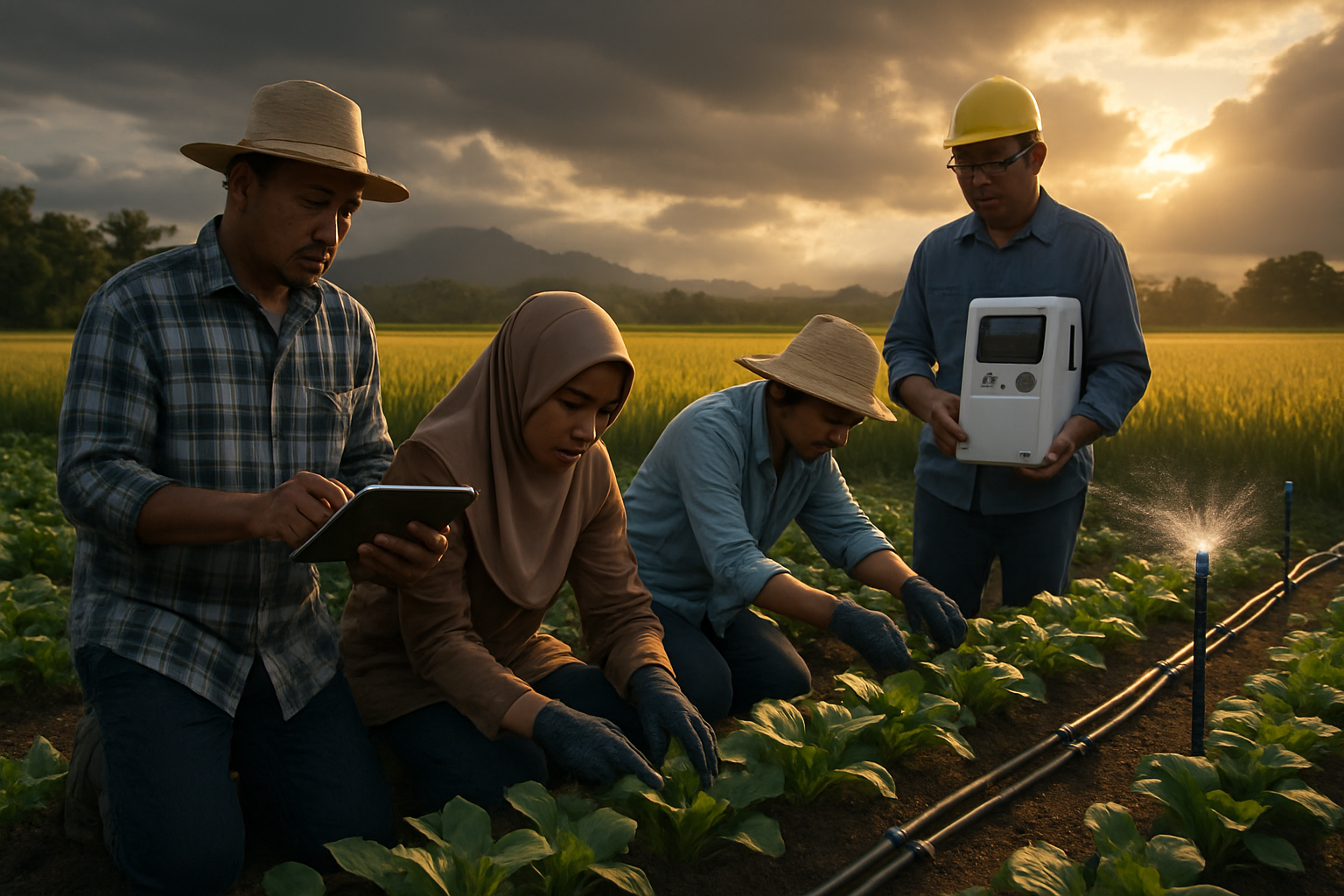
A groundbreaking shift is occurring across the developing world as agricultural leaders abandon traditional approaches in favor of innovative, outcome-driven strategies designed to secure food independence amid unprecedented climate pressures. Malaysia's Sarawak state has emerged as a flagship example of this transformation, with officials declaring that routine agricultural administration must give way to results-focused delivery systems.
Speaking at the 2025 Excellent Service Award Ceremony of the Sarawak Department of Agriculture in Sibu, State Minister of Food Industry, Commodity and Regional Development Dr. Stephen Rundi Utom emphasized the urgent need for agricultural evolution. "Agriculture must move beyond routine administration to outcome-driven delivery if Sarawak is to become a major food producer and future net exporter," Dr. Rundi declared, setting the stage for what experts are calling the most significant agricultural policy shift in Southeast Asia.
The Climate Imperative Driving Change
This agricultural renaissance occurs against the backdrop of January 2026 marking the hottest month in recorded history—the 18th consecutive month exceeding 1.5°C above pre-industrial levels. The relentless warming has forced rapid adaptation across global agricultural systems, with traditional farming cycles disrupted by extreme weather patterns that demand immediate strategic responses.
Malaysia's initiative reflects a broader pattern emerging across developing nations, where governments are recognizing that food security can no longer rely on conventional approaches. The Sarawak model emphasizes measurable outcomes rather than procedural compliance, representing a fundamental paradigm shift that could influence agricultural policy across the Global South.
Learning from Global Success Stories
The Malaysian approach builds upon successful agricultural transformations documented across multiple continents throughout 2026. In Africa, the Democratic Republic of Congo's Institut Congolais pour la Conservation de la Nature supported over 11,000 farmers through conservation-focused approaches, while Kenya's Nguruman irrigation scheme rehabilitation has benefited more than 10,000 farmers in the Kajiado West sub-county.
Egypt's strategic "food security triangle"—a collaboration between the Supply Minister, Agriculture Minister, and development agencies—has demonstrated how coordinated government action can stabilize markets and ensure food availability during critical periods like Ramadan. Similarly, the Philippines' village-based feed ecosystem initiative has created integrated rural economic systems that reduce external input dependency through community-based agricultural self-sufficiency.
"Despite our challenges, Africa stands on the threshold of true integration. Our success hinges on our collective will to align national reforms with continental goals."
— Emmanuel Armah-Kofi Buah, Ghana Minister
Technology-Tradition Integration
What distinguishes the current agricultural renaissance from previous modernization efforts is the sophisticated integration of traditional knowledge with cutting-edge technology. Algeria's groundbreaking "Tamr Al-Aghanm" innovation converts date waste into livestock feed, representing a circular economy approach that honors traditional practices while embracing scientific advancement.
Finland has achieved winter raspberry cultivation breakthroughs using controlled environment agriculture, demonstrating how technology can overcome seasonal limitations. Papua New Guinea's Markham Valley corn production, expected to generate over K5 million through mechanized harvesting, shows how developing nations can leverage modern equipment while maintaining traditional ecological connections.
Indonesia's integrated conservation model exemplifies this balance, combining wildlife protection programs with sustainable poultry farming initiatives that provide alternative livelihoods while reducing pressure on natural resources.
South-South Cooperation Emergence
A significant trend accompanying this agricultural transformation is the rise of South-South cooperation, where developing nations lead innovation and share solutions among themselves rather than relying solely on traditional North-South aid relationships. Zimbabwe's donation of 370 metric tonnes of maize to Malawi demonstrates regional solidarity during food crises, while Uzbekistan's farmers are studying Chinese seed production practices through direct knowledge exchange programs.
This pattern reflects growing confidence among developing nations in their capacity to address complex agricultural challenges through peer-to-peer learning and resource sharing. The African Continental Free Trade Agreement (AfCFTA) is facilitating such cooperation by enabling cross-border agricultural ventures and shared value chains.
Economic Development Beyond the Farm
The Malaysian model and similar initiatives worldwide demonstrate that modern agricultural development extends far beyond farm-level improvements. These programs create sustainable employment in conflict-affected areas, establish price stabilization mechanisms for consumer protection, enhance dairy competitiveness through improved fodder management, and reduce rural poverty through integrated economic opportunities.
Algeria's coordination between multiple ministries has shown how strategic import management can protect consumers while supporting domestic producers. India's diverse approaches to fodder crop management—with Tamil Nadu losing area while Karnataka improved coverage—highlight the complexity of modern livestock industry challenges and the need for region-specific solutions.
Addressing Supply Chain Vulnerabilities
Recent global food crises have exposed critical vulnerabilities in international supply chains. Argentina's beef consumption fell to 20-year lows despite the country's identity as a major producer, while Ghana's cocoa sector faces mounting economic pressures from climate-related risks and rising production costs. Kenya's drought response through fertilizer subsidy programs demonstrates how governments can intervene effectively during critical planting seasons.
The European experience, including Sweden's agricultural regulation burden and Romania's pesticide import investigations, shows that even developed nations struggle with balancing consumer protection, producer viability, and environmental sustainability.
Climate Adaptation Strategies
The agricultural innovations emerging from developing nations represent diverse climate adaptation strategies. Conservation agriculture in the Democratic Republic of Congo, strategic import coordination in Egypt, livestock feed management improvements in India, and village-based integration in the Philippines all demonstrate different approaches to building resilience against climate volatility.
These strategies share common elements: community ownership, international cooperation, technology-traditional knowledge synthesis, gender integration, and economic development that extends beyond individual farms to strengthen entire rural communities.
Success Factors and Challenges
The success of Malaysia's agricultural transformation and similar initiatives worldwide depends on several critical factors. Community ownership ensures that programs reflect local needs and cultural practices. International cooperation provides access to knowledge, technology, and markets that individual nations cannot develop alone. The synthesis of traditional wisdom with modern technology creates sustainable solutions that respect cultural heritage while embracing innovation.
However, significant challenges remain. Funding sustainability represents a constant concern for developing nations pursuing agricultural modernization. Technical capacity building requires sustained investment in education and training. Climate unpredictability continues to disrupt traditional farming cycles, demanding adaptive management approaches that can respond quickly to changing conditions.
Templates for Global Scaling
The Malaysian approach, combined with successful initiatives across Africa, Asia, and Latin America, provides templates for scaling food security interventions globally. These models demonstrate that agricultural innovation, traditional wisdom, and international cooperation can address fundamental food access challenges when combined with sustained political commitment and adequate resource allocation.
The diversity of approaches—from Indonesia's wildlife protection combined with sustainable agriculture to Papua New Guinea's commercial farming transitions to Nicaragua's livestock fair integration—shows that there is no single solution to agricultural challenges. Instead, successful food security requires multiple pathways that can be adapted to local conditions while contributing to global resilience.
Future Implications
As the global community grapples with feeding a growing population amid accelerating climate change, the innovations emerging from developing nations offer hope for sustainable solutions. The proactive resilience building demonstrated in Malaysia, Kenya, Algeria, and other nations represents a fundamental shift from reactive crisis management to strategic food system transformation.
The success of these initiatives could influence international development policy, demonstrate the capacity for innovation outside traditional centers of agricultural research, and provide practical models for countries facing similar challenges. Most importantly, they show that food security is achievable through coordinated action that combines immediate crisis response with long-term capacity building.
The window for building resilient, equitable food systems is narrowing as climate impacts accelerate. However, the agricultural renaissance documented across developing nations in 2026 demonstrates that the tools, knowledge, and cooperation necessary for transformation are available. Success depends on scaling these innovations rapidly while maintaining the community-centered approaches that have made them effective.
As Dr. Rundi's vision for Sarawak demonstrates, the future of global food security may well depend on developing nations leading the way toward agricultural systems that prioritize outcomes over procedures, innovation over convention, and resilience over short-term efficiency. The transformation has begun; the question now is whether it can scale quickly enough to meet the challenges ahead.