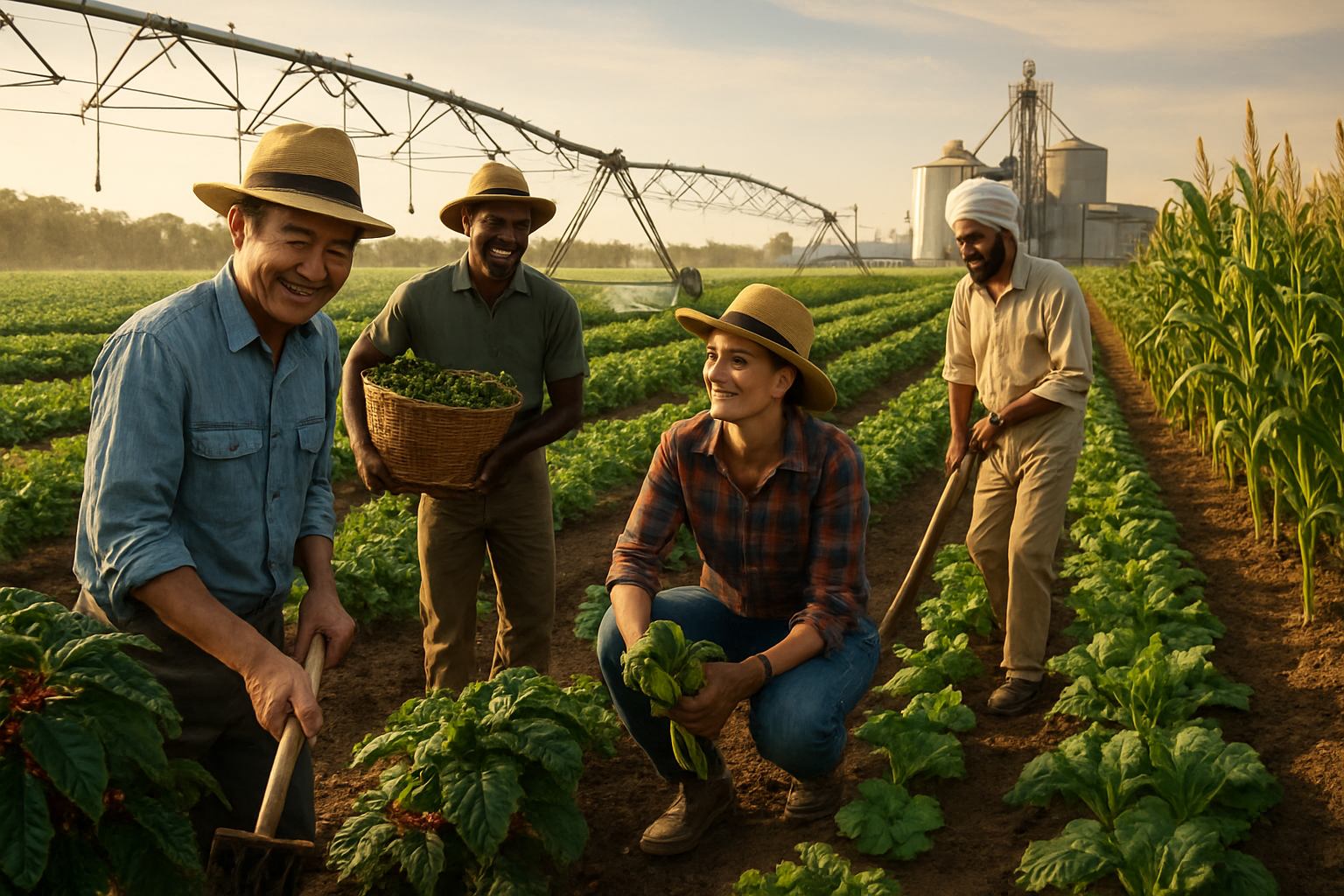
A remarkable transformation is unfolding across the global agricultural landscape as nations from the Caribbean to Central Africa implement revolutionary food security initiatives amid the 20th consecutive month of temperatures exceeding 1.5°C above pre-industrial levels.
At the forefront of this agricultural renaissance, the Democratic Republic of Congo is preparing to launch the harvest of 40,000 tonnes of corn produced by the Service National (SN), marking a significant milestone in the 2025-2026 agricultural season. Lieutenant-General Jean-Pierre Kasongo Kabwik, commander of the Service National, announced that the country's head of state will officially launch this historic harvest in the coming days, representing a major achievement in domestic food production.
Simultaneously, the World Food Programme (WFP) has unveiled ambitious plans to strengthen local food systems in the DRC through enhanced domestic production capabilities. David Stevenson, WFP Director for the DRC, announced this strategic shift during a workshop in Kinshasa focused on formulating the Country Strategic Plan (CSP) to address humanitarian needs while building long-term agricultural resilience.
Caribbean Leadership in Food Security Innovation
The Caribbean region has emerged as an unexpected leader in agricultural innovation, with Jamaica receiving unprecedented international support for climate adaptation. The Green Climate Fund (GCF) has approved a transformative US$50 million project, supported by the Food and Agriculture Organization (FAO), to enhance climate resilience among vulnerable small farmers across six central Jamaica parishes responsible for roughly 70% of the country's domestic food production.
This initiative, titled "ADAPT Jamaica: Enhancing climate change resilience of vulnerable smallholders in Central Jamaica," represents the first single-country climate investment Jamaica has received from the GCF. The project will be implemented in Clarendon, Manchester, St Ann, St Catherine, St Elizabeth, and Trelawny, with US$35 million provided as a grant and US$15 million contributed by the Jamaican government.
"This represents a new paradigm in agricultural development where climate adaptation and food security are no longer separate goals but integrated strategies for survival and prosperity."
— Analysis from Caribbean Agricultural Development Experts
Middle Eastern Supply Chain Innovation
Jordan has demonstrated sophisticated crisis management through comprehensive poultry sector coordination. Government ministers including Industry, Trade and Supply Minister Yarab Al-Qudah and Agriculture Minister Saeb Khresat held extensive meetings with poultry farmers to address sector challenges amid regional disruptions. Officials confirmed that supply chains remain stable with regular vessel arrivals through Aqaba port, while emphasizing contingency measures to ensure feed availability, particularly corn, which is essential for poultry production.
The proactive approach has maintained adequate poultry meat supplies in markets for extended periods, demonstrating how coordinated government-industry collaboration can maintain food security during geopolitical uncertainties. Poultry farmers confirmed sufficient inventory levels while authorities monitor transportation routes and storage capabilities to prevent disruptions.
Climate Context and Global Implications
These agricultural developments occur during an unprecedented period of environmental stress. January 2026 marked the hottest month in recorded history, extending what is now the longest sustained warming streak in human records. This sustained temperature increase has fundamentally altered traditional farming cycles, water availability, and pest management patterns worldwide, forcing rapid adaptation in agricultural systems designed for historical climate conditions.
The convergence of climate pressures with innovative agricultural responses represents what experts describe as a "critical juncture" in global food security. Traditional seasonal patterns that have guided farming for millennia are becoming increasingly unreliable, requiring sophisticated integration of modern technology with traditional ecological knowledge.

Technology-Tradition Integration Success
The most successful agricultural adaptations demonstrate sophisticated synthesis of cutting-edge technology with traditional farming wisdom and community-based management systems. In the DRC, corn production combines modern agricultural science with established farming practices developed over generations. Jamaica's climate adaptation project specifically emphasizes community ownership while incorporating precision agriculture and advanced irrigation techniques.
This approach has proven superior to purely technological solutions that ignore local traditions and community structures. Countries implementing comprehensive agricultural protection demonstrate greater economic resilience and attract sustainable investment compared to those relying solely on traditional methods or technology-only approaches.
South-South Cooperation Emergence
A significant shift is occurring in international agricultural cooperation, with developing nations increasingly sharing expertise through peer partnerships rather than traditional North-South aid relationships. This approach has proven more culturally appropriate and economically sustainable than conventional development assistance.
The African Continental Free Trade Agreement (AfCFTA) is enabling cross-border agricultural ventures and shared value chains, allowing countries to collectively address food security challenges that individual nations cannot tackle independently. Regional integration is creating opportunities for knowledge sharing, joint infrastructure development, and coordinated crisis response.
Economic Development Beyond Farming
These agricultural innovations function as comprehensive economic engines extending far beyond farm-level improvements. The DRC's corn harvest creates employment across transportation, processing, and storage sectors while reducing import dependencies. Jamaica's climate adaptation project generates sustainable rural employment while building infrastructure that supports entire agricultural ecosystems.
Jordan's supply chain management demonstrates how coordinated agricultural policies protect consumer purchasing power while supporting producer incomes, creating economic stability during volatile periods. The multiplier effects include infrastructure development, market access enhancement, and rural economic strengthening that benefit entire communities.
Implementation Challenges and Success Factors
Despite remarkable progress, significant challenges remain. Funding sustainability is critical for developing nations where immediate economic pressures often override long-term environmental considerations. Technical capacity building requires sustained investment in education, training, and institutional development beyond initial technology deployment.
Climate change continues to disrupt project timelines, requiring adaptive management that can respond to rapidly changing conditions. Success factors consistently identified across regions include community ownership of development processes, transparent governance, sustained political commitment that transcends electoral cycles, and international cooperation that respects local autonomy while providing technical and financial support.
"The window for building resilient, equitable food systems is narrowing rapidly as environmental pressures intensify and population growth increases agricultural resource demands."
— International Food Security Analysts
Strategic Global Significance
The agricultural developments of March 2026 provide diverse, complementary templates for addressing global food security challenges. The combination of immediate crisis response (DRC corn production), strategic international partnerships (Jamaica climate adaptation), and supply chain management (Jordan poultry coordination) demonstrates comprehensive approaches addressing multiple food security dimensions simultaneously.
These models can be adapted and scaled to similar contexts worldwide, contributing to resilient global food systems capable of serving growing populations amid accelerating environmental change. The diversity of approaches provides resilience against single-solution dependencies while offering multiple adaptation pathways for different national circumstances.
Future Implications and Decisive Decade
The success of current agricultural transformations may determine whether food production systems can keep pace with environmental change while serving growing populations during what experts call the "critical climate action decade." The stakes are unprecedented, but the demonstrated innovation capacity of farming communities and governments provides cautious optimism for building sustainable, resilient food systems.
Coordination between immediate crisis response and long-term resilience building is crucial for global food systems confronting accelerating environmental change. The tools and knowledge exist for comprehensive responses, but success depends on sustained international cooperation, enhanced multi-sector coordination, and increased financial commitments that recognize food security as essential infrastructure for human prosperity and planetary sustainability.
Human Dimension at the Center
At the heart of these developments lies a fundamental human dimension—millions of farmers, food workers, and vulnerable communities depend on stable, fair global food systems. The choices made during this critical period may determine food security trajectories for decades ahead, making coordinated international action more urgent than ever.
The agricultural renaissance emerging across continents demonstrates both the extraordinary challenges facing global food systems and the remarkable human capacity for innovation, cooperation, and adaptation. Success in scaling these innovations globally will determine whether agricultural systems can maintain effectiveness while ensuring community benefit and environmental sustainability during Earth's most challenging environmental period in recorded history.