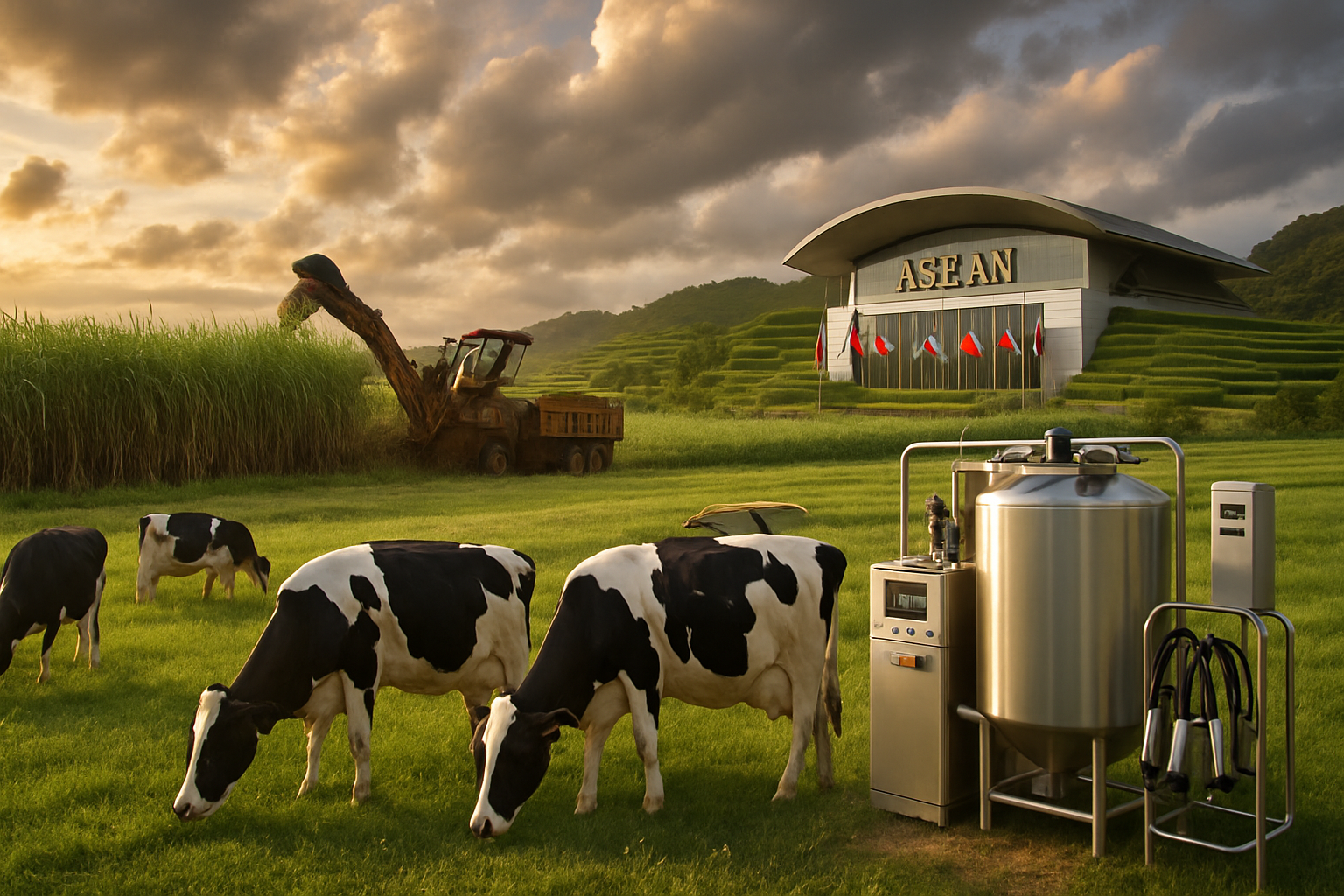
Agricultural sectors worldwide are experiencing a remarkable transformation as dairy production surges in Barbados, sugar industries face disruption, and international summits prioritize food security amid the longest sustained warming period in recorded history.
The global agricultural landscape in March 2026 presents a complex tapestry of innovation and crisis, with developments spanning from the Caribbean's heifer importation programs to Southeast Asian diplomatic initiatives focused on agricultural resilience. These developments unfold during the 20th consecutive month of global temperatures exceeding 1.5°C above pre-industrial levels, fundamentally altering traditional farming cycles worldwide.
Caribbean Agricultural Revolution
Barbados stands at the forefront of agricultural innovation in the Caribbean, where a strategic heifer importation program is revolutionizing the island's dairy sector. In December 2024, Barbados imported 180 pregnant cattle from Canada, marking a pivotal moment for the nation's agricultural sustainability efforts.
James Paul, Chief Executive Officer of the Barbados Agricultural Society, reported significant improvements in milk production at the Society's headquarters at Grotto, Beckles Road, St Michael. "The decision to import the heifers has already begun to help save the industry," Paul confirmed, highlighting the program's immediate impact on dairy output.
This success builds upon historical memory of previous agricultural transformations across developing nations. Similar to Burkina Faso's strategic partnership with Brazil that brought 710 high-performance pregnant cows to strengthen domestic dairy production, Barbados demonstrates the effectiveness of international cooperation in agricultural modernization.
Sugar Industry Faces Critical Challenges
While dairy production flourishes, Barbados' sugar sector confronts severe disruptions that threaten the 2026 harvest. The Portvale Sugar Factory has implemented a temporary suspension of grinding operations and shift work, resulting in no cane being reaped and growing concerns about crop spoilage.
"Starting tomorrow, Friday, March 27, 2026, all shift work will be suspended," announced Shanice Stevenson, Operations Manager of the Barbados Energy & Sugar Company, in a memorandum to workers.
— Shanice Stevenson, Operations Manager
The suspension represents a critical juncture for Barbados' sugar industry, historically a cornerstone of the island's economy. The timing of this disruption during harvest season compounds concerns about economic losses and potential long-term impacts on sugar production capacity.
ASEAN Summit Prioritizes Food Security
In the Philippines, President Ferdinand Marcos Jr. announced that the 2026 Association of Southeast Asian Nations (ASEAN) Summit will adopt a "bare bones" format, with primary focus on oil, food, and migrant workers amid the fuel crisis caused by Middle East tensions. This strategic prioritization reflects the growing recognition of food security as a critical component of regional stability and economic resilience.
The decision to streamline the summit agenda around essential issues including food security demonstrates how geopolitical tensions are reshaping international cooperation frameworks. The emphasis on food systems indicates ASEAN's acknowledgment that agricultural stability underpins broader regional security.
Climate Change as Agricultural Catalyst
These agricultural developments occur within an unprecedented climate context. January 2026 marked the hottest month in recorded history, extending a streak of 20 consecutive months above the critical 1.5°C warming threshold. This sustained temperature increase has fundamentally altered agricultural systems worldwide, forcing rapid adaptation in crop selection, irrigation methods, and harvest timing.
The warming trend functions as both challenge and catalyst for agricultural innovation. Countries implementing comprehensive agricultural adaptation strategies demonstrate greater resilience, with successful examples spanning multiple continents. From Malaysia's outcome-driven agricultural delivery transformation to Kenya's irrigation rehabilitation serving 10,000+ farmers, the pattern reveals sophisticated technology-tradition integration as the most effective adaptation approach.
Global Food Security Templates
The agricultural renaissance emerging in 2026 provides diverse templates for addressing global food security challenges. Barbados' dairy program exemplifies how strategic international partnerships can strengthen domestic production capacity while reducing import dependencies. The success builds on proven models from across the developing world, including:
- Egypt's livestock expansion program benefiting 45,353 beneficiaries with 526,760 head of cattle
- Uganda's cattle revival in the Teso region after decades of decline
- Algeria's innovative "Tamr Al-Aghanm" date waste to livestock feed conversion
- Zimbabwe's regional solidarity through 370 metric tonnes of maize donations to Malawi
Technology-Traditional Knowledge Synthesis
The most successful agricultural adaptations demonstrate sophisticated integration of cutting-edge technology with traditional farming knowledge and community-based management systems. This synthesis approach proves superior to purely technological solutions that ignore local traditions and community structures.
Barbados' dairy program respects established livestock management practices while introducing beneficial innovations through international partnerships. Similarly, agricultural developments worldwide show that sustainable food security requires approaches combining modern agricultural science with indigenous wisdom, community ownership principles, and economic development strategies extending beyond farm-level improvements.
South-South Cooperation Emergence
A significant pattern emerging from 2026's agricultural developments is the rise of South-South cooperation, where developing nations increasingly share expertise through peer partnerships rather than traditional North-South aid relationships. This approach proves more culturally appropriate and economically sustainable than conventional development assistance models.
The Barbados-Canada partnership exemplifies beneficial North-South cooperation, while regional Caribbean collaboration demonstrates South-South knowledge sharing effectiveness. These partnerships emphasize mutual benefit, technology sharing, and capacity building while enabling participating nations to maintain development control rather than creating dependency relationships.
Economic Development Engine
Agricultural innovations function as comprehensive economic development engines extending far beyond simple food production improvements. Barbados' dairy program generates employment in transportation, processing, and veterinary services while reducing milk import costs and supporting rural economic stability.
The economic multiplier effects include infrastructure development, market access enhancement, and creation of sustainable rural employment opportunities. These benefits particularly matter as agricultural sectors face mounting pressures from climate change, supply chain disruptions, and evolving consumer demands.
Implementation Challenges and Success Factors
Despite promising developments, significant implementation challenges persist across global agricultural transformation efforts. Funding sustainability remains critical for developing nations where immediate economic pressures often override long-term environmental considerations. Technical capacity building requires sustained investment in education, training, and institutional development beyond initial technology deployment.
Climate change disrupts project timelines, requiring adaptive management capabilities to respond to rapidly changing conditions. Success factors consistently identified across agricultural innovations include:
- Community ownership and engagement in development processes
- Transparent governance preventing corruption and ensuring accountability
- Sustained political commitment transcending electoral cycles
- International cooperation respecting local autonomy while providing technical support
- Economic viability generating tangible benefits for participating communities
Strategic Global Significance
The window for building resilient, equitable food systems is narrowing rapidly as environmental pressures intensify and population growth increases agricultural resource demands. Agricultural innovation must keep pace with accelerating climate change while maintaining effectiveness principles that ensure community benefit and environmental sustainability.
The convergence of climate pressures, supply chain vulnerabilities, and economic instabilities creates a critical decision point for global food security policy. The tools and knowledge exist for comprehensive responses to these challenges, but success depends on sustained international cooperation, enhanced coordination across multiple sectors and scales, and increased financial commitments that recognize food security as essential infrastructure for human prosperity and planetary sustainability.
Future Implications
The agricultural developments of 2026 may prove decisive for global food security trajectories in the decades ahead. The human dimension remains central to these efforts—millions of farmers, food workers, and vulnerable communities depend on stable, fair global food systems that balance immediate humanitarian needs with long-term sustainability goals.
Success in coordinating immediate crisis response with long-term resilience building will be crucial for global food systems serving growing populations amid accelerating environmental change. The stakes are unprecedented, but the demonstrated ingenuity of farming communities and the framework for international cooperation provide cautious optimism for building adaptive capacity during Earth's most challenging environmental period in recorded history.
As nations grapple with these interconnected challenges, the examples set by Barbados' dairy transformation, the Philippines' diplomatic prioritization of food security, and global agricultural innovations provide both inspiration and practical templates for scaling successful interventions worldwide while maintaining the flexibility and innovation necessary for continued adaptation to unprecedented global challenges.