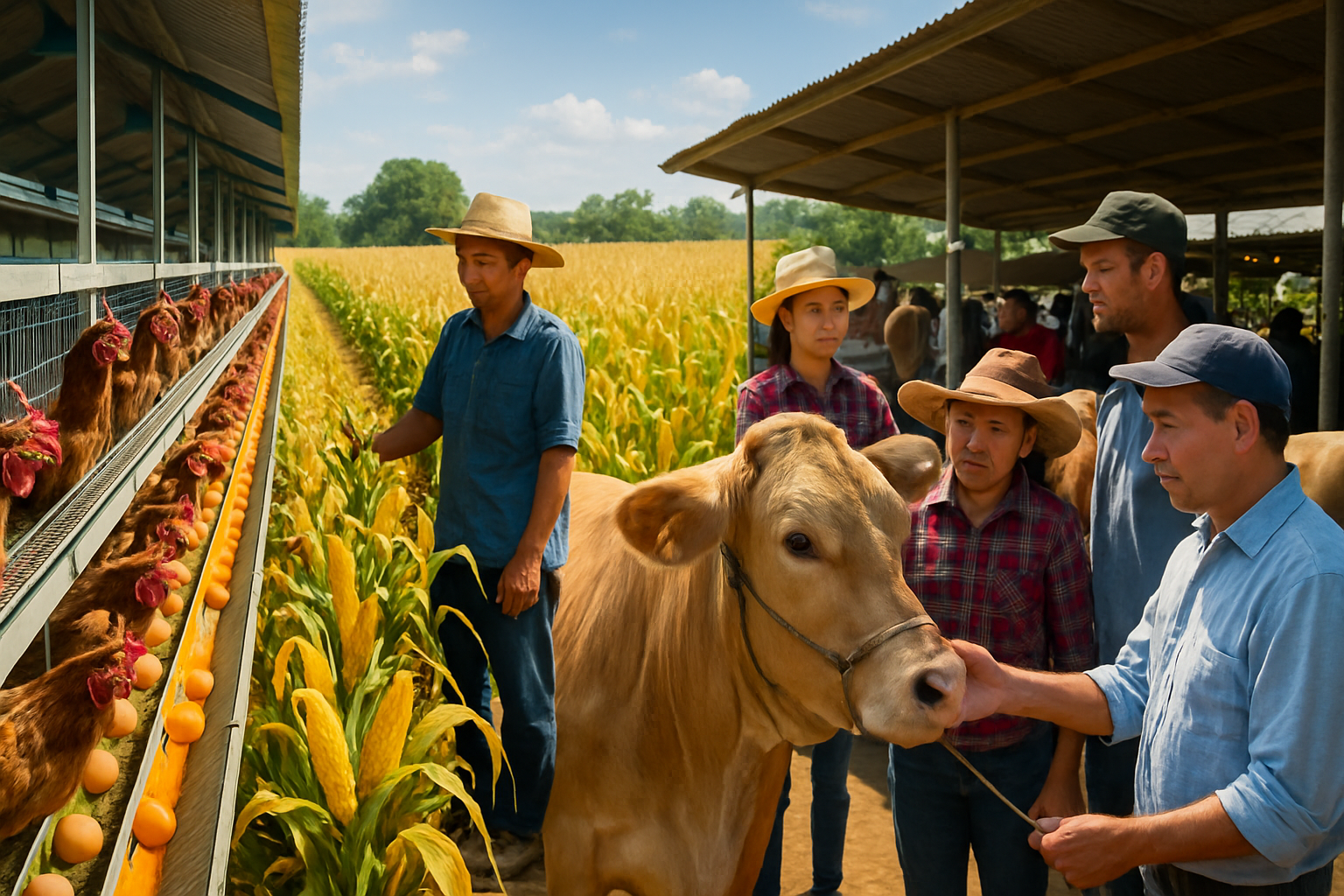
A coordinated wave of agricultural development initiatives across Indonesia, Nicaragua, and Papua New Guinea signals a new chapter in global rural transformation, as governments and communities embrace innovative approaches to food security and economic empowerment amid mounting climate pressures.
The convergence of these three distinct yet interconnected agricultural stories reflects broader trends documented throughout February 2026, where nations worldwide are reimagining rural development through community-centered approaches, technological integration, and sustainable farming practices.
Indonesia Advances Poultry Sector Through Community Empowerment
In Aceh Tamiang, Indonesia, a strategic push to develop the region's poultry industry exemplifies how local leadership can drive agricultural transformation. Deputy Chairman of the District People's Representative Council (DPRK), Syaiful Bahri, has emerged as a champion for egg-laying chicken farming, advocating for systematic development through carefully planned small and medium enterprise (UMKM) empowerment schemes.
This initiative represents more than economic development—it embodies Indonesia's integrated conservation model that combines traditional ecological knowledge with modern agricultural science. The approach addresses immediate economic needs while reducing pressure on natural resources, a critical balance in a region where conservation and livelihoods must coexist.
"Systematic approaches balancing economic development with environmental protection are essential for sustainable rural transformation."
— Syaiful Bahri, Deputy Chairman, DPRK Aceh Tamiang
The timing of Indonesia's poultry sector development occurs alongside the nation's broader environmental conservation efforts. Recent initiatives have included wildlife protection programs, such as the successful pangolin rescue operations in Central Kalimantan, demonstrating how agricultural development can serve as an alternative livelihood strategy that reduces pressure on protected ecosystems.
Nicaragua Celebrates Agricultural Heritage at Premier Livestock Fair
Matagalpa, Nicaragua, launched 2026 with its first high-level livestock fair, an ambitious celebration featuring exhibitions, professional rodeo events, and family activities. The event represents a significant milestone for Central America's agricultural sector, positioning Nicaragua as a regional hub for livestock excellence and rural cultural preservation.
The fair's comprehensive approach—combining traditional livestock showcasing with modern entertainment—reflects Nicaragua's strategy to make agriculture appealing to younger generations while honoring established farming traditions. This model has proven successful across Latin America, where countries are working to counter rural youth migration to urban areas.
The event's timing aligns with broader regional agricultural modernization efforts. Recent developments across Latin America have included Mexico's indigenous farming knowledge internationalization through the Sembrando Vida program, Ecuador's agricultural university serving as a regional development catalyst, and Argentina's historic wheat export resumption to China after a 30-year hiatus.
Papua New Guinea Eyes Commercial Agriculture Revolution
Perhaps the most transformative development comes from Papua New Guinea, where calls for large-scale commercial farming represent a fundamental shift in the nation's agricultural paradigm. The island nation, with its challenging geography spanning over 800 languages across remote mountain valleys and scattered islands, faces unique obstacles in agricultural development.
The push toward commercial farming in PNG comes as the country experiences record-breaking temperatures, with 2025 confirmed as one of the warmest years on record in the Western Pacific. This climate reality is forcing rapid adaptation in agricultural practices, making the transition to mechanized, climate-resilient farming systems increasingly urgent.
Papua New Guinea's agricultural transformation builds on successful pilot projects, including the impressive corn production initiatives in Markham Valley, where mechanized harvesting demonstrations at Rumion Farm have shown the potential for scaling traditional farming operations. These efforts have already generated expectations of K5+ million in revenue, demonstrating the economic viability of commercial agricultural approaches.

Climate Context Driving Innovation
These agricultural developments unfold against the backdrop of unprecedented climate challenges. January 2026 marked the 18th consecutive month of temperatures exceeding 1.5°C above pre-industrial levels, creating extreme weather conditions that disrupt traditional farming cycles and force rapid adaptation.
The three nations' approaches reflect sophisticated understanding of climate adaptation requirements. Indonesia's focus on alternative livelihoods through poultry farming reduces pressure on forests while providing economic resilience. Nicaragua's livestock fair celebration preserves traditional knowledge while encouraging innovation. Papua New Guinea's commercial agriculture push represents a necessary evolution toward climate-resilient food systems.
Regional Integration and Knowledge Sharing
The agricultural developments across these three nations exemplify the growing importance of South-South cooperation and regional knowledge sharing. Unlike traditional North-South aid relationships, these initiatives emerge from local innovation, community ownership, and peer-to-peer learning networks.
This trend reflects broader patterns documented throughout 2026, where developing nations increasingly lead global agricultural innovation. From Algeria's groundbreaking date waste-to-livestock feed conversion to Finland's winter raspberry cultivation breakthrough, practical solutions emerge from diverse geographical and economic contexts.
The Indonesian model of integrating conservation with agricultural development offers lessons for tropical nations worldwide. Nicaragua's approach to cultural preservation through agricultural celebration provides templates for maintaining rural traditions while embracing modernization. Papua New Guinea's commercial agriculture transition demonstrates how small island developing states can leverage technology to overcome geographical constraints.
Economic Implications and Market Access
The economic dimensions of these agricultural developments extend far beyond farm-level production. Indonesia's UMKM empowerment schemes create sustainable employment in rural areas while supporting national food security goals. Nicaragua's livestock fair positions the country advantageously for regional agricultural trade, particularly through Central American integration frameworks.
Papua New Guinea's commercial agriculture push could transform the nation's economic profile, reducing dependence on mineral exports while providing sustainable rural employment. The success of mechanized farming operations in challenging tropical conditions could establish PNG as a technological leader in Pacific Island agriculture.
These developments align with broader economic trends, including the African Continental Free Trade Agreement's facilitation of agricultural partnerships, Asian cooperation frameworks supporting technology transfer, and Caribbean modernization initiatives led by nations like Barbados.
Technology Integration and Traditional Knowledge
A common thread across all three initiatives is the sophisticated integration of modern technology with traditional agricultural knowledge. Indonesia's approach respects established community structures while introducing systematic business development. Nicaragua's livestock fair combines traditional animal husbandry expertise with contemporary marketing and event management.
Papua New Guinea's commercial agriculture transition represents perhaps the most dramatic technological leap, moving from subsistence farming to mechanized operations. However, success depends on maintaining connections to traditional ecological knowledge that has sustained Pacific Island communities for millennia.
Challenges and Implementation Requirements
Despite promising beginnings, these agricultural development initiatives face significant implementation challenges. Funding sustainability remains critical, particularly for developing nations managing multiple priorities with limited resources. Technical capacity building requires sustained investment in education, training, and infrastructure development.
Climate unpredictability adds another layer of complexity, as changing weather patterns disrupt traditional planting cycles and create new pest and disease pressures. International cooperation becomes essential for accessing climate adaptation technologies, drought-resistant crop varieties, and sustainable farming equipment.
Success factors identified across these initiatives include community ownership, transparent governance frameworks, sustained political commitment, and adaptive management capabilities. The most effective programs balance economic development objectives with environmental protection and cultural preservation.
Future Implications for Global Food Security
The agricultural developments across Indonesia, Nicaragua, and Papua New Guinea provide valuable templates for scaling food security interventions globally. Their diverse approaches—community empowerment, cultural celebration, and technological transformation—demonstrate multiple pathways for achieving sustainable rural development.
As climate pressures intensify and global food systems face increasing stress, these initiatives offer hope that locally-led innovation can provide resilient solutions. The emphasis on community participation, technological integration, and environmental sustainability creates models replicable across diverse geographical and economic contexts.
The convergence of these three stories in February 2026 reflects broader momentum in global agricultural development, where traditional wisdom meets modern science to create food systems capable of serving growing populations while protecting planetary boundaries.
"These initiatives demonstrate that agricultural innovation emerges from community needs, local knowledge, and commitment to sustainable development rather than top-down technological impositions."
— Agricultural Development Analysis, February 2026
As these programs develop throughout 2026, their successes and challenges will provide crucial insights for agricultural development practitioners worldwide. The combination of immediate economic benefits, long-term sustainability focus, and community ownership represents a maturing understanding of how agricultural transformation can serve both human prosperity and planetary health in an era of accelerating climate change.