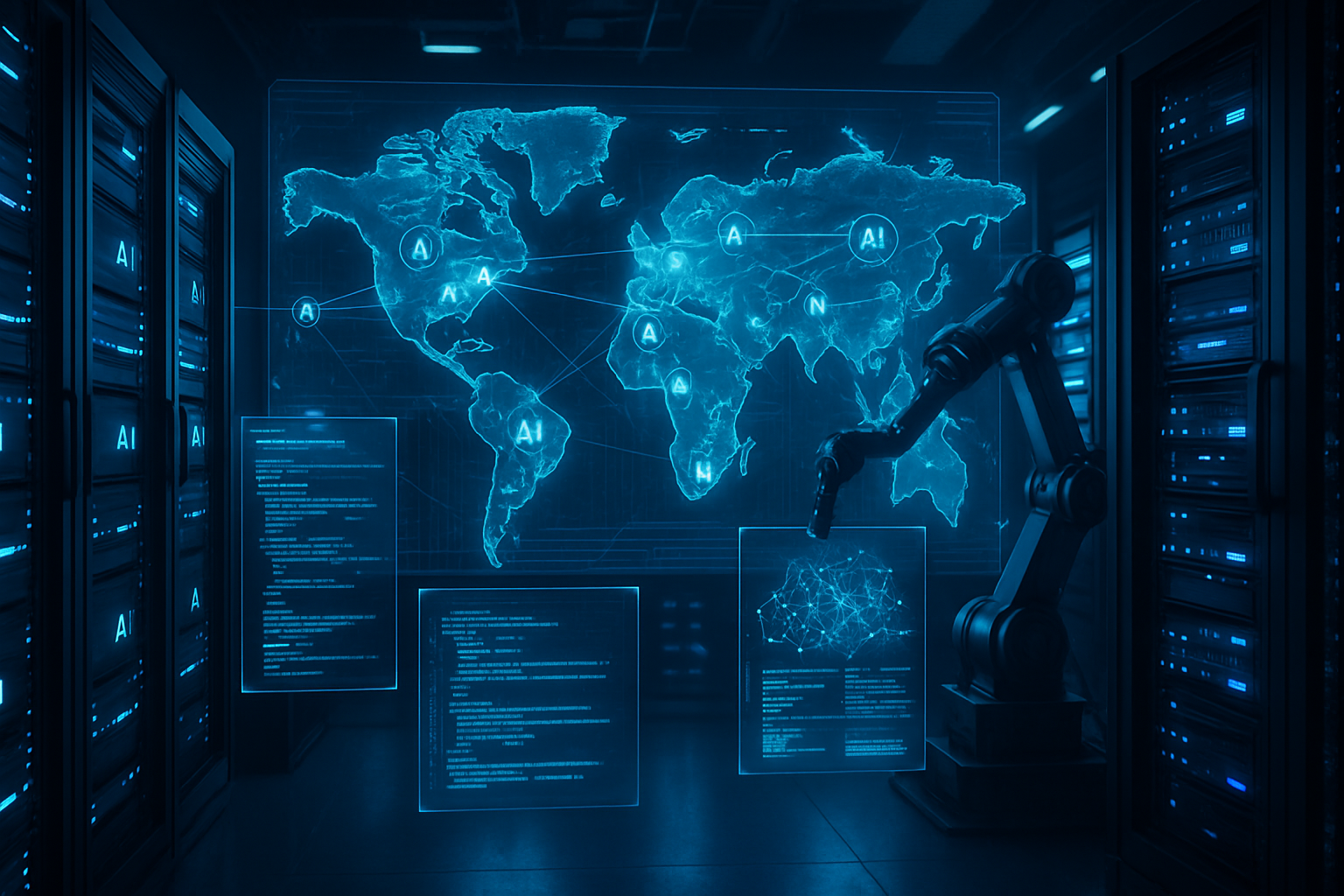
March 2026 has emerged as a critical inflection point in the global artificial intelligence revolution, with major developments spanning from Amazon's acquisition of Swiss robotics startup Rivr to China's expansion of its digital yuan system and the Philippines Supreme Court's approval of AI integration across all court levels—collectively signaling the transition of AI from experimental technology to essential infrastructure worldwide.
The scope and coordination of these developments across diverse sectors and nations demonstrates what technology experts are calling "the most significant period of AI integration since the technology boom began," affecting everything from package delivery systems to national judicial processes and cross-border digital governance.
Corporate AI Infrastructure Investments Accelerate
Amazon's acquisition of Rivr, a Swiss Federal Institute of Technology (ETH Zurich) spin-off specializing in stair-climbing delivery robots, represents a strategic push into advanced robotics capabilities. The company, which has been testing package delivery and courier services at select locations, offers Amazon sophisticated mobility solutions for complex urban environments where traditional delivery methods face limitations.
This acquisition aligns with broader corporate AI infrastructure investments that continue despite global semiconductor constraints. Historical analysis shows Alphabet committing $185 billion to AI infrastructure in 2026—the largest single-year corporate technology investment in history—while Amazon pursues over $1 trillion in development plans, demonstrating unprecedented corporate confidence in AI's essential role across business operations.
China's Digital Currency Revolution Gains Momentum
China's announcement that 12 additional commercial banks will join its central bank-backed digital currency system marks a significant expansion of the e-CNY (digital yuan) ecosystem. This development follows Beijing's pledge to "steadily develop the digital yuan" in its latest five-year plan, representing a fundamental shift in the nation's approach to digital currency from cash alternative to comprehensive financial infrastructure.
The expansion demonstrates China's systematic approach to AI and digital technology implementation, part of what analysts describe as a response to the "4-2-1 problem"—single children supporting four aging parents and grandparents—that is driving urgent demand for technological solutions to maintain economic productivity despite demographic pressures.
Simultaneously, Chinese scientists have achieved a revolutionary breakthrough in computational efficiency with software capable of simulating supersonic fuel combustion physics in just one week—a task that previously required years of supercomputer time. Developed by researcher Yao Wei at the Institute of Mechanics, Chinese Academy of Sciences, this advancement in hypersonic weapon design capabilities demonstrates China's commitment to maintaining technological competitiveness across multiple domains.
European Digital Governance Challenges
Estonia, long considered the world's most digital country, faces new questions about maintaining its leadership position as other nations rapidly advance their own digital capabilities. A generation after launching its digital revolution, Estonia remains a global benchmark for e-government, but the question is evolving from whether Estonia is digital to whether it can sustain its leadership role in an increasingly competitive landscape.
The Netherlands is addressing digital sovereignty concerns through government testing of European messaging applications to reduce reliance on foreign platforms like WhatsApp and Signal. State Secretary Willemijn Aerdts, responsible for Digital Economy and Sovereignty, warns that dependence on foreign messaging apps poses risks to government operations, reflecting broader European efforts to develop technological independence.
Judicial System AI Integration Breaks New Ground
The Philippines Supreme Court's approval of artificial intelligence across all court levels represents a watershed moment in judicial system modernization. This comprehensive integration spans from local courts to the highest judicial authority, establishing the Philippines as a pioneer in AI-enhanced legal proceedings and potentially serving as a template for other nations considering similar digital transformation of their judicial systems.
The development occurs within a broader context of institutional AI adoption, building on successful models like Canada's AI teaching assistants that maintain critical thinking standards and Malaysia's world-first AI-integrated Islamic school that combines technological capabilities with traditional educational values.
Emerging AI Employment Paradigms
Romania reports the emergence of AI systems that directly hire human workers through platforms where AI agents assign tasks, set deadlines, determine compensation, and request proof of delivery. This represents a fundamental shift in employment relationships, with artificial intelligence taking on management functions traditionally reserved for human supervisors.
Trinidad and Tobago's Minister of Tertiary Education and Skills Training Prakash Persad is encouraging citizens to pursue "AI-proof" careers, acknowledging the growing impact of artificial intelligence on the workforce while emphasizing the importance of developing skills that complement rather than compete with AI capabilities.
These developments align with recent research by Dr. Frank Bäumer documenting the "double workload effect," where AI implementation often creates more work and declining efficiency rather than the promised productivity gains, as workers must perform their original responsibilities while also supervising and correcting AI outputs.
Global Infrastructure Constraints Drive Innovation
Despite the accelerating AI adoption, the global semiconductor crisis continues to shape development patterns. Memory chip prices have surged sixfold, affecting major producers Samsung, SK Hynix, and Micron, with shortages expected to persist until 2027 when new fabrication facilities come online.
Paradoxically, these constraints are spurring innovation in memory-efficient algorithms and sustainable deployment strategies that maximize AI capabilities while minimizing hardware requirements. This "constraint-driven innovation" is potentially democratizing access to advanced AI technologies and creating more sustainable approaches to technological development.
Platform Accountability and Content Moderation
Meta's implementation of advanced AI systems for combating scams and identity theft represents a significant shift toward AI-powered content moderation. The technology company announced a transition toward artificial intelligence systems for platform moderation, citing superior results in detecting scams, celebrity impersonation, and content that violates safety guidelines.
This development occurs amid intensifying global regulatory pressure, with Spain implementing the world's first criminal executive liability framework for platform executives and France conducting AI cybercrime raids, representing the most sophisticated attempt at global technology governance since internet commercialization.
International Cooperation and Governance Challenges
The United Nations has established an Independent Scientific Panel of 40 experts under Secretary-General António Guterres, representing the first fully independent international AI impact assessment body. This initiative acknowledges that AI governance requires unprecedented international cooperation to balance innovation acceleration with responsible development.
However, coordination remains challenging due to national security and economic competitiveness concerns, with different regulatory philosophies complicating unified approaches. The successful models emerging demonstrate that human-centered AI approaches consistently outperform wholesale replacement strategies, emphasizing technology as amplification tools serving human goals rather than substituting for human capabilities.
Looking Forward: The March 2026 Watershed
Technology experts characterize March 2026 as a "civilizational choice point" determining whether AI serves human flourishing or becomes an exploitation tool. The convergence of massive corporate investments, regulatory frameworks, infrastructure constraints, and international cooperation efforts creates an unprecedented coordination challenge.
The most promising path involves sophisticated human-AI collaboration that amplifies human capabilities while preserving creativity, cultural understanding, and ethical reasoning that define human potential. Success requires resolving infrastructure constraints while maintaining innovation momentum, developing sustainable business models that prioritize human welfare, and fostering international cooperation that balances competitiveness with stability.
The decisions made in 2026 are likely to establish decades-long patterns for human-AI relationships, making this period crucial for ensuring that artificial intelligence serves humanity's highest aspirations while addressing pressing global challenges through democratic oversight and human welfare protection.
As the window for proactive adaptation narrows rapidly, the coming months will test whether global institutions, corporations, and civil society can coordinate effectively to harness AI's transformative potential while preserving the human elements that define sustainable, ethical progress in the 21st century.