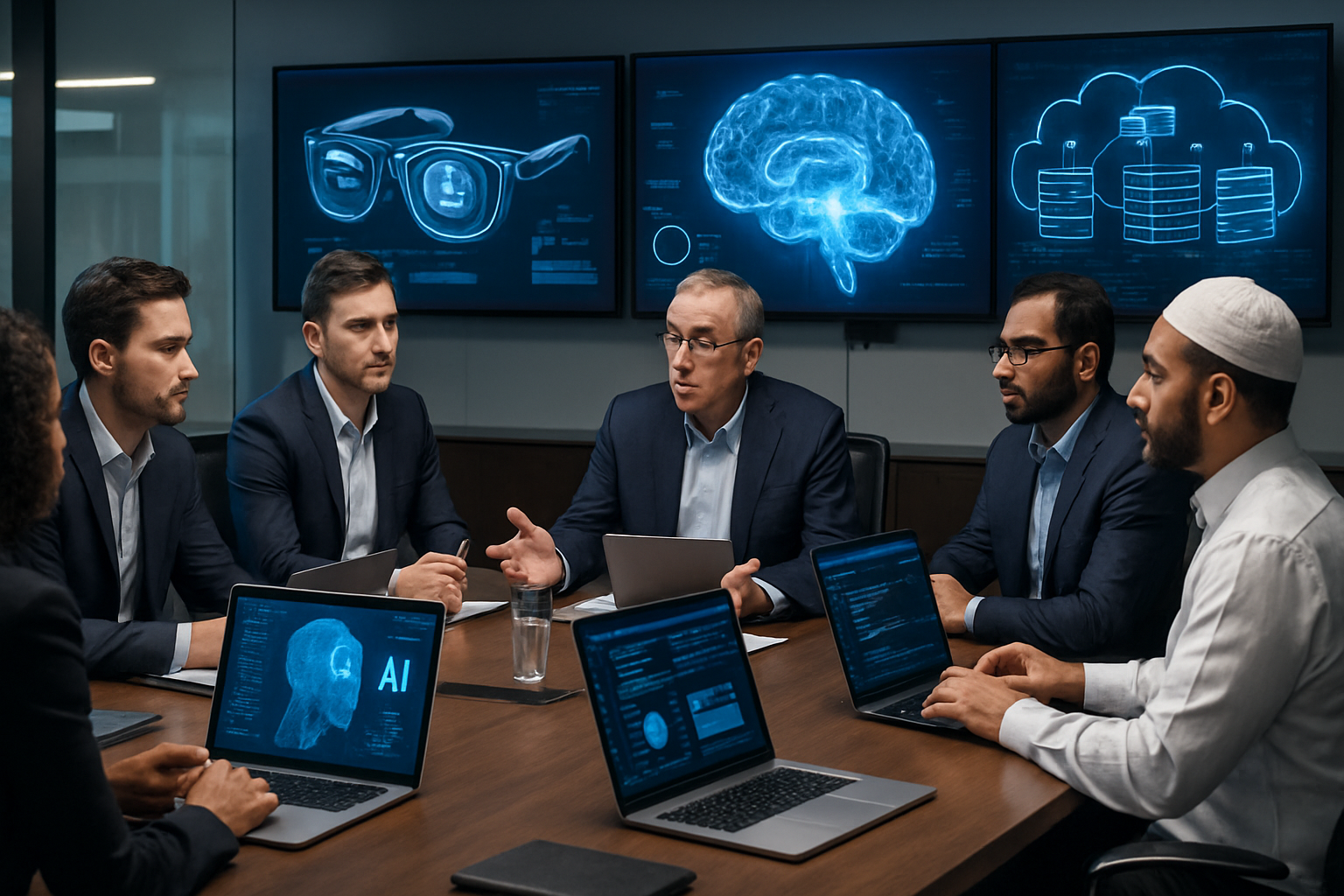
April 2026 has emerged as what industry experts are calling a "civilizational choice point" for artificial intelligence, with major technology companies unveiling revolutionary AI initiatives while grappling with unprecedented infrastructure challenges and regulatory pressures that will shape the future of human-AI relationships for decades to come.
Huawei Enters the AI Glasses Arena
Chinese technology giant Huawei Technologies has officially entered the intensifying AI glasses market with the launch of its first artificial intelligence-powered eyewear, directly challenging established players including Meta, Alibaba Group, and domestic competitor Rokid. Priced from 2,499 yuan (US$367), the new glasses weigh just 35.5 grams and feature comprehensive AI functions ranging from voice interaction to seamless payments integration.
The glasses are powered by Huawei's self-developed chip specifically designed for eyewear applications, representing the company's continued push for technological sovereignty despite ongoing global semiconductor restrictions. This launch comes as the AI glasses market has experienced explosive growth, with global shipments reaching 8.7 million units in 2025 according to Omdia analysts, marking a 322% increase over the previous year.
Industry analysts view Huawei's entry as particularly significant given the company's position in the broader US-China technology competition. Nvidia CEO Jensen Huang recently warned that Chinese AI companies optimizing models on Huawei chips would represent a "horrible outcome" for US technological supremacy, highlighting the geopolitical implications of these consumer technology advances.
Anthropic's NSA Partnership Sparks Controversy
Perhaps the most controversial development in April's AI landscape has been reports of Anthropic providing the National Security Agency with advance access to its powerful Mythos AI model. While details remain limited, Austrian media reports suggest this represents an attempt by the safety-focused AI company to align with the Trump administration's defense priorities.
The partnership has drawn significant criticism from technology experts who view it as a departure from Anthropic's founding principles of AI safety and civilian oversight. Some analysts describe the company's statements about the collaboration as "grossly exaggerated" and characterize it as "catastrophe PR" for the company's reputation.
This development occurs against the backdrop of broader military-civilian tensions in AI development. The Pentagon has been pressuring AI companies to deploy systems on classified networks without civilian safety restrictions, while companies like Anthropic have historically maintained permanent safety safeguards preventing autonomous weapons applications and mass surveillance capabilities.
Regional AI Innovation Surge
Beyond the headline-grabbing developments from major corporations, April 2026 has witnessed significant AI innovation across diverse global markets. Azerconnect Group and NVIDIA signed a strategic cooperation agreement marking Azerbaijan's entry into advanced cloud gaming and AI technologies, demonstrating how smaller nations are positioning themselves in the global AI ecosystem.
In Latin America, Datec launched Lucy, described as an "ecosystem of AI agents" trained to handle, sell, and manage conversations through WhatsApp automatically 24 hours a day. This Bolivia-based innovation represents the democratization of AI business tools, extending sophisticated automation capabilities to small and medium enterprises across telecommunications, banking, gastronomy, and retail sectors.
The regional diversity in AI development reflects what experts call the emergence of a "multipolar AI landscape" that challenges the traditional US-China duopoly. European digital sovereignty initiatives, Asian innovation hubs, and Global South participation are creating distributed AI capabilities that prevent single-entity control while enabling culturally sensitive development approaches.
Adobe and Enterprise AI Integration
Adobe's launch of a comprehensive AI suite for corporate clients represents another significant milestone in the enterprise AI transformation. The suite arrives as competition intensifies in the business AI market, with companies racing to provide integrated solutions that can replace traditional software-as-a-service models.
This development is part of what industry analysts have dubbed the "SaaSpocalypse" - the elimination of hundreds of billions in traditional software market capitalization as AI systems demonstrate direct replacement capabilities for conventional solutions. Microsoft's Mustafa Suleyman's predictions that AI will replace the majority of office workers within two years are gaining credibility as enterprise AI tools become increasingly sophisticated.
The enterprise AI revolution is occurring alongside massive infrastructure investments despite global supply chain constraints. Alphabet committed $185 billion to AI infrastructure in 2026 - the largest single-year corporate technology investment in history - while Amazon outlined plans exceeding $1 trillion over the decade, demonstrating industry confidence in the transition from experimental AI to essential infrastructure.
Infrastructure Challenges Drive Innovation
The global semiconductor crisis continues to shape AI development in unexpected ways. Memory chip prices have surged sixfold, affecting operations at Samsung, SK Hynix, and Micron, with shortages expected to persist until 2027 when new fabrication facilities come online. Consumer electronics costs have increased 20-30% over the past year, creating pressure across the technology ecosystem.
However, this crisis has paradoxically driven innovation toward more efficient approaches. Companies are developing memory-efficient algorithms, alternative processing architectures, and sustainable deployment strategies that maximize AI capabilities while minimizing hardware requirements. This constraint-driven innovation is potentially democratizing AI access by forcing more thoughtful implementation approaches.
The World Bank projects that AI water demand could reach 4.2-6.6 billion cubic meters annually by 2027 for data center cooling - equivalent to four to six times Denmark's total annual water consumption. These environmental challenges are driving investment in renewable energy infrastructure and more efficient computing architectures.
Regulatory Frameworks and International Cooperation
April 2026 has also witnessed unprecedented regulatory coordination as governments worldwide grapple with AI governance challenges. Spain's implementation of the world's first criminal executive liability framework for technology platforms is spreading across Europe, creating imprisonment risks for technology executives who fail to maintain adequate safety standards.
The United Nations has established an Independent Scientific Panel comprising 40 global experts under Secretary-General António Guterres, representing the first fully independent international AI assessment body. This initiative reflects growing recognition that AI governance requires unprecedented coordination between governments, companies, institutions, and civil society.
France has conducted cybercrime raids on AI companies, while European Commission investigations into Digital Services Act violations could result in penalties worth billions of dollars for addictive design features. These coordinated responses represent the most sophisticated global technology governance effort since internet commercialization, specifically designed to prevent regulatory arbitrage.
Success Models in Human-AI Collaboration
Amid the technological turbulence, several successful human-AI collaboration models have emerged as templates for thoughtful integration. Canadian universities implementing AI teaching assistants have maintained critical thinking standards while enhancing educational experiences. Malaysia operates the world's first AI-integrated Islamic school, combining artificial intelligence capabilities with traditional learning approaches.
Singapore's WonderBot 2.0 heritage education system demonstrates how AI can preserve and enhance cultural understanding rather than replace human knowledge. These success stories share common characteristics: treating AI as amplification tools rather than replacement mechanisms, maintaining sustained human development commitments, ensuring meaningful stakeholder engagement, and demonstrating cultural sensitivity in implementation.
"The future lies in sophisticated human-AI collaboration that amplifies our capabilities while preserving the creativity, cultural understanding, and ethical reasoning that define human potential," explains Dr. Maria Santos, a technology policy researcher at the European AI Institute.
— Dr. Maria Santos, European AI Institute
The April 2026 Civilizational Choice Point
Industry experts characterize April 2026 as a critical juncture that will determine whether artificial intelligence serves human flourishing and democratic values or becomes a tool for exploitation and control beyond democratic accountability. The convergence of advancing capabilities, regulatory pressures, massive infrastructure investments, and international cooperation requirements creates unprecedented coordination challenges.
The window for coordinated action is narrowing rapidly as AI capabilities advance faster than governance frameworks can adapt. Decisions made in 2026 are establishing decades-long human-AI relationship patterns that will affect civilization itself. The challenge lies in ensuring that technological transformation serves humanity's highest aspirations while maintaining the distinctly human qualities that artificial intelligence cannot replicate.
Success requires sophisticated approaches that balance innovation acceleration with safety governance, commercial interests with human welfare, and national competitiveness with international cooperation. The stakes extend beyond individual privacy or corporate profits to the fundamental question of whether democratic institutions can maintain meaningful oversight of technologies that are rapidly becoming essential infrastructure.
Looking Ahead: The Path Forward
As April 2026 developments continue to unfold, the most promising path involves treating AI as sophisticated amplification tools that serve specific human goals rather than wholesale replacement mechanisms for human judgment, creativity, and cultural understanding. Organizations and nations that embrace human-centered approaches are demonstrating superior outcomes compared to those pursuing pure automation strategies.
The global AI transformation represents the most significant technological shift since the emergence of the internet, with implications extending far beyond individual companies or sectors to fundamental changes in how technology serves human needs and enhances daily life. The decisions made during this critical period will determine whether artificial intelligence achieves its transformative promise or requires dramatic corrections to address systemic risks.
The April 2026 developments underscore that the future of AI lies not in replacing human capabilities but in amplifying them while preserving the wisdom, empathy, and cultural understanding that provide meaning to the human experience. As this technological revolution continues to unfold, the challenge remains ensuring that AI serves humanity's aspirations through thoughtful governance frameworks that maintain democratic values during the transition from experimental technology to essential infrastructure.