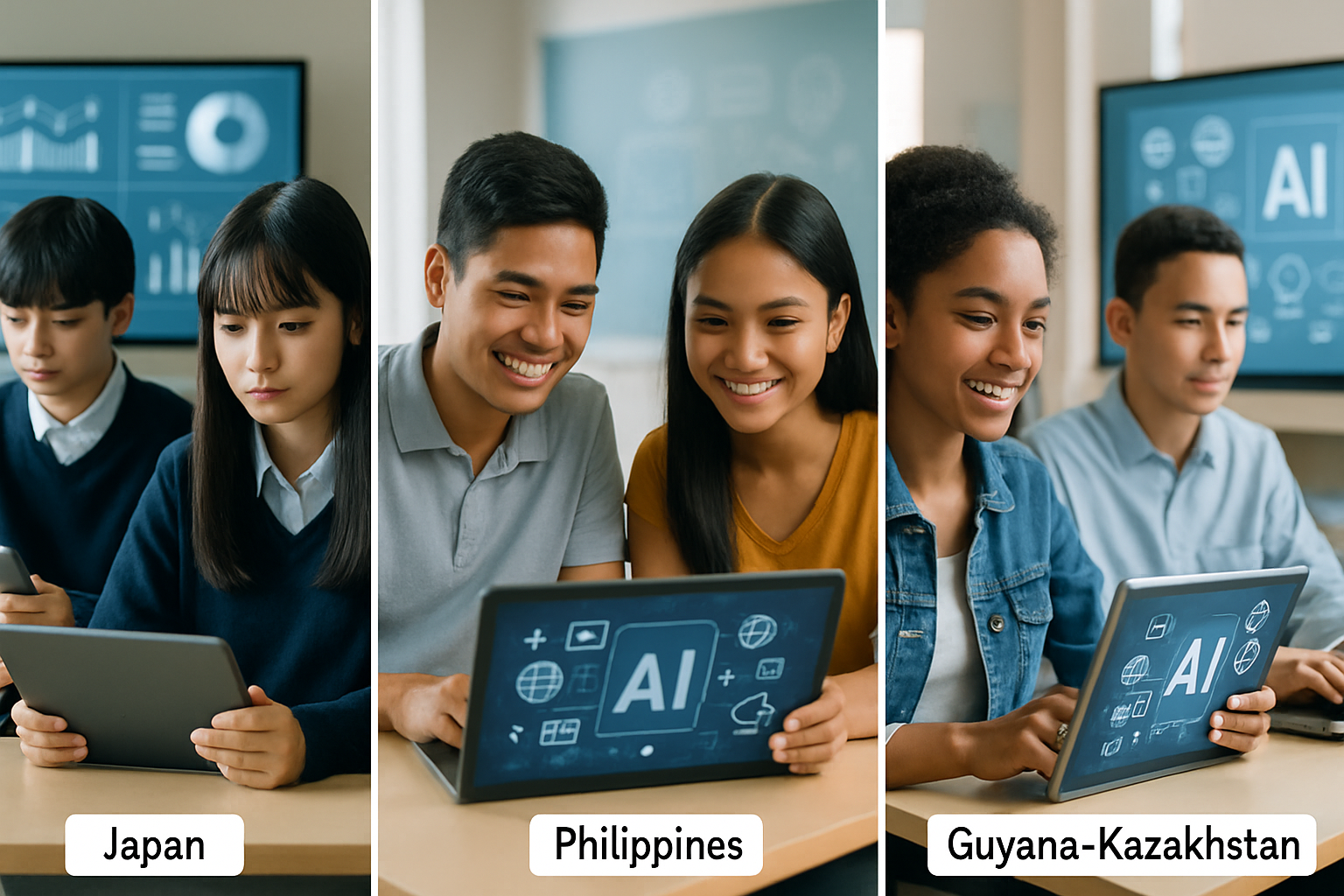
Countries worldwide are implementing artificial intelligence tools in educational systems with dramatically different outcomes, as revealed by a comprehensive investigation across four nations showing both promising innovations and concerning challenges in the global race to digitize learning.
The evidence from Japan, Philippines, Guyana, and Kazakhstan presents a complex picture of the 2026 Educational Technology Renaissance, demonstrating that successful AI integration requires far more nuanced approaches than simple technology deployment.
Japan: High AI Adoption Meets Unexpected Consequences
Japan leads in student AI adoption, with nearly half of high school students now using artificial intelligence tools, according to a comprehensive child agency survey. However, this early adoption has revealed significant unintended consequences that education experts worldwide are closely monitoring.
The survey found that students are spending dramatically more time online, with many experiencing severe disruptions to sleep schedules and academic performance. This represents a critical challenge for educational systems: how to harness AI's educational potential while preventing the digital lifestyle disruptions that can undermine learning outcomes.
"The irony is that tools designed to enhance education may be contributing to conditions that make learning more difficult,"
— Educational Technology Researcher, analyzing Japan's early AI adoption data
Japan's experience serves as an important case study for other nations planning AI educational initiatives. The high adoption rate demonstrates student enthusiasm for AI tools, but the associated lifestyle disruptions suggest that implementation requires comprehensive digital wellness strategies, not just technology deployment.
Philippines: Strategic AI Integration with Cultural Sensitivity
The Philippines is taking a markedly different approach through the Department of Education's partnership with the Department of Science and Technology's newly launched National Artificial Intelligence Center for Research and Innovation (NAICRI). Education Secretary Sonny Angara has emphasized that Filipino students must be prepared for an AI-integrated future while ensuring the technology is "used safely, fairly, and responsibly."
The Philippine approach represents sophisticated policy thinking that addresses both technological advancement and cultural preservation. The Department of Education is focusing on "institutionalizing the integration of AI through three" key areas, though the complete framework details are still emerging.
This strategy contrasts sharply with Japan's more organic, student-led adoption. The Philippines is implementing top-down governance structures designed to prevent the negative outcomes observed in early-adopting nations while maximizing educational benefits.
Guyana: Small Nation Leadership in Global AI Strategy
Guyana's approach reflects the unique challenges and opportunities facing smaller nations in the AI education race. Vice-President Dr. Bharat Jagdeo has issued warnings that artificial intelligence could create new development divides between larger and smaller nations, urging immediate integration of AI into national planning processes.
Dr. Jagdeo's concerns highlight a critical global equity issue: ensuring that AI educational tools don't exacerbate existing educational inequalities between nations with different technological capabilities and resources. His call for immediate AI integration into national planning suggests Guyana recognizes both the risks of being left behind and the potential for smaller nations to leverage AI for educational leapfrogging.
"AI must be integrated into national planning now to prevent a new development divide from emerging between nations,"
— Vice-President Dr. Bharat Jagdeo, addressing global AI equity concerns
Guyana's leadership on this issue is significant because it represents the perspective of nations that must navigate AI adoption without the extensive technological infrastructure of larger economies. Their approach could provide valuable templates for other developing nations facing similar challenges.
Kazakhstan: Comprehensive Digitalization Initiative
Kazakhstan has launched the most systematic approach to AI education integration through its "Year of Digitalization and Artificial Intelligence" initiative for 2026. The comprehensive plan, approved by Prime Minister Olzhas Bektenov, encompasses eight priority blocks and ten key initiatives aimed at modernizing public administration, expanding AI education, and strengthening cybersecurity.
This represents the most ambitious national AI education strategy documented among the four countries studied. Kazakhstan's approach acknowledges that successful AI integration requires coordination across multiple sectors, not just educational institutions. The initiative specifically targets accelerating the country's transition to a new digital economy while ensuring educational systems support this transformation.
The Kazakhstan model demonstrates how AI educational initiatives can serve broader national development goals, positioning education as a strategic infrastructure component rather than an isolated sector.
Global Context: The 2026 Educational Technology Renaissance
These four nations' experiences occur within what experts are calling the "2026 Educational Technology Renaissance" - a global phenomenon characterized by thoughtful digital tool integration with traditional educational values rather than wholesale technological replacement of human-centered learning.
Historical context from our investigation of educational AI integration shows this renaissance builds on earlier successes including Malaysia's world-first AI-integrated Islamic school, Singapore's WonderBot 2.0 conversational learning system, and Canada's responsible AI teaching assistant programs that maintain critical thinking standards.
However, the current implementation faces significant infrastructure challenges. A global memory crisis has driven semiconductor prices up sixfold, affecting companies like Samsung, SK Hynix, and Micron, creating bottlenecks for AI-powered educational systems that may persist until 2027 when new fabrication facilities come online.
Success Patterns and Critical Factors
Analysis of successful AI educational integration reveals several critical success factors that transcend national boundaries:
- Sustained Political Commitment: Programs that survive electoral cycles demonstrate long-term educational vision
- Comprehensive Stakeholder Engagement: Successful initiatives incorporate input from educators, students, families, and communities
- Cultural Sensitivity: AI tools must be adapted to local educational traditions rather than imposed as standardized solutions
- Human-Centered Approaches: Technology should enhance rather than replace fundamental teacher-student relationships
- Balanced Implementation: Rapid technological adoption must be balanced with digital wellness and educational outcome monitoring
The evidence suggests that countries achieving the best results treat AI as a powerful tool serving educational goals rather than as an end in itself. The Philippines' emphasis on safety and responsibility, Kazakhstan's systematic planning, and even Japan's experience with unintended consequences all contribute valuable lessons for global educational policy development.
Infrastructure and Implementation Challenges
All four nations face the same fundamental infrastructure constraints affecting global AI education deployment. The semiconductor shortage is forcing educational institutions to develop memory-efficient algorithms, hybrid approaches that combine AI tools with traditional methods, and cloud-based solutions that can optimize resource usage during supply constraints.
These constraints are paradoxically driving innovation in educational technology. Institutions are discovering that the most effective AI educational applications often require less computational power than initially assumed, focusing on targeted interventions rather than comprehensive system replacement.
The infrastructure challenges also highlight the importance of international cooperation in educational technology development. Smaller nations like Guyana benefit from partnerships with technological leaders, while larger nations like Kazakhstan can share successful implementation strategies with regional partners.
Regional Leadership and Global Implications
Each nation studied offers distinct insights for international educational policy:
Japan provides crucial data on the risks of rapid, unmanaged AI adoption, demonstrating the need for comprehensive digital wellness strategies alongside technology deployment.
Philippines offers a model for culturally sensitive AI integration that balances technological advancement with social responsibility and educational tradition preservation.
Guyana represents smaller nations' perspectives on AI equity and the strategic importance of preventing new digital divides from emerging.
Kazakhstan demonstrates comprehensive national coordination approaches that integrate educational AI with broader economic and social development strategies.
These diverse approaches suggest that successful AI educational integration requires adaptation to specific cultural, economic, and social contexts rather than standardized global solutions.
Economic and Social Implications
Countries implementing comprehensive AI education reforms are reporting measurable benefits including improved community resilience, reduced long-term social service demands, and enhanced international competitiveness through strategic human capital development.
The prevention-first approaches demonstrated in these programs generate superior economic returns compared to crisis-response educational models. Early investment in AI education infrastructure and teacher training produces benefits including reduced intervention costs, decreased unemployment among graduates, and improved workforce productivity.
However, the social implications extend beyond economic measures. Educational AI integration affects cultural transmission, community relationships, and the preservation of traditional knowledge systems. The most successful programs demonstrate sophisticated understanding of these complex interactions.
Looking Forward: Critical Decisions Ahead
February 2026 represents a critical juncture for global educational policy, with the success or failure of current AI integration initiatives likely determining educational trajectories for the coming decade.
The stakes extend beyond individual institutional success to include global capacity for addressing climate change, technological disruption, and social cohesion challenges. Quality educational systems serve as strategic 21st-century infrastructure, and their AI integration success will significantly impact international development and cooperation.
The evidence from Japan, Philippines, Guyana, and Kazakhstan suggests that effective AI-age educational reform requires thoughtful integration of technological tools with enduring educational principles rather than wholesale replacement of human-centered learning approaches.
Success depends on maintaining the uniquely human elements of education - imagination, cultural understanding, emotional depth, and authentic expression - while leveraging AI capabilities to explore new educational possibilities and address persistent challenges in educational access and quality.
The window for effective action is narrowing as technology continues advancing rapidly. Countries that can successfully balance innovation with educational wisdom, global competitiveness with cultural authenticity, and technological advancement with human development will likely establish international leadership in educational policy and practice.
The experiences of these four nations provide valuable templates for educational modernization that preserves human creativity, critical thinking, and cultural knowledge while preparing students for an interconnected global economy that increasingly requires both technical competence and cultural wisdom.