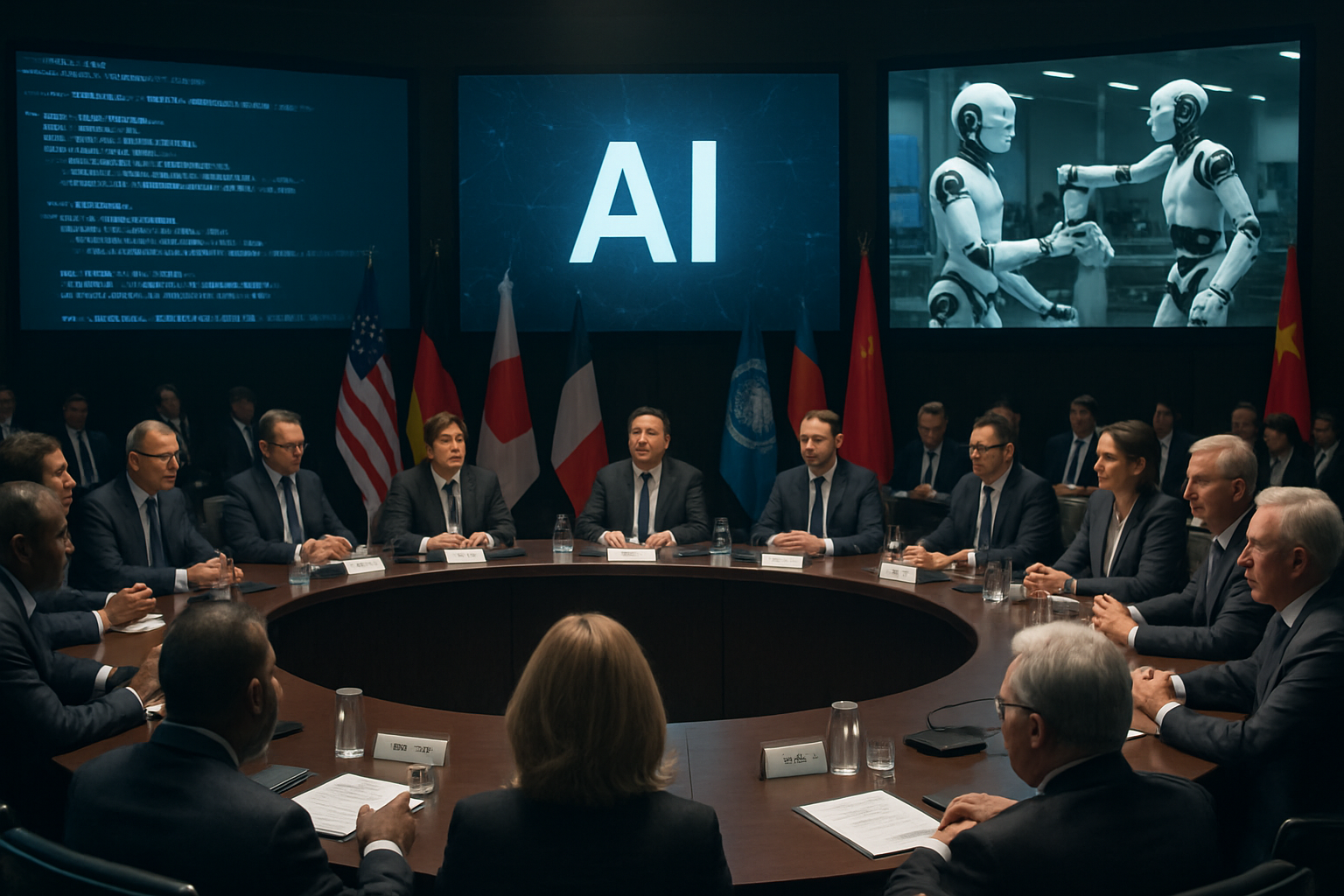
A stark divide in global artificial intelligence governance has emerged as China demonstrates breakthrough humanoid robotics capabilities while Western governments scramble to build regulatory frameworks, highlighting a critical inflection point that could determine the future of AI development worldwide.
The contrast was most vividly displayed during China's Spring Festival celebrations, where sophisticated humanoid robots performed advanced martial arts routines, sending what observers describe as a clear message about the nation's technological capabilities. Meanwhile, California announced the establishment of a new AI oversight unit and pressed forward with investigations into major AI companies, including Elon Musk's xAI venture.
China's Humanoid Robot Breakthrough
Chinese robotics companies showcased remarkable advances during Lunar New Year festivities, with humanoid robots demonstrating complex kung fu movements and lion dance performances. The displays featured robots executing sophisticated human movements with unprecedented precision, marking what industry experts consider a transition from laboratory concepts to mass-production reality.
According to reporting from multiple international outlets, the demonstrations involved robots from several leading Chinese companies, including units capable of performing somersaults, coordinated martial arts sequences, and culturally significant traditional dances. The timing and public nature of these displays has not gone unnoticed by international observers.
"These robots represent a fundamental shift from experimental prototypes to practical applications," noted a technology analyst following the developments. "Beijing is clearly sending a message about its capabilities to the world."
— Industry Technology Expert
The demonstrations come amid broader Chinese advances in AI infrastructure, including the development of massive computing clusters and significant investments in AI education integration, positioning the nation as a formidable competitor in the global AI race.
Western Regulatory Response Intensifies
In stark contrast to China's showcase approach, Western governments are focusing heavily on regulatory frameworks and oversight mechanisms. California's announcement of a new AI oversight unit represents the latest in a series of governmental responses to rapid AI development, particularly following concerns about the societal impact of advanced AI systems.
The California initiative includes pressing forward with investigations into xAI, Musk's artificial intelligence venture, as part of broader efforts to ensure AI development serves public interests. This regulatory approach reflects growing Western concerns about AI safety, transparency, and corporate accountability in the sector.
Simultaneously, Spain has implemented what experts describe as the world's most aggressive social media platform regulations, featuring unprecedented criminal executive liability for tech platform leaders. This European approach signals a coordinated Western effort to establish democratic oversight of AI-enhanced digital platforms.
Global AI Impact Summit Positions India as Bridge
Against this backdrop of competing approaches, India has emerged as a potential mediator through its hosting of major AI summits featuring leaders from both Western tech giants and developing economies. The country's "People, Planet, Progress" framework represents an attempt to find middle ground between rapid technological advancement and responsible development.
The summit has attracted participation from Google's Sundar Pichai, OpenAI's Sam Altman, and other major industry figures, positioning India as a bridge between advanced and developing economies in AI governance discussions. This approach contrasts sharply with the more polarized positions taken by China and Western regulatory authorities.
Infrastructure Crisis Constrains All Players
Despite divergent approaches to AI governance, all major players face the same fundamental challenge: a global semiconductor shortage that has driven memory chip prices up by 600% and created significant infrastructure bottlenecks. The crisis affects Samsung, SK Hynix, and Micron operations, with supply constraints expected to persist until new fabrication facilities come online in 2027.
This infrastructure crisis has created what industry observers call a "leveling effect," forcing even the most advanced AI developers to prioritize applications and potentially creating opportunities for more efficient, safety-conscious approaches to AI development.

Military Applications Drive Competition
The governance divide extends into military applications, where the Pentagon has been pressing AI companies to expand tools into classified networks while some companies, particularly Anthropic, resist loosening safety restrictions on their systems. Reports indicate that ChatGPT has already been integrated into military AI systems, representing a significant escalation in military AI deployment.
Ukrainian forces have deployed AI-enhanced drone systems with improved low-light vision capabilities, while approximately one-third of countries have agreed to AI warfare governance frameworks. Notably, the United States and China have abstained from comprehensive commitments in this area, highlighting the geopolitical tensions surrounding AI development.
Successful Integration Models Emerge
Despite the polarized global landscape, several successful AI integration models have emerged that balance technological advancement with human-centered approaches. Canadian universities have successfully implemented AI teaching assistants while maintaining critical thinking standards, and Malaysia has launched the world's first AI-integrated Islamic school, combining artificial intelligence with traditional religious and academic learning.
Singapore's WonderBot 2.0 demonstrates successful AI applications in heritage education, providing examples of how artificial intelligence can enhance rather than replace fundamental educational relationships.
Economic Disruption Accelerates
The AI governance crisis unfolds amid what industry analysts term the "SaaSpocalypse" – a market disruption that has eliminated hundreds of billions in market capitalization as AI systems directly replace traditional software functions. Chinese DeepSeek breakthroughs have challenged assumptions about US technological dominance, creating a multipolar AI landscape that complicates unified governance approaches.
Corporate investment continues at unprecedented levels, with Alphabet committing potentially $185 billion to AI infrastructure in 2026 and Amazon announcing over $1 trillion in development plans. However, questions about immediate returns on these massive investments persist amid the infrastructure constraints.
International Cooperation Attempts
The United Nations has established an Independent International Scientific Panel on Artificial Intelligence with 40 experts, led by Secretary-General António Guterres. This represents the first fully independent global AI impact assessment body, though coordination challenges persist as nations increasingly view AI development as a national security matter.
Different regulatory philosophies – European precautionary principles, Asian industry self-regulation approaches, and fragmented US policies – complicate efforts to establish unified international frameworks for AI governance.
Critical Inflection Point
February 2026 represents what many observers consider the most critical juncture in AI development since the current boom began. The convergence of safety warnings from industry insiders, major technological breakthroughs, infrastructure constraints, and intensifying regulatory pressures has created a moment that could determine whether AI fulfills its transformative promise or creates systemic risks requiring dramatic corrections.
The success of diverse approaches – from China's demonstration-focused strategy to California's regulatory framework and India's bridge-building efforts – will likely influence international AI policy for decades to come. The decisions made in this critical period will determine whether artificial intelligence serves broad human welfare or becomes concentrated in the hands of a few powerful actors beyond democratic control.
As the global community grapples with these challenges, the need for unprecedented coordination between governments, technology companies, educational institutions, and civil society has never been more urgent. The stakes could not be higher: the future of human-AI interaction and the preservation of democratic governance in an age of transformative technology.