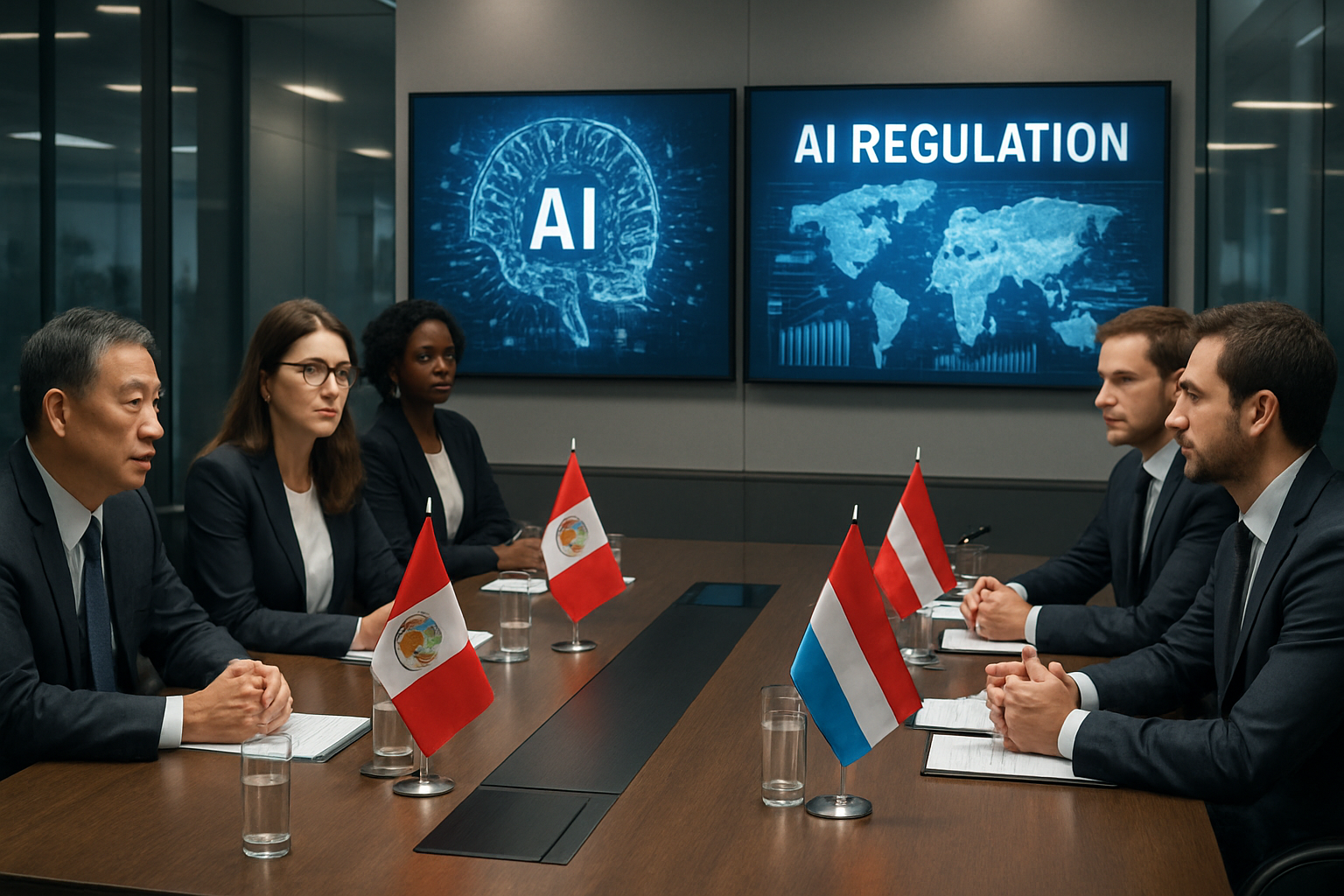
China has elevated artificial intelligence to a top national priority while emphasizing "safe and orderly development" amid growing global anxiety about the disruptive impact of rapidly advancing technology, as revealed in multiple international developments across four continents.
The 15th five-year plan submitted to China's National People's Congress positions the nation's AI Plus initiative as a cornerstone of national strategy, even as other countries grapple with the unprecedented challenges of regulating artificial intelligence without stifling innovation. This coordinated global effort represents the most significant technology governance challenge since the dawn of the internet age.
China's Strategic AI Vision
Beijing's approach reflects a calculated balance between technological ambition and regulatory control. The five-year plan emphasizes "safe and orderly development" of artificial intelligence, positioning China as a leader in responsible AI governance while maintaining competitive advantage in the global technology race.
This strategic positioning comes at a critical juncture when artificial intelligence is transitioning from experimental applications to essential infrastructure across industries. China's emphasis on "orderly" development suggests recognition that unchecked AI advancement could create systemic risks requiring dramatic corrections.
"The emphasis on safe and orderly development reflects China's understanding that AI governance requires unprecedented coordination between innovation acceleration and responsible oversight."
— International Technology Policy Analysis
Latin America's Consumer AI Revolution
While China focuses on national strategy, Latin America is experiencing a grassroots AI adoption phenomenon. During Samsung's Galaxy Unpacked event in San Francisco, the company revealed that nine out of ten Galaxy smartphone users in Latin America actively utilize artificial intelligence functions in their daily lives.
This represents one of the highest AI adoption rates globally, demonstrating that developing economies are not merely passive recipients of AI technology but active participants in the digital transformation. The high usage rates in Latin America contrast sharply with more cautious institutional approaches in other regions.
The consumer-driven adoption pattern suggests that AI integration success depends on practical utility rather than top-down implementation, offering valuable insights for policymakers worldwide struggling with AI governance frameworks.
European Regulatory Revolution
Europe is pioneering the world's most aggressive AI regulation framework. Austria's ongoing debates about "radical left AI" highlight the political complexities surrounding artificial intelligence governance, while European institutions develop unprecedented criminal liability frameworks for technology executives.
Spain has implemented the world's first criminal executive liability framework for social media platforms, creating imprisonment risks for tech leaders who fail to comply with child protection measures. This represents a fundamental shift from corporate penalties to personal accountability for technology company executives.
The European approach contrasts sharply with China's state-directed development model and Latin America's market-driven adoption, illustrating the diverse pathways nations are taking toward AI governance.
Greece's AI Transformation Journey
Greece is undergoing a significant technological transformation, moving from traditional chatbot interactions to sophisticated AI agents that fundamentally change how citizens interact with digital services. This evolution from simple automated responses to intelligent, context-aware systems represents the broader global shift in AI capabilities.
The transition from chatbots to AI agents demonstrates how artificial intelligence is becoming more integrated into daily life and government services. These systems can understand complex queries, maintain context across conversations, and provide personalized assistance that was previously impossible with traditional automated systems.

Infrastructure Crisis and Global Challenges
Despite rapid AI advancement, the global technology sector faces unprecedented infrastructure challenges. Memory semiconductor prices have surged sixfold, affecting major manufacturers including Samsung, SK Hynix, and Micron. This crisis is expected to persist until 2027 when new fabrication facilities come online.
The semiconductor shortage creates a "critical vulnerability window" that criminals exploit while organizations struggle with resource limitations. Paradoxically, these constraints are spurring innovation in memory-efficient algorithms and hybrid processing approaches that may benefit long-term technological development.
The World Bank projects that AI water demand could reach 4.2-6.6 billion cubic meters by 2027 for data center cooling alone—equivalent to four to six times Denmark's annual water consumption. These environmental challenges add another layer of complexity to AI governance decisions.
International Cooperation and Governance
The United Nations has established an Independent Scientific Panel on Artificial Intelligence with 40 global experts, representing the first fully independent global AI assessment body. This initiative, led by UN Secretary-General António Guterres, demonstrates international recognition that AI governance requires unprecedented cooperation.
However, coordination remains challenging as nations view AI as a matter of national security and economic competitiveness. Different regulatory philosophies—European precautionary principles, Asian industry self-regulation, and fragmented U.S. policies—complicate unified approaches to global AI governance.
Success Models and Human-Centered Approaches
Despite challenges, several successful AI integration models have emerged worldwide. Malaysia operates the world's first AI-integrated Islamic school, combining artificial intelligence with traditional religious and academic learning. Singapore's WonderBot 2.0 has achieved remarkable success in heritage education, while Canadian universities have implemented AI teaching assistants that maintain critical thinking standards.
These success stories share common elements: they treat AI as an amplification tool serving human goals rather than as an end in itself. They emphasize sustained political commitment, comprehensive stakeholder engagement, cultural sensitivity, and clear pedagogical or organizational objectives.
"The most successful AI implementations demonstrate that technology should enhance rather than replace fundamental human relationships and capabilities."
— Global AI Integration Study
Employment and Social Implications
The employment implications of AI advancement remain hotly debated. Microsoft's Mustafa Suleyman predicts AI will replace the majority of office workers within two years, with lawyers and auditors facing displacement within 18 months. However, regional variations suggest different approaches to workforce transformation.
While Western companies often implement traditional layoffs, Asian companies are investing in reskilling programs. Indian IT giants like Infosys, Wipro, and HCL are implementing worker transition programs rather than mass layoffs, demonstrating alternative approaches to AI-driven workforce changes.
The "SaaSpocalypse"—the elimination of hundreds of billions in traditional software market capitalization—represents the most dramatic market disruption since the dot-com era, as AI systems directly replace conventional software solutions.
Military and Security Dimensions
AI's military applications are expanding globally, creating new geopolitical tensions. The Pentagon has integrated ChatGPT into military systems, while Ukrainian forces deploy AI-enhanced drone systems. However, only one-third of countries have agreed to AI warfare governance frameworks, with the U.S. and China abstaining from comprehensive commitments.
This fragmented approach to military AI governance highlights the challenge of regulating dual-use technologies that have both civilian and military applications. The unauthorized use of AI systems in sensitive operations demonstrates the difficulty of enforcing usage restrictions once AI capabilities are deployed.
Looking Forward: Critical Decisions Ahead
March 2026 represents a critical inflection point in global AI development. The convergence of supply chain constraints, regulatory intensification, massive investments, and calls for international cooperation creates unprecedented coordination requirements.
Success in navigating these challenges depends on several key factors: resolving infrastructure constraints while maintaining innovation momentum, developing sustainable business models that prioritize human welfare, and fostering international cooperation that balances national competitiveness with global stability.
The choices made in 2026 will likely determine whether AI fulfills its transformative promise or creates systemic risks requiring dramatic corrections. Rather than slowing innovation, current challenges may drive more thoughtful, sustainable, and collaborative approaches to artificial intelligence advancement.
The Path Forward
The global AI regulation landscape reveals a multipolar world where different nations are pursuing distinct approaches to technology governance. China's emphasis on "orderly development," Latin America's consumer-driven adoption, Europe's regulatory innovation, and various national strategies represent a diverse ecosystem of AI governance models.
The ultimate test will be whether democratic institutions can effectively regulate multinational technology platforms while preserving the benefits of digital connectivity and innovation. The stakes extend far beyond individual privacy concerns to fundamental questions about democratic governance, childhood development, and human agency in an increasingly digital world.
As artificial intelligence transitions from experimental applications to essential infrastructure, the decisions made by governments, companies, and international bodies in 2026 will echo through decades, determining whether AI serves human flourishing while preserving the creativity, empathy, and wisdom that define human potential.