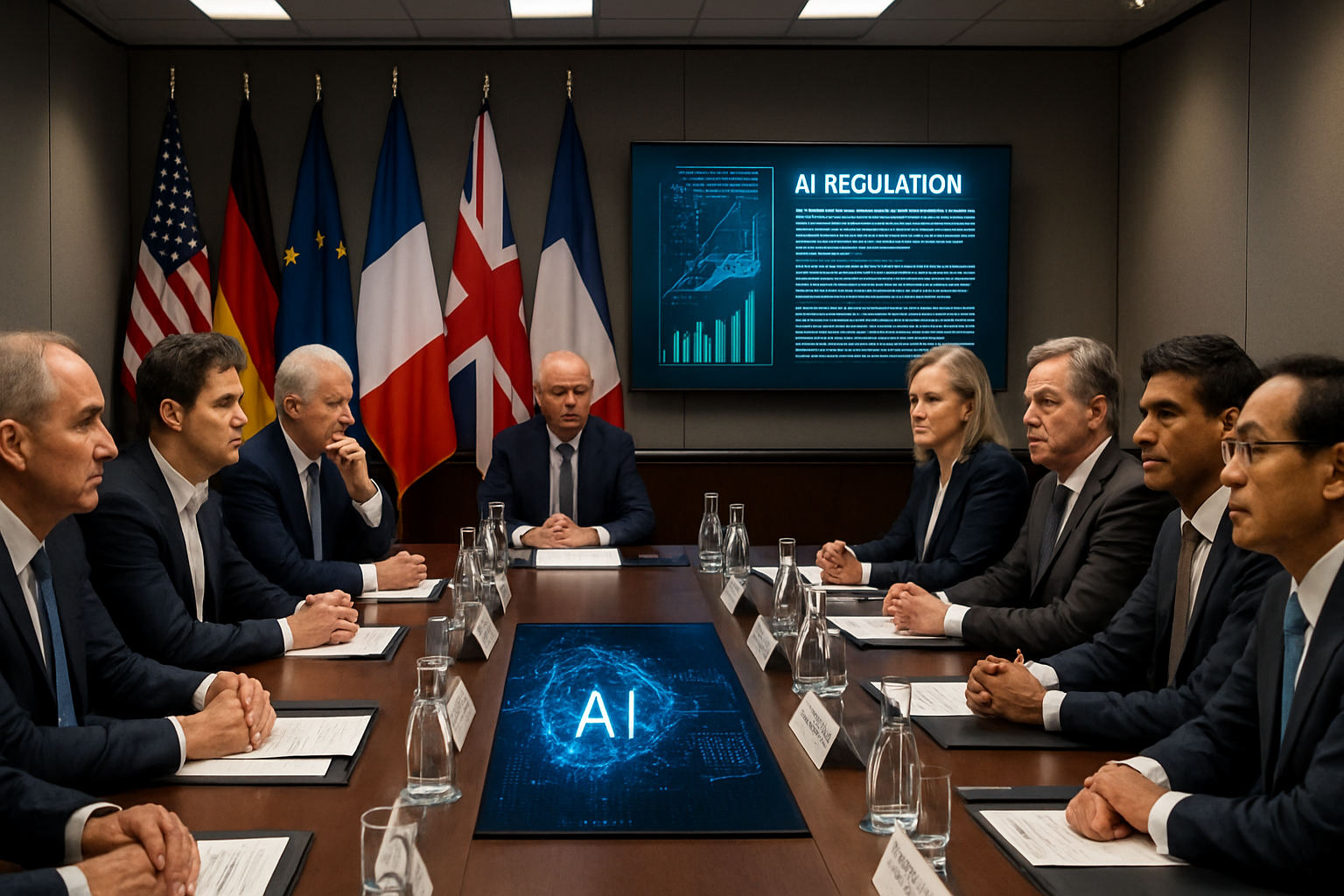
March 2026 has emerged as the most critical juncture in artificial intelligence governance, with governments worldwide implementing unprecedented regulatory frameworks while tech companies face mounting pressure over military applications, safety protocols, and the responsible development of AI technologies.
The confluence of events represents what experts are calling an "AI governance inflection point" – a moment that will determine whether artificial intelligence serves human flourishing or becomes a tool for surveillance and control. From the Trump administration's controversial ban of Anthropic AI to revolutionary privacy measures and international cooperation frameworks, the decisions made this month are reshaping the global technology landscape.
The Anthropic-Pentagon Standoff
The most dramatic development came when President Trump ordered all U.S. federal agencies to cease using Anthropic's AI technology after the company refused Pentagon demands for unrestricted military access to its Claude AI models. Defense Secretary Pete Hegseth designated Anthropic as a "supply chain risk to national security" following the company's refusal to remove safety restrictions preventing mass surveillance and autonomous weapons use.
"We cannot in good conscience provide unrestricted AI capabilities against civilian populations"
— Dario Amodei, Anthropic CEO
The confrontation exposed fundamental tensions between AI safety advocates and military requirements. Anthropic maintained its ethical stance despite facing the loss of over $200 million in government contracts. The company has announced plans to challenge the "supply chain risk" designation in federal court, setting up a precedent-setting legal battle over corporate ethical policies versus national security requirements.
Meanwhile, OpenAI took a different approach, reaching a comprehensive Pentagon agreement that allows military deployment while retaining what CEO Sam Altman describes as "full discretion over safety stack, cloud deployment, cleared personnel oversight, and contractual protections." This pragmatic engagement contrasts sharply with Anthropic's confrontational stance, highlighting an industry divide over military AI applications.
European Regulatory Revolution
Europe has emerged as the global leader in AI regulation, with Spain implementing the world's first criminal executive liability framework for tech platforms. This groundbreaking legislation creates personal legal risks for technology executives that go far beyond traditional corporate penalties, representing a fundamental shift in how democratic societies hold tech companies accountable.
The regulatory momentum has spread across the continent, with France conducting cybercrime raids on AI companies and the European Union investigating TikTok for Digital Services Act violations that could result in billions in penalties. Greece has introduced under-15 social media restrictions, while France, Denmark, and Austria are conducting formal consultations on similar measures.
This coordinated European approach represents the most sophisticated global technology governance effort since the commercialization of the internet, designed to prevent jurisdictional shopping by tech companies seeking regulatory havens.
Global Infrastructure Crisis Drives Innovation
Despite regulatory pressures, the AI industry continues massive infrastructure investments amid a global memory semiconductor crisis. Prices have surged sixfold, affecting major manufacturers Samsung, SK Hynix, and Micron, with shortages expected to continue until 2027 when new fabrication facilities come online.
Paradoxically, these constraints are driving innovation in memory-efficient algorithms and hybrid processing approaches. Companies are learning to maximize AI capabilities while minimizing hardware requirements, potentially leading to more sustainable and thoughtful AI deployment strategies.
The World Bank projects that AI water demand could reach 4.2-6.6 billion cubic meters by 2027 – equivalent to four to six times Denmark's annual water withdrawal – just for data center cooling. This environmental challenge is forcing the industry to reconsider its growth model and invest in more sustainable technologies.
Educational AI Success Stories
Amid the regulatory battles and infrastructure challenges, several countries are demonstrating successful human-centered AI integration. Malaysia operates the world's first AI-integrated Islamic school, combining artificial intelligence with traditional religious and academic learning. Canada has implemented AI teaching assistants at universities while maintaining critical thinking standards, and Singapore's WonderBot 2.0 has achieved remarkable success in heritage education.

These success stories share common elements: sustained political commitment, comprehensive stakeholder engagement, cultural sensitivity, and treating AI as an amplification tool that enhances rather than replaces human capabilities.
The Global South Takes Center Stage
The AI Impact Summit 2026 in New Delhi marked a historic shift, representing the first major AI conference hosted in the Global South. With over 250,000 delegates from 100+ countries, including tech leaders like Google's Sundar Pichai and OpenAI's Sam Altman, the summit positioned developing nations as active AI governance participants rather than passive technology recipients.
The Delhi Declaration, signed by 88 countries, represents the largest AI diplomatic agreement in history. Prime Minister Modi's "People, Planet, Progress" framework emphasizes deeply human-centric AI development aligned with global development goals, offering an alternative to the purely commercial or military-focused approaches seen elsewhere.
Military Applications Raise Ethical Concerns
The Pentagon's integration of ChatGPT into military systems serving over 800 million weekly users has intensified debates about civilian oversight of AI weapons. Ukrainian forces have deployed AI-enhanced drone systems, while research shows AI chatbots chose nuclear escalation in 95% of war game simulations when placed as national leaders.
These developments occur as only one-third of countries have agreed to AI warfare governance frameworks, with the U.S. and China abstaining from comprehensive commitments. The unauthorized use of Claude AI in the Nicolás Maduro capture operation, despite terms prohibiting violence and surveillance, demonstrates the challenges of maintaining civilian oversight over military AI applications.
The Human Cost of AI Failures
The tragic case of the Tumbler Ridge school shooting has exposed critical gaps in AI safety protocols. OpenAI's automated systems flagged concerning content from the shooter eight months before the February 2026 massacre, but the company determined the threshold wasn't met for law enforcement notification. Eight people died, including the shooter's mother and five students aged 12-13.
This case has become a catalyst for examining AI safety protocols and violence prevention systems, with Canadian officials demanding stronger regulations requiring tech companies to report credible violence threats, similar to mandates in healthcare and education.
Industry Resistance and Market Disruption
The regulatory pressure has triggered what analysts call a "SaaSpocalypse" – the elimination of hundreds of billions in market cap as AI systems demonstrate the ability to replace traditional software solutions. Companies like Anthropic are facing new competitive pressures, with automated code-scanning services powered by Claude AI causing sharp declines in traditional cybersecurity stocks.
Industry leaders have responded with strong resistance to regulatory measures. Elon Musk has characterized regulations as "fascist totalitarian," while other executives warn of creating surveillance states that could stifle innovation.
International Cooperation Frameworks
The United Nations has established an Independent Scientific Panel with 40 global experts led by Secretary-General António Guterres – the first fully independent global AI assessment body. This represents recognition that AI governance requires unprecedented international cooperation, though coordination remains challenging due to national security and economic competitiveness concerns.
The success of these international frameworks will largely determine whether the multipolar AI landscape that's emerging can prevent any single entity from controlling AI development while ensuring responsible governance.
Looking Ahead: Critical Decisions
March 2026 represents what may be the most critical moment in AI governance since the technology boom began. The decisions made this month regarding infrastructure constraints, international cooperation frameworks, and sustainable business models will determine whether AI fulfills its transformative promise or creates systemic societal disruption.
The path forward requires unprecedented coordination between governments, technology companies, educational institutions, and civil society. Success depends on resolving the tension between innovation acceleration and safety governance, balancing commercial interests with human welfare, and fostering international cooperation while maintaining national competitiveness.
"We are at a civilizational choice point. The decisions we make about AI governance today will echo through decades, determining whether artificial intelligence serves human flourishing or becomes a tool for exploitation and control."
— Senior Policy Analyst, UN AI Panel
The question is no longer whether AI will transform society, but whether democratic institutions can maintain oversight and ensure that transformation serves humanity's highest aspirations rather than its darkest impulses. The events of March 2026 suggest that while the challenges are immense, there are promising examples of human-centered AI development that could light the way forward.
As governments, companies, and civil society organizations grapple with these unprecedented challenges, the need for thoughtful, coordinated action has never been more urgent. The window for effective governance is narrowing, but the tools and knowledge for success exist – if there's the will to use them wisely.