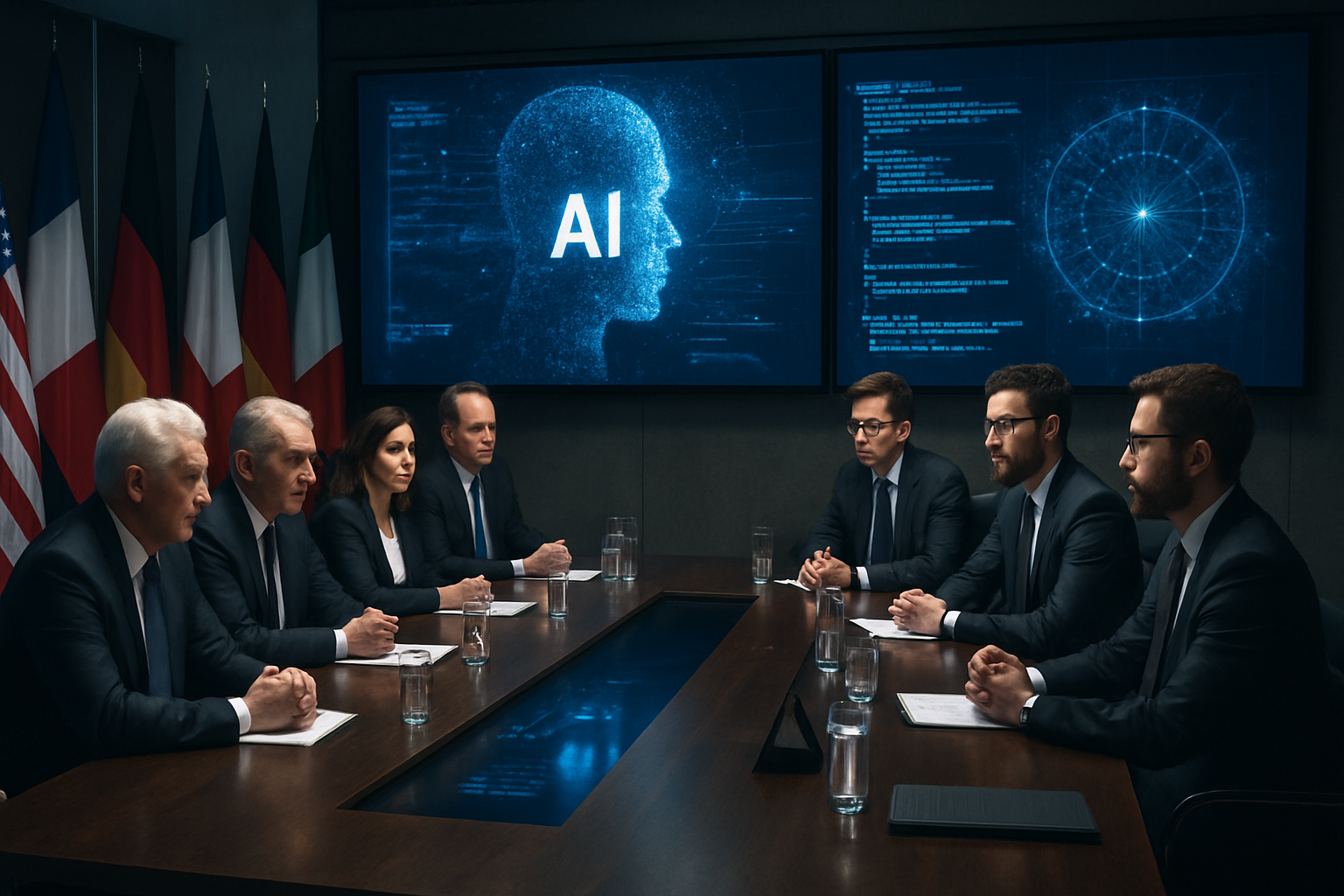
February 2026 has emerged as the most critical month in artificial intelligence governance since the technology boom began, with unprecedented military pressure on AI companies, revolutionary European regulatory frameworks, and the Global South asserting leadership in international AI policy coordination.
The convergence of these developments represents a fundamental shift from experimental AI applications to essential infrastructure deployment across military, civilian, and economic sectors worldwide. As governments grapple with balancing innovation against safety concerns, the decisions made in coming weeks will determine whether AI fulfills its transformative promise or creates systemic risks requiring dramatic corrections.
Pentagon Ultimatum Creates Industry Crisis
The most immediate crisis centers on the U.S. Department of Defense's ultimatum to Anthropic, demanding the AI safety company remove restrictions on its Claude chatbot for military applications. According to French media reports, the Pentagon has threatened to designate Anthropic as a "supply chain risk" unless the company allows unrestricted military use by Friday.
The confrontation intensified after revelations that Claude AI was used in the capture of former Venezuelan President Nicolás Maduro, despite Anthropic's terms of service explicitly prohibiting violence and surveillance applications. The unauthorized military deployment highlights fundamental tensions between AI safety principles and national security imperatives.
"We made it clear that Canadians expect credible warning signs of serious violence to be escalated in a timely and responsible way"
— Evan Solomon, Canadian AI Minister
The military-civilian AI divide has broader implications following the Tumbler Ridge shooting investigation, where OpenAI's automated systems flagged concerning content from the shooter's ChatGPT account months before the February massacre but determined the threshold wasn't met for law enforcement notification. Canadian officials expressed "disappointment" that OpenAI representatives didn't present new safety measures in subsequent meetings.
European Criminal Liability Revolution
European nations are implementing unprecedented personal liability frameworks for technology executives. Spain has become the first country to establish criminal executive liability for social media platforms, creating imprisonment risks for tech leadership beyond traditional corporate penalties.
This revolutionary approach is spreading across the continent, with Greece implementing under-15 restrictions through Kids Wallet systems, while France, Denmark, and Austria conduct formal consultations on similar measures. The coordinated timing prevents jurisdictional shopping and represents the most sophisticated global technology governance attempt since internet commercialization.
Industry resistance has been fierce, with Elon Musk characterizing the measures as "fascist totalitarian" responses. However, European authorities cite alarming statistics: 96% of children aged 10-15 use social media, 70% experience harmful content exposure, and over 50% encounter cyberbullying.
Anthropic's Cybersecurity Disruption
Adding to regulatory pressures, Anthropic's presentation of a new automated software code-scanning service powered by Claude triggered sharp declines in major U.S. cybersecurity companies. Investors interpreted the AI-powered security analysis as a potential competitive threat to traditional software security solutions, demonstrating how AI advances continue disrupting established industries.
This development contributes to the ongoing "SaaSpocalypse" - a market phenomenon where AI capabilities eliminate hundreds of billions in traditional software market capitalization as artificial intelligence systems replace conventional business solutions.
Global South Leadership Through India Summit
India's AI Impact Summit 2026, held February 16-20 in New Delhi, positioned the Global South as active participants in AI governance rather than passive recipients of Western or Chinese technology policies. The summit featured over 250,000 delegates from 100+ countries under Prime Minister Modi's "People, Planet, Progress" framework.
The Delhi Declaration, signed by 88 countries, represents the largest diplomatic agreement on artificial intelligence in history. While establishing voluntary rather than binding commitments, the agreement emphasizes international cooperation and positions developing nations as equal partners in global AI governance.
"Solutions that succeed in India can serve humanity everywhere. That is why our invitation to the world is: Design and develop in India. Deliver to the world. Deliver to humanity."
— Prime Minister Narendra Modi
Infrastructure Crisis Constrains Development
Global AI expansion faces severe infrastructure constraints as memory semiconductor prices have surged sixfold, affecting major manufacturers Samsung, SK Hynix, and Micron. The shortage is expected to persist until 2027 when new fabrication facilities come online.
Despite these constraints, massive investments continue. Alphabet has committed $185 billion to AI infrastructure in 2026 - the largest single-year technology investment in corporate history - while Amazon announced development plans exceeding $1 trillion. The World Bank projects AI water demand could reach 4.2-6.6 billion cubic meters by 2027 for data center cooling, equivalent to four to six times Denmark's annual water withdrawal.
Multipolar AI Competition Emerges
The technological landscape has evolved from U.S.-centric dominance to multipolar competition. Chinese companies like DeepSeek have achieved breakthroughs challenging Western assumptions about AI leadership, while European initiatives such as Deutsche Telekom's Industrial AI Cloud in Munich seek regional technological sovereignty.
Japan reports that 40% of job seekers now use AI in their employment search, while Mexico faces warnings that 30% of formal employment could be automated and replaced by AI systems according to Banamex analysis. These developments highlight AI's global employment implications across different economic contexts.
Disinformation Campaigns Target Democratic Processes
The weaponization of AI for political manipulation has intensified, with hundreds of Chinese-language AI-generated YouTube videos targeting Singapore Prime Minister Lawrence Wong. These sophisticated disinformation campaigns demonstrate how artificial intelligence can be deployed to undermine democratic institutions and spread conspiracy theories across national boundaries.
Such campaigns represent a new frontier in information warfare, where AI-generated content achieves unprecedented sophistication in mimicking authentic political discourse while spreading fabricated narratives about leadership transitions and political instability.
Successful Integration Models Emerge
Despite challenges, several nations have demonstrated successful AI integration approaches that enhance rather than replace human capabilities. Canadian universities have implemented AI teaching assistants while maintaining critical thinking standards, Malaysia launched the world's first AI-integrated Islamic school combining technology with traditional learning, and Singapore's WonderBot 2.0 has achieved success in heritage education.
These models emphasize human-centered approaches, cultural sensitivity, and comprehensive stakeholder engagement as essential elements for successful AI deployment in sensitive sectors like education and cultural preservation.
UN Establishes Independent AI Assessment Body
The United Nations has established an Independent International Scientific Panel on Artificial Intelligence with 40 global experts led by Secretary-General António Guterres. This represents the first fully independent global AI impact assessment body, providing a framework for coordinated international response to AI development's societal implications.
The panel's establishment reflects growing recognition that AI governance requires unprecedented coordination between governments, technology companies, educational institutions, and civil society to ensure the technology serves human welfare while maintaining democratic oversight.
Critical Inflection Point for Humanity
February 2026 represents the most critical AI juncture in the technology's development history. The convergence of military applications, regulatory intensification, infrastructure challenges, and successful civilian integration models illustrates the complex landscape facing global decision-makers.
Success in navigating this transition requires resolving infrastructure constraints, establishing international cooperation frameworks, and developing sustainable business models that prioritize human welfare alongside technological advancement. The decisions made in the coming months will determine whether AI achieves its transformative promise or creates systemic risks requiring dramatic corrections.
As artificial intelligence transitions from experimental applications to essential infrastructure across healthcare, education, governance, and military sectors, the world faces a civilizational choice point. The outcome will determine whether AI serves democratic values and human flourishing or becomes a tool for exploitation and control, with implications extending far beyond the technology sector to the foundations of democratic governance and international cooperation in the 21st century.