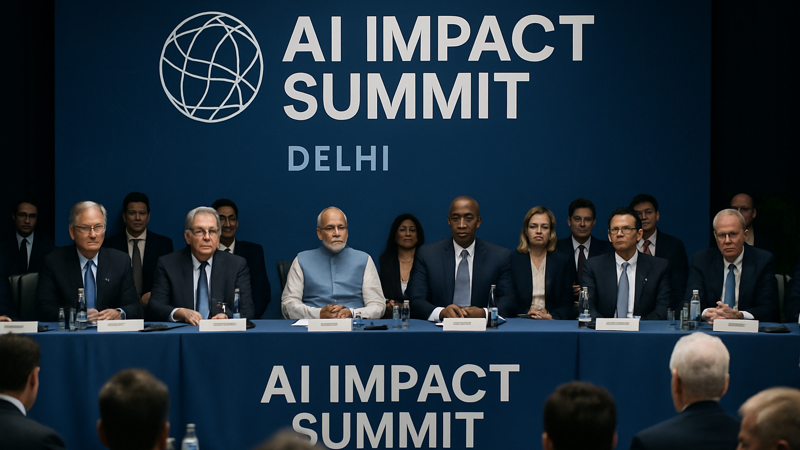
World leaders and technology executives convened in New Delhi this week for the AI Impact Summit 2026, marking the first major artificial intelligence conference hosted in the Global South as nations worldwide wrestle with mounting concerns over AI regulation, employment disruption, and cybersecurity threats.
The five-day summit, which began February 16 at Bharat Mandapam, brings together representatives from over 45 countries alongside industry leaders including Google's Sundar Pichai, OpenAI's Sam Altman, Nvidia's Jensen Huang, and Anthropic's Dario Amodei. Prime Minister Narendra Modi positioned India as a bridge between advanced economies and developing nations, promoting what organizers call "inclusive innovation" through three guiding principles: People, Planet, and Progress.
Escalating Global Regulatory Pressure
The Delhi summit occurs amid the most significant wave of artificial intelligence regulation in internet history. Spain has implemented the world's first criminal executive liability framework for social media platforms, while France has conducted cybercrime raids on AI companies over content violations. The European Union recently concluded that TikTok violated the Digital Services Act through "addictive design" features, with potential penalties reaching billions of euros.
Australia's under-16 social media ban, which eliminated 4.7 million teen accounts in December 2025, has provided a successful implementation model that European nations are now adapting. Greece is preparing under-15 restrictions using the Kids Wallet application, while France, Denmark, and Austria are conducting formal consultations on similar measures.
"Real age verification systems suggest identity document and biometric authentication requirements, raising significant privacy concerns about comprehensive government databases,"
— European Commission Official, Digital Services Act Investigation
The regulatory intensification extends beyond social media platforms. The United Nations has established an Independent International Scientific Panel on Artificial Intelligence with 40 global experts, described as the first fully independent scientific body for AI impact assessment. This represents a coordinated international response to the rapid pace of AI development and its societal implications.
Employment and Economic Disruption Warnings
A central theme at the Delhi summit involves AI's impact on employment, with Microsoft Chief AI Officer Mustafa Suleyman predicting that AI could replace the majority of office workers within two years. He specifically cited lawyers and auditors as professions facing automation within 18 months, highlighting the urgency of workforce adaptation strategies.
The technology sector is experiencing what analysts term a "SaaSpocalypse" – the elimination of hundreds of billions in market capitalization as AI systems directly replace traditional software functions. Indian IT giants including Infosys, Wipro, and HCL Tech have seen stock declines of 6% as their core services face AI-powered competition.
However, some regions report more optimistic scenarios. Portugal indicates that 90% of young people are using generative AI daily as a "new normal" without significant employment concerns, while India's IT sector appears to be adapting through worker transition to AI-enhanced roles rather than mass job losses.
Infrastructure Crisis Constraining Development
A critical challenge facing AI development is the global memory crisis, with semiconductor prices experiencing a sixfold surge affecting major manufacturers Samsung, SK Hynix, and Micron. The shortage is expected to continue until 2027 when new fabrication facilities come online, creating severe bottlenecks for AI infrastructure development.
Consumer electronics costs have increased 20-30% due to supply shortages, while the World Bank projects AI water demand could reach 4.2-6.6 billion cubic meters by 2027 for data center cooling – equivalent to four to six times Denmark's annual water withdrawal.
Cybersecurity Threats Multiply
The summit addresses mounting cybersecurity concerns as criminals increasingly weaponize AI technology. Google's quarterly threat intelligence report revealed that state actors from China, North Korea, and Iran have attempted to exploit the company's Gemini chatbot for cyberattacks, phishing, and malware development.
Danish authorities confirmed AI-powered deepfake extortion schemes spreading rapidly, using generative AI to create convincing fake images for blackmail. Interpol has warned that cybercriminals are "weaponizing" AI for sophisticated fraud, creating fake investment endorsements and online scam messages that appear genuine.
"By identifying these early indicators and offensive proofs of concept, we aim to arm defenders with the intelligence necessary to anticipate the next phase of AI-enabled threats,"
— Google Threat Intelligence Group
Military AI Applications Raise Ethical Concerns
Military applications of AI have become a contentious issue at the summit. The Pentagon has threatened to cut ties with Anthropic over AI safety restrictions, demanding that four AI companies allow military use for "all lawful purposes." The dispute intensified after unauthorized use of Anthropic's Claude AI chatbot in the Venezuelan President Nicolás Maduro capture operation, despite terms of service prohibiting violence and surveillance applications.
Ukrainian forces are already deploying AI-enhanced drone systems with improved low-light vision capabilities, while approximately one-third of countries have agreed to AI warfare governance frameworks. However, the United States and China have abstained from comprehensive military AI commitments, highlighting the geopolitical complexity of regulating AI in defense applications.
Successful Integration Models Emerge
Despite the challenges, the summit showcases successful AI integration models that prioritize human welfare alongside technological advancement. Canadian universities have successfully implemented AI teaching assistants while maintaining critical thinking standards, while Malaysia operates the world's first AI-integrated Islamic school combining technology with traditional learning approaches.
Singapore's WonderBot 2.0 demonstrates effective AI application in heritage education, providing conversational learning systems that enhance rather than replace human instruction. These examples suggest that thoughtful AI integration can strengthen rather than undermine fundamental educational relationships.
Global South Leadership in AI Governance
India's hosting of the summit represents a significant moment for Global South leadership in AI policy discussions. The Delhi Declaration, expected to emerge from the conference, could position developing nations as active AI policy participants rather than passive recipients of Western or Chinese technology.
Zimbabwe is advancing with 20 AI-powered traffic camera sites in Harare starting March 2026, while São Tomé and Príncipe focuses on solar-powered micro-grids addressing continental energy access challenges. These developments demonstrate how developing nations are leveraging AI technology to address specific local needs while contributing to global governance discussions.
Corporate Investment Continues Despite Challenges
Major technology companies continue aggressive AI investment despite regulatory and infrastructure challenges. Alphabet has committed a potential $185 billion to AI infrastructure in 2026, while Amazon plans over $1 trillion in development expenses. Google has launched Gemini 3 Deep Think AI platform designed for complex problems in science, engineering, and advanced research.
However, the investment occurs alongside growing internal tensions. Former Anthropic security researchers have resigned with warnings that "the world is in peril" due to AI development outpacing safety measures, highlighting conflicts between commercial pressures and safety considerations at leading AI companies.
Looking Forward: Critical Decisions Ahead
The Delhi summit represents a critical inflection point as AI transitions from experimental applications to essential infrastructure across healthcare, education, finance, and defense sectors. Success depends on resolving infrastructure constraints, establishing international cooperation frameworks, and developing sustainable business models that prioritize human welfare alongside technological advancement.
Key decisions made in 2026 will determine whether AI fulfills its transformative promise for human prosperity or creates systemic risks requiring dramatic corrections. The convergence of safety warnings, technical breakthroughs, infrastructure constraints, and regulatory pressures creates the most critical moment since the AI boom began.
"This is a historic moment that will define whether we harness AI for the betterment of humanity or allow it to become a source of division and disruption,"
— Prime Minister Narendra Modi, AI Impact Summit 2026
As the summit continues through February 20, the international community faces fundamental questions about democratic governance of transformative technology, the balance between innovation and safety, and the role of developing nations in shaping the AI-powered future. The outcomes of these discussions will influence AI development trajectories for decades to come, determining whether artificial intelligence serves as a tool for global prosperity or becomes a source of unprecedented social and economic disruption.