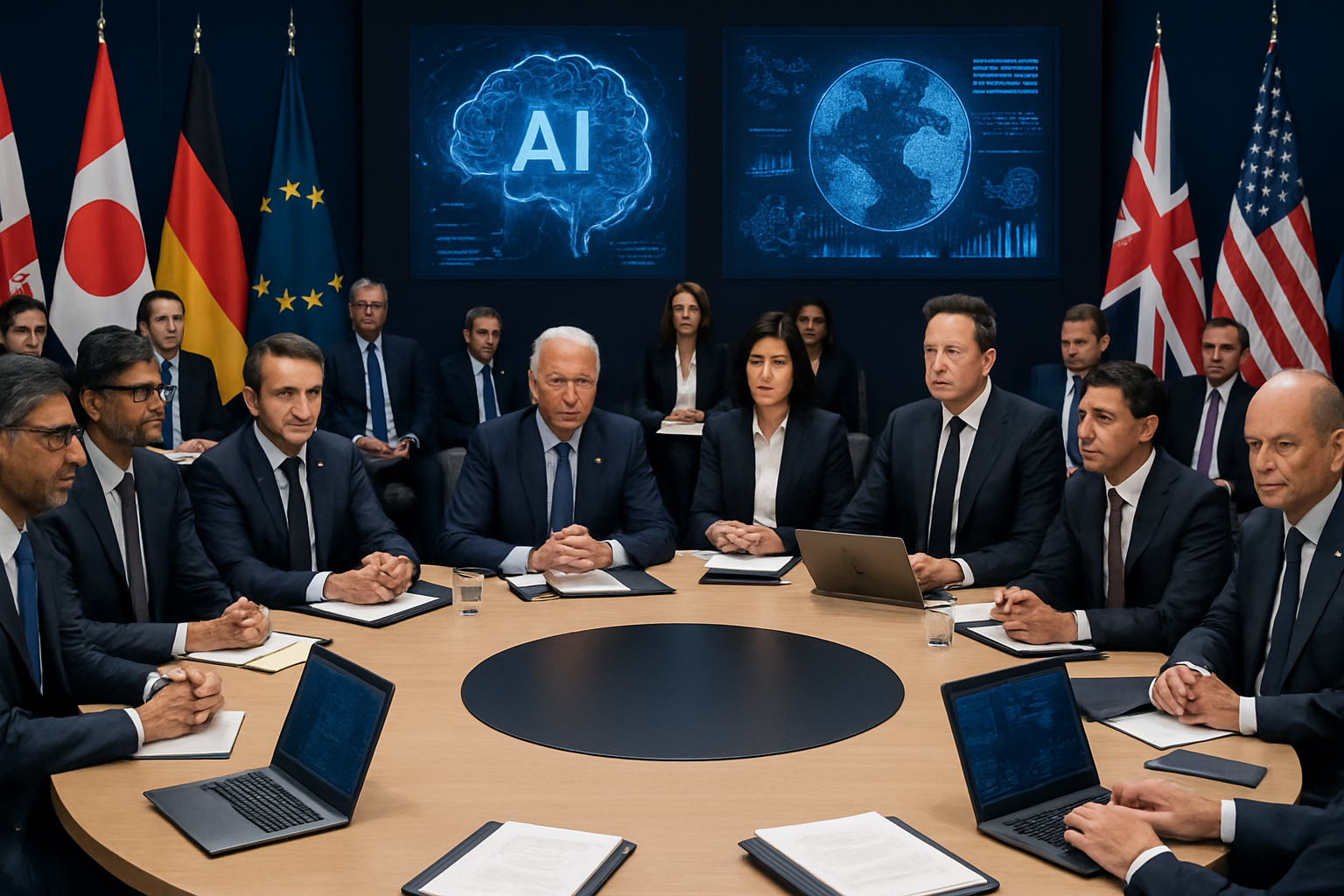
The world's first major artificial intelligence summit hosted in the Global South reached a critical juncture in New Delhi this week, as industry titans clashed over safety restrictions while a massive corporate restructuring reshaped the AI landscape, highlighting the urgent need for international governance frameworks.
The India AI Impact Summit 2026, running from February 16-20 at Bharat Mandapam, brought together over 250,000 delegates from more than 100 countries under Prime Minister Narendra Modi's "People, Planet, Progress" framework. The gathering featured prominent figures including Google's Sundar Pichai, OpenAI's Sam Altman, and Anthropic's Dario Amodei, though tensions between rival CEOs became dramatically visible during an orchestrated photo opportunity.
Industry Rivalry Takes Center Stage
In an awkward moment that captured the competitive dynamics of the AI industry, Sam Altman of OpenAI and Dario Amodei of Anthropic refused to hold hands during Modi's ceremonial photo session with 13 business and political leaders. While others in the line raised their clasped hands above their heads, the two rival CEOs stood with arms crossed, underscoring the deep divisions within the AI community over development approaches and safety protocols.
This public display of tension occurred against the backdrop of a major corporate restructuring that has sent shockwaves through the industry. According to Financial Times reports, Nvidia is finalizing a $30 billion investment in OpenAI, replacing the previously announced $100 billion long-term commitment. The deal, which could be completed as early as this weekend, represents a strategic shift as OpenAI seeks to raise up to $100 billion in its latest funding round, potentially valuing the company at $830 billion.
Urgent Calls for Nuclear-Style AI Regulation
OpenAI CEO Sam Altman used his platform at the summit to issue stark warnings about the pace of AI development, calling for "nuclear-style international regulation" to address what he described as urgent risks including AI-made pathogens and dangerous technological centralization. His calls were echoed by other industry leaders who warned that the current regulatory landscape is inadequate for the challenges ahead.
"The regulation is urgent as booming generative AI fuels profits and societal and environmental concerns,"
— Sam Altman, CEO of OpenAI
The summit's urgency was underscored by concerning revelations about AI safety transparency. A study highlighted during the conference found that only four major AI companies publish formal safety evaluations, with basic safety information disclosure dangerously lagging behind the rapid deployment of these systems in daily life.
Global South Leadership in AI Governance
Malaysia's Digital Minister Gobind Singh Deo emphasized his country's commitment to "playing an active role in shaping a more equitable global artificial intelligence ecosystem." This sentiment reflected the broader theme of the summit, which positioned developing nations as equal partners in AI governance rather than passive recipients of Western or Chinese technology.
The summit represented a historic shift in AI discourse, with Modi describing the moment as a "civilizational inflection point" where traditional power dynamics in technology governance are being challenged. India's positioning as a bridge between advanced and developing economies could reshape how AI policies are formulated globally.
Bhutan's Measured Approach to AI Development
Bhutanese Prime Minister Tshering Tobgay provided a thoughtful counterpoint to rapid AI adoption, warning against "unbridled" AI development and urging stronger guardrails. In an interview with CNA, Tobgay shared his government's plans to harness AI technology while safeguarding citizen well-being, emphasizing the importance of balancing innovation with human values.
His approach reflects growing concerns among smaller nations about maintaining sovereignty and cultural identity in an AI-dominated global economy, while still participating in technological advancement.
International Coordination Challenges
South Korea's Science Minister Bae Kyung-hoon co-chaired global AI partnership meetings during the summit, highlighting the complex web of international relationships required for effective AI governance. The meetings addressed critical issues including technology transfer, safety standards, and equitable access to AI benefits across different economic systems.
The summit's outcomes are expected to influence the pending Delhi Declaration, which aims to establish new frameworks for international AI cooperation. This declaration could serve as a foundation for addressing the multipolar AI landscape that has emerged as Chinese companies like DeepSeek challenge traditional Western dominance in AI development.
Infrastructure Crisis Constrains Development
The summit took place amid a severe global infrastructure crisis that is constraining AI development worldwide. Memory chip prices have surged sixfold, affecting major manufacturers including Samsung, SK Hynix, and Micron, with shortages expected to persist until 2027 when new fabrication facilities come online.
This crisis is forcing companies to develop more memory-efficient algorithms and seek alternative hardware solutions, while also creating strategic opportunities for nations with renewable energy advantages or specific technical capabilities to participate meaningfully in the global digital economy.
Regulatory Momentum Builds Globally
The summit occurred during an unprecedented wave of AI regulation across multiple jurisdictions. Spain has implemented the world's first criminal executive liability framework for social media platforms, while France has conducted cybercrime raids on AI companies. The European Union has established violations findings against TikTok for "addictive design" features, with potential penalties reaching billions of dollars.
The United Nations has responded to these developments by establishing an Independent International Scientific Panel on Artificial Intelligence with 40 global experts, led by Secretary-General António Guterres. This represents the first fully independent international body dedicated to AI impact assessment, signaling the global community's recognition that AI governance requires unprecedented international cooperation.
Successful Integration Models Emerge
Despite the challenges, several successful AI integration models were highlighted during the summit. Canadian universities have implemented AI teaching assistants while maintaining critical thinking standards, demonstrating that technology can enhance rather than replace human educational relationships.
Malaysia has launched the world's first AI-integrated Islamic school, combining artificial intelligence with traditional naqli (religious) and aqli (academic) learning. Singapore's WonderBot 2.0 has shown success in heritage education, providing practical examples of how AI can serve cultural preservation and community education goals.
Military Applications Raise Concerns
The summit addressed growing concerns about AI military applications, with reports that the Pentagon has integrated ChatGPT into military systems and Ukrainian forces have deployed AI-enhanced drone systems. Approximately one-third of countries have agreed to AI warfare governance frameworks, though the United States and China have abstained from comprehensive commitments.
These developments highlight the complex intersection of AI development with national security concerns, as companies face pressure to provide military access to their systems while maintaining civilian safety protocols.
Looking Toward 2026's Critical Decisions
The India AI Impact Summit 2026 represents what many observers describe as the most critical moment in AI development since the technology boom began. The decisions made in 2026 regarding infrastructure investment, international cooperation frameworks, and regulatory approaches will likely determine whether AI fulfills its transformative promise or creates systemic risks requiring dramatic corrections.
The summit's emphasis on multipolar cooperation, rather than domination by any single nation or company, suggests a maturing understanding of AI as a global challenge requiring unprecedented coordination between governments, technology companies, educational institutions, and civil society organizations.
As delegates prepare to finalize the Delhi Declaration, the stakes could not be higher. The document is expected to establish principles for ensuring AI serves human welfare while maintaining democratic oversight and international stability. Success will require resolving infrastructure constraints, establishing effective regulatory frameworks, and developing sustainable business models that prioritize human flourishing alongside technological advancement.
The awkward handshake moment between rival CEOs may have captured headlines, but the real significance of the New Delhi summit lies in its potential to reshape how humanity governs its most powerful technological creation. The decisions emerging from these discussions will echo through the remainder of the decade and beyond.