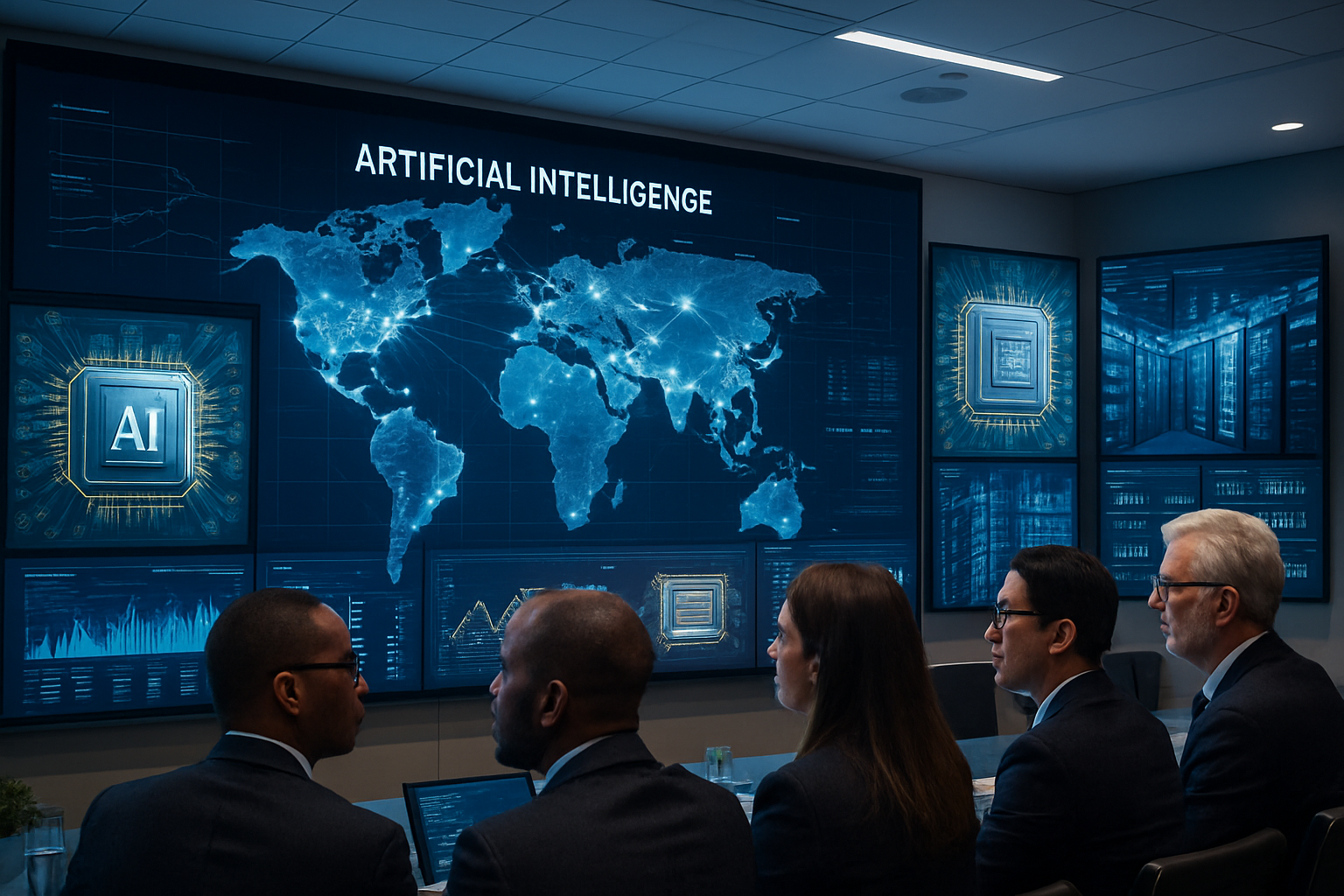
March 2026 has witnessed an unprecedented surge in artificial intelligence development and adoption globally, with breakthrough partnerships in drug discovery, mandatory AI education initiatives, and escalating cybersecurity threats highlighting the technology's rapid integration into critical sectors worldwide.
Hong Kong AI Firm Expands Middle East Drug Discovery Operations
Hong Kong-listed Insilico Medicine has secured a pivotal cooperation agreement with the United Arab Emirates' drug regulator to advance AI-powered drug discovery across the Middle East region. The partnership represents a significant milestone in international AI collaboration, particularly as geopolitical tensions continue to reshape global technology partnerships.
Market response was overwhelmingly positive, with Insilico shares rising as much as 12.8% in morning trading before settling at an 8.6% gain to close at HK$56.10. This performance significantly outpaced the benchmark Hang Seng Index, which gained only 0.3% on the same day.
The agreement positions Insilico Medicine to expand its AI-driven pharmaceutical research capabilities across a strategically important region, building on the company's existing expertise in using artificial intelligence to accelerate drug development timelines and reduce research costs.
Pakistan Mandates AI Education for All Undergraduates
In a groundbreaking educational reform, Pakistan's Higher Education Commission (HEC) has made artificial intelligence education mandatory for all undergraduate programs across the country's universities. The initiative, announced by HEC Chairman Prof. Dr. Niaz Ahmad Akhtar, represents one of the most comprehensive AI education mandates implemented globally.
The three-credit-hour AI course requirement aims to equip students across all disciplines with foundational knowledge of emerging technologies, preparing graduates for the evolving demands of the digital economy. Dr. Akhtar emphasized that this initiative positions Pakistan at the forefront of preparing its workforce for an AI-integrated future.
"This comprehensive plan addresses current challenges and leads the higher education sector toward holistic development. We are ensuring every graduate, regardless of their major, understands how to safely and effectively utilize AI technologies."
— Prof. Dr. Niaz Ahmad Akhtar, HEC Chairman
The Pakistani initiative joins a growing global movement toward systematic AI education integration. This builds on successful models from Malaysia's world-first AI-integrated Islamic school, Singapore's WonderBot 2.0 heritage education system, and Canadian universities implementing AI teaching assistants while maintaining critical thinking standards.
Emerging Cybersecurity Threats Target AI Infrastructure
While AI adoption accelerates globally, new cybersecurity challenges have emerged that specifically exploit artificial intelligence systems. Security researchers have documented a concerning trend of AI-enhanced malware that can analyze user behavior patterns in real-time, customizing attack vectors for maximum effectiveness.
The threat landscape has become increasingly sophisticated, with criminals leveraging AI chatbots to automate vulnerability detection, script writing, and data theft operations. This represents a dangerous evolution where artificial intelligence becomes both a target and a weapon in cybercriminal activities.
Regulatory responses are intensifying across multiple jurisdictions. Spain has implemented the world's first criminal executive liability framework for tech platforms, while France has conducted cybercrime raids on AI companies. The European Union is investigating potential Digital Services Act violations with billions in penalties possible.
Global Infrastructure Challenges Constrain Growth
Despite the surge in AI adoption and investment, significant infrastructure challenges continue to constrain global development. The ongoing semiconductor crisis has driven memory chip prices to surge sixfold, affecting major manufacturers including Samsung, SK Hynix, and Micron, with shortages expected to continue through 2027.
These constraints have paradoxically spurred innovation in efficiency, with developers creating memory-efficient algorithms, hybrid processing approaches, and creative deployment strategies that maximize AI capabilities while minimizing hardware requirements.
International Governance Framework Takes Shape
The United Nations has established an Independent International Scientific Panel on Artificial Intelligence, featuring 40 global experts led by Secretary-General António Guterres. This represents the first fully independent global AI assessment body, designed to provide coordinated international responses to AI development and its societal implications.
The panel includes Nobel Peace Prize laureate Maria Ressa, Canadian AI pioneer Yoshua Bengio, and Google DeepMind's Joelle Barral, bringing together technical expertise, applied AI experience, safety considerations, and infrastructure knowledge from across the globe.
Success Models Emerge Globally
Despite challenges, several successful AI integration models have emerged that demonstrate effective human-centered approaches. Malaysia continues to lead with its AI-integrated Islamic school combining artificial intelligence with traditional religious and academic learning. Singapore's WonderBot 2.0 has achieved remarkable success in heritage education, while Canadian universities have successfully implemented AI teaching assistants that enhance rather than replace critical thinking development.
These success stories share common elements: sustained political commitment, comprehensive stakeholder engagement, cultural sensitivity, and treating AI as an amplification tool serving human goals rather than as an end in itself.
Employment and Economic Implications
The rapid AI advancement is reshaping global employment patterns, with significant regional variations in approaches. While some predictions suggest dramatic job displacement, successful examples demonstrate that thoughtful implementation can enhance human capabilities rather than replace them.
The "SaaSpocalypse" phenomenon has eliminated hundreds of billions in traditional software market capitalization as AI systems demonstrate direct replacement capabilities for conventional solutions. However, regions implementing comprehensive worker transition programs, such as those seen in Asian markets, show more promising adaptation patterns than Western models focused primarily on efficiency gains.
Environmental and Sustainability Concerns
The World Bank projects that AI water demand could reach 4.2-6.6 billion cubic meters by 2027 for data center cooling alone—equivalent to four to six times Denmark's annual water withdrawal. This environmental impact adds urgency to developing more sustainable AI deployment strategies.
The convergence of infrastructure constraints, environmental concerns, and massive ongoing investments creates unprecedented coordination requirements for governments, technology companies, educational institutions, and civil society organizations.
Critical Inflection Point for Global Technology Policy
March 2026 represents a critical juncture in the transition from experimental AI applications to essential infrastructure across multiple sectors. The success of this transformation will depend on resolving infrastructure constraints, establishing effective international cooperation frameworks, and developing sustainable business models that prioritize human welfare alongside technological advancement.
Key decisions made during this period will determine whether AI achieves its transformative promise while preserving human creativity, empathy, and wisdom, or whether corrections will be needed to address systemic disruptions. The window for effective coordinated action is narrowing as technology advances rapidly, requiring unprecedented collaboration between innovation acceleration and responsible governance.
The developments across Hong Kong, Pakistan, and emerging global cybersecurity challenges illustrate the multipolar landscape of AI development, where distributed capabilities and diverse cultural approaches may provide more resilient and equitable outcomes than centralized technological dominance.