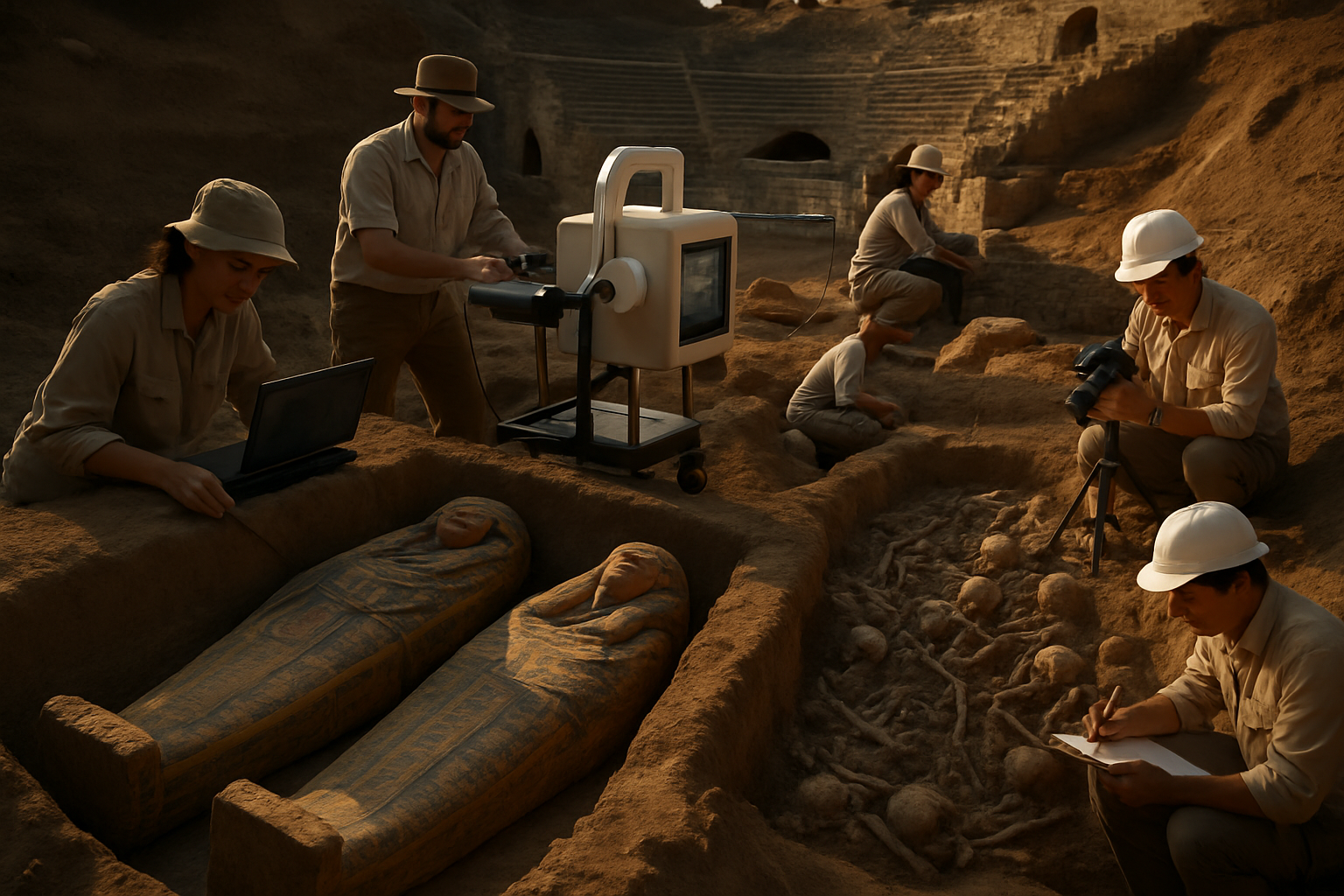
A convergence of remarkable archaeological discoveries across Egypt, Italy, and the Balkans is revolutionizing our understanding of ancient civilizations, revealing sophisticated societies, artistic achievements, and the darker chapters of human history that have remained hidden for millennia.
These findings, emerging simultaneously from excavations in Luxor's West Bank, conservation efforts in the Vatican's Sistine Chapel, and a mass grave site in northern Serbia, represent what scholars are calling the most significant archaeological revelations in decades. Each discovery not only adds crucial pieces to the puzzle of human development but also demonstrates how advanced analytical techniques are unlocking secrets previously thought lost to time.
Egypt's Luxor Unveils Sacred Treasures of Amun Chanters
In the shadow of Luxor's ancient monuments, an Egyptian archaeological mission affiliated with the Supreme Council of Antiquities and the Zahi Hawass Foundation for Heritage and Antiquities has made what may be the most significant discovery in the region since the Valley of the Kings excavations. Working in the southwestern corner of the Tomb of Seneb in the Qurna area, archaeologists have uncovered a cache of painted wooden coffins containing mummies, accompanied by a collection of rare papyri dating to the Third Intermediate Period.
The discovery is particularly significant because these coffins belonged to Amun chanters—religious officials who played crucial roles in the elaborate ceremonies of ancient Thebes. The painted decorations on the wooden sarcophagi reveal intricate religious imagery and hieroglyphic texts that provide unprecedented insights into the spiritual beliefs and daily practices of ancient Egyptian religious personnel.
Sherif Fathy, Egypt's Minister of Tourism and Antiquities, described the find as a significant addition to Egypt's growing record of major archaeological discoveries. The excavation reflects the state's continued support for archaeological research under a comprehensive strategy aimed at preserving cultural heritage and highlighting its civilizational and human value.
What makes this discovery particularly remarkable is the pristine condition of the papyri found within the coffins. These documents, written in hieratic script, contain religious texts, administrative records, and personal correspondence that illuminate the complex bureaucratic and spiritual world of ancient Egyptian temple life. The preservation of organic materials like papyrus is extraordinarily rare, making these documents invaluable primary sources for understanding Third Intermediate Period society.
Vatican's Sistine Chapel: Preserving Michelangelo's Masterpiece
Meanwhile, in Vatican City, one of humanity's greatest artistic treasures is receiving its most comprehensive restoration in over three decades. Michelangelo's iconic "The Last Judgment" fresco in the Sistine Chapel is undergoing a meticulous cleaning process to remove a light whitish residue left by millions of visitors over the years.
The restoration project represents a fascinating intersection of Renaissance artistry and 21st-century conservation science. The whitish film coating portions of the masterpiece is primarily composed of dust, skin cells, and respiratory moisture from the estimated five million annual visitors to the Sistine Chapel. Climate change and increased tourism have accelerated the accumulation of these deposits, threatening the long-term preservation of Michelangelo's work.
Vatican conservators are employing cutting-edge techniques including micro-cleaning procedures, advanced imaging technology, and sophisticated climate monitoring systems. The restoration team must balance the need to preserve the fresco's original pigments and techniques with the practical requirements of maintaining the Chapel as an active religious site and major tourist destination.
The project has broader implications for cultural heritage preservation worldwide. As global tourism continues to grow and climate change poses new threats to historic sites, the Vatican's approach to balancing accessibility with conservation is being closely studied by institutions globally.
Serbia's Prehistoric Violence Reveals Dark Chapter of Early European History
Perhaps the most sobering discovery comes from northern Serbia, where archaeologists have uncovered a 2,800-year-old mass grave containing the remains of 77 individuals, predominantly women and children. This prehistoric burial site provides chilling evidence of organized violence in early Iron Age Europe.
Analysis of the skeletal remains reveals that most victims died from deliberate blows to the head, in what researchers describe as a "brutal, deliberate, and efficient" episode of mass violence. The systematic nature of the killings suggests this was not a random act of warfare but rather a calculated campaign of elimination targeting specific populations.
The discovery is providing crucial insights into the emergence of organized violence during the early Iron Age, a period marked by significant migrations and territorial conflicts throughout the Carpathian Basin. The demographics of the victims—primarily women and children—suggest this may have been part of a deliberate strategy to eliminate rival communities entirely.
Research teams using advanced forensic techniques, including DNA analysis and isotope studies, are working to understand the broader context of this violence. Preliminary findings suggest the victims were not local to the area, raising questions about population movements, territorial disputes, and the complex social dynamics of prehistoric European societies.
Technological Revolution in Archaeological Research
These three discoveries exemplify how modern archaeological methods are revolutionizing our understanding of the past. In Egypt, ground-penetrating radar and advanced chemical analysis are enabling researchers to locate and safely extract delicate organic materials. Digital imaging techniques are creating permanent records of hieroglyphic texts and artistic decorations before they undergo conservation treatment.
At the Vatican, conservators are using multispectral imaging to analyze pigment layers invisible to the naked eye, while environmental monitoring systems track microscopic changes in the Chapel's atmosphere. These technologies allow for preventive conservation approaches that address threats before they cause irreversible damage.
The Serbian site demonstrates the power of modern forensic archaeology, where techniques borrowed from criminal investigation are revealing the circumstances of deaths that occurred nearly three millennia ago. Stable isotope analysis is providing information about the victims' origins and diet, while osteological examination is revealing details about their lives and deaths.
International Cooperation and Cultural Diplomacy
These discoveries are occurring within a broader context of international archaeological cooperation that characterized February 2026. From Croatia's ancient sarcophagus findings to Australia's prehistoric whale fossils, the month has witnessed unprecedented collaboration between research institutions worldwide.
The Egyptian excavations involve partnerships with international universities and museums, ensuring that findings are shared with the global scholarly community while remaining in their country of origin. The Vatican restoration project draws on expertise from conservation specialists across Europe and North America. Even the Serbian investigation includes collaborations with forensic anthropologists and ancient DNA specialists from multiple countries.
This collaborative approach represents a mature evolution in archaeological practice, where discoveries are viewed as contributions to humanity's shared heritage rather than national possessions. Digital documentation and virtual reality technologies are making these findings accessible to researchers and the public worldwide, even as the physical artifacts remain in their home institutions.
Climate Change and Heritage Preservation
All three discoveries underscore the urgent challenges facing cultural heritage preservation in an era of climate change. Egypt's archaeological sites face threats from groundwater changes and extreme weather events. The Vatican's conservation efforts are directly responding to the effects of climate change on historic buildings. The Serbian site was excavated partly because of environmental threats to the area.
These challenges are driving innovation in preservation techniques and creating new urgency around documentation efforts. Archaeologists are working against time to excavate and record sites before they are lost to development, environmental change, or conflict.
Economic and Cultural Impact
Beyond their scholarly significance, these discoveries are generating substantial economic benefits through cultural tourism. Egypt's new finds are already attracting international attention and are expected to boost visitor numbers to the Luxor region. The Vatican restoration is enhancing one of the world's most visited cultural sites. Even the Serbian discovery is drawing academic tourists and contributing to regional cultural tourism development.
The discoveries also contribute to cultural diplomacy efforts, with countries using archaeological findings to strengthen international relationships and showcase their contributions to world civilization. Egypt's discoveries reinforce its position as a guardian of ancient heritage, while Italy's conservation efforts demonstrate leadership in cultural preservation techniques.
Looking Forward: Implications for Future Research
These February 2026 discoveries are establishing new standards for archaeological research and cultural preservation. The integration of traditional excavation methods with cutting-edge analytical techniques is revealing aspects of ancient life previously invisible to researchers.
The Egyptian papyri will require years of careful translation and analysis, potentially revealing new information about religious practices, economic systems, and daily life in ancient Thebes. The Vatican restoration is providing a template for preserving other Renaissance masterpieces facing similar environmental challenges. The Serbian mass burial site is contributing to a growing database of information about prehistoric violence and social organization.
Perhaps most importantly, these discoveries demonstrate that significant archaeological findings continue to emerge from well-studied regions. Even areas like Luxor, the Vatican, and the Balkans, which have been the focus of archaeological attention for generations, still hold secrets that can fundamentally alter our understanding of human history.
As these investigations continue, they promise to yield insights that will reshape textbooks and challenge long-held assumptions about ancient civilizations. The convergence of sophisticated technology, international cooperation, and dedicated scholarship is creating a golden age of archaeological discovery that is revealing the complexity, creativity, and tragedy of human experience across millennia.