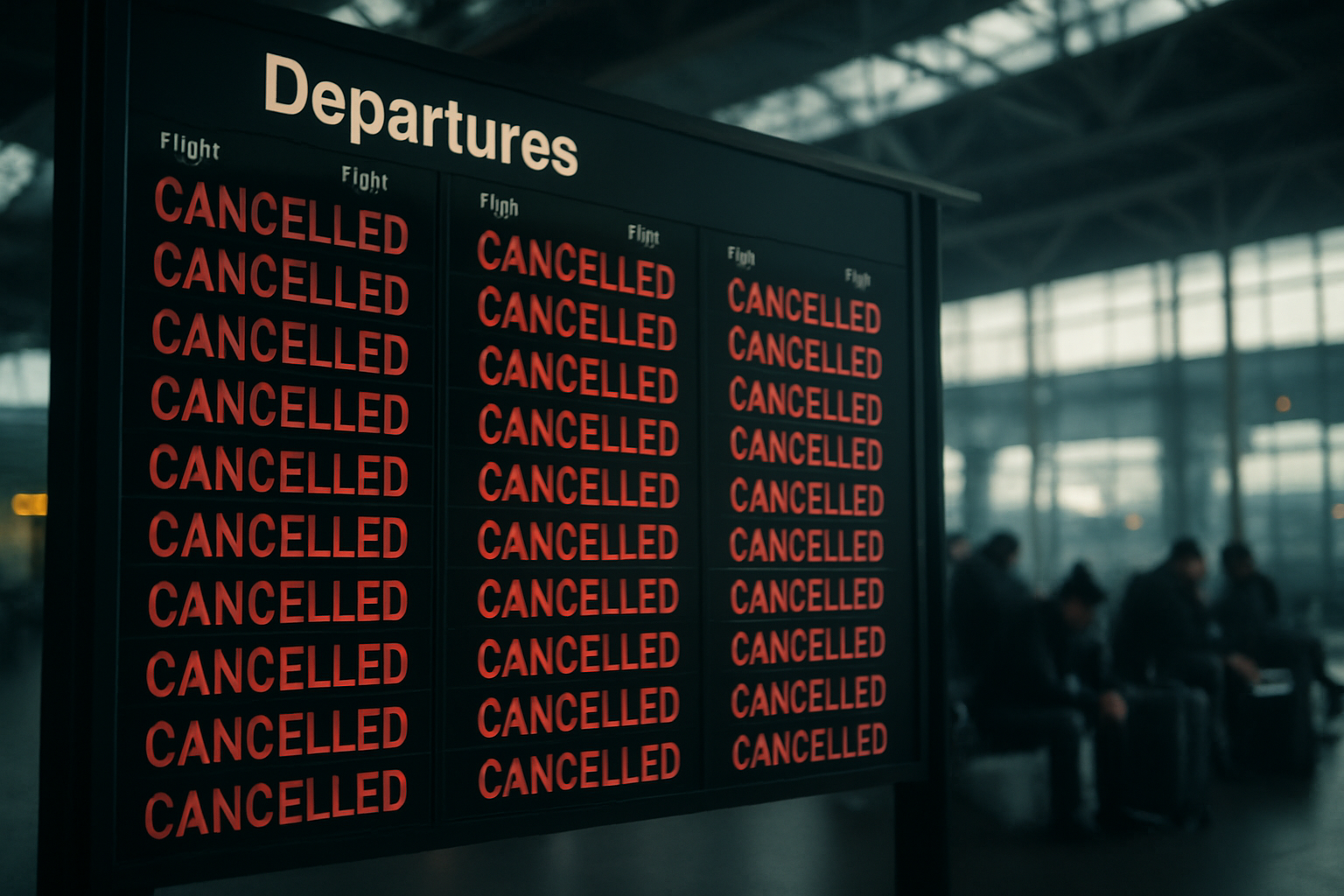
Airlines operating repatriation flights from the Middle East are arriving with rows of empty seats, while thousands of stranded citizens desperately wait for tickets out of the conflict zone as the Iran crisis creates the most comprehensive global aviation disruption since the COVID-19 pandemic.
The federal government of Australia expressed disappointment that repatriation flights from Dubai are sitting half empty, with around 270 passengers aboard an Emirates flight arriving in Melbourne – representing only half the aircraft's usual capacity. This paradox of empty seats amid desperate demand illustrates the complex challenges facing aviation authorities during the ongoing Middle East crisis.
Historic Aviation Crisis Unfolds
Over 18,000 flights have been cancelled worldwide since March 1, 2026, following the escalation of the Iran conflict and the implementation of Operation Epic Fury by US and Israeli forces. Eight countries – Iran, Iraq, Israel, UAE, Qatar, Syria, Kuwait, and Bahrain – simultaneously closed their airspace, creating the most comprehensive regional aviation shutdown in modern history.
Dubai International Airport, the world's busiest with over 86 million passengers annually, remains completely shut down after sustaining missile damage during Iranian retaliation strikes. The closure of this critical Europe-Asia hub has created cascading effects throughout global aviation networks, forcing complex rerouting strategies and dramatically increased operational costs.
Singapore Airlines and Regional Response
Singapore Airlines and its subsidiary Scoot have extended flight cancellations to Middle East destinations, with the carrier stating that "as the situation remains fluid, other SIA flights may be affected." The airline industry's cautious approach reflects the unpredictable nature of geopolitical conflicts compared to weather-related disruptions.
Major international carriers have suspended operations indefinitely, including Emirates, Etihad Airways, Air France-KLM, Wizz Air, and Bulgaria Air. The simultaneous grounding of multiple carriers serving the region has eliminated hundreds of thousands of seats from the global aviation network.
The Repatriation Paradox
Australian authorities report that several planeloads carrying hundreds of passengers on Etihad and Emirates flights have safely returned to Melbourne and Sydney since fighting began. However, the concerning trend of half-empty aircraft reveals systemic challenges in crisis evacuation procedures.
Government sources indicate that late confirmations and safety concerns contribute to the underutilization of available seats. The complexity of coordinating evacuations during active conflicts, combined with rapidly changing security situations, creates logistical nightmares for both airlines and government agencies.
"It's really disappointing that repatriation flights from Dubai to Australia are sitting half empty, as thousands of stranded citizens wait desperately for their ticket out of the Middle Eastern warzone."
— Australian Federal Government Official
Global Impact and Energy Consequences
The aviation crisis has coincided with severe energy market disruptions. Oil prices have surged over 10% to more than $80 per barrel as Iran declared the Strait of Hormuz – through which 40% of global oil transit passes – "unsafe." Natural gas prices have exploded by 24% in Europe and 78% in the United States.
Major shipping companies Maersk and MSC have suspended operations in the Persian Gulf, leaving over 150 oil tankers stranded with billions of dollars worth of cargo. Qatar has halted LNG production at its Ras Laffan and Mesaid facilities, affecting approximately 20% of global LNG exports.
Unprecedented International Evacuations
What has emerged is the largest coordinated international evacuation operation since the Arab Spring of 2011. Australia faces the challenge of extracting 115,000 nationals, while Germany is working to repatriate 30,000 tourists. Cyprus activated its ESTIA evacuation plan for the first time in history to coordinate the return of over 2,000 nationals from the UAE.
The European Union has demonstrated unprecedented coordination, with multiple member states sharing resources and flight schedules. Sweden and Serbia ordered immediate evacuations from Iran, citing "extremely uncertain" security conditions, while the United States authorized the departure of non-essential embassy personnel from 15 Middle Eastern countries.
Individual Stories of Disruption
The human cost of the crisis extends far beyond statistics. Emily Grosser, a Swedish traveler, paid 6,000 SEK (approximately $560) for alternative routing from Paris to Australia, demonstrating the extreme financial burden placed on individual passengers. Twenty-eight Romanian students remain blocked at Dubai airport, while cricket teams from the West Indies and Zimbabwe are stranded in India following the T20 World Cup.
Swedish travel agencies report their busiest crisis period since COVID-19, with every call classified as an emergency. The rapid deterioration of the security situation has caught many travelers off guard, with some facing days of uncertainty about return routes.
Aviation Industry Transformation
Airlines have been forced to implement emergency protocols unprecedented in scope. These include enhanced fuel loading to avoid refueling in affected zones, complex rerouting through Caribbean stopovers for trans-Pacific routes, and dramatically increased operational costs due to longer flight times and reduced passenger capacity.
The crisis has exposed the aviation industry's over-dependence on Middle Eastern hubs for Europe-Asia connections. With Russian and Ukrainian airspace already closed due to ongoing conflicts, the additional closure of Middle Eastern routes has created severe challenges for maintaining global connectivity.
Economic Ripple Effects
Global stock markets have experienced severe volatility, with Pakistan's KSE-100 index crashing 8.97% in its largest single-day decline in history. Dow futures fell 400-570 points, while PayPay postponed its $1.1 billion IPO due to market uncertainty.
The Persian Gulf region serves as a critical trade hub beyond energy, affecting consumer goods and industrial materials worldwide. Supply chain vulnerabilities have been exposed, particularly in manufacturing sectors dependent on Gulf logistics networks, including automotive, electronics, and textiles.
Diplomatic Context and Nuclear Implications
The aviation crisis stems from the complete collapse of US-Iran nuclear negotiations despite achieving a "broad agreement on guiding principles" – the most significant progress since the JCPOA collapse in 2018. Iran maintained that ballistic missiles and regional proxies were "red lines" to be excluded from nuclear-only talks, while the US demanded comprehensive negotiations including missiles, armed groups, and human rights issues.
This breakdown occurred against the backdrop of a broader nuclear governance crisis, with the New START treaty having expired on February 5 – marking the first time in over 50 years without US-Russia nuclear constraints. China's nuclear expansion has further complicated multilateral frameworks, leading UN Secretary-General Guterres to declare that nuclear risks are at their "highest in decades."
Recovery Timeline Uncertainty
Unlike weather-related disruptions that follow predictable patterns, the recovery timeline for this crisis depends entirely on the resolution of military operations and the normalization of diplomatic tensions. Airlines are conducting daily operational reviews but cannot make long-term scheduling decisions due to the unpredictable nature of geopolitical conflicts.
Even when flights resume, industry experts estimate that clearing the backlog of stranded passengers and cancelled flights could take weeks. The scale of disruption has forced airlines to reconsider fundamental aspects of route planning, risk assessment, and contingency planning for an increasingly volatile geopolitical environment.
Template for Future Crisis Management
The March 2026 Middle East aviation crisis represents a template-setting moment for 21st-century crisis management in an interconnected world where regional conflicts instantly become global challenges. The crisis has demonstrated both the strengths and limitations of international cooperation frameworks in protecting civilian air travel during geopolitical emergencies.
Success in containing the crisis and restoring normal aviation operations could provide valuable templates for future emergency response protocols. However, failure to resolve the situation could fundamentally reshape international aviation approaches to geopolitical risk, potentially accelerating the industry's move toward route diversification and reduced dependence on single regional hubs.
As the situation continues to evolve, the aviation industry faces the challenge of maintaining essential global transportation links while navigating an increasingly complex geopolitical landscape. The empty seats on repatriation flights serve as a stark symbol of the disconnect between the urgency of crisis response and the practical challenges of implementation in a world where regional conflicts can instantly disrupt global mobility.