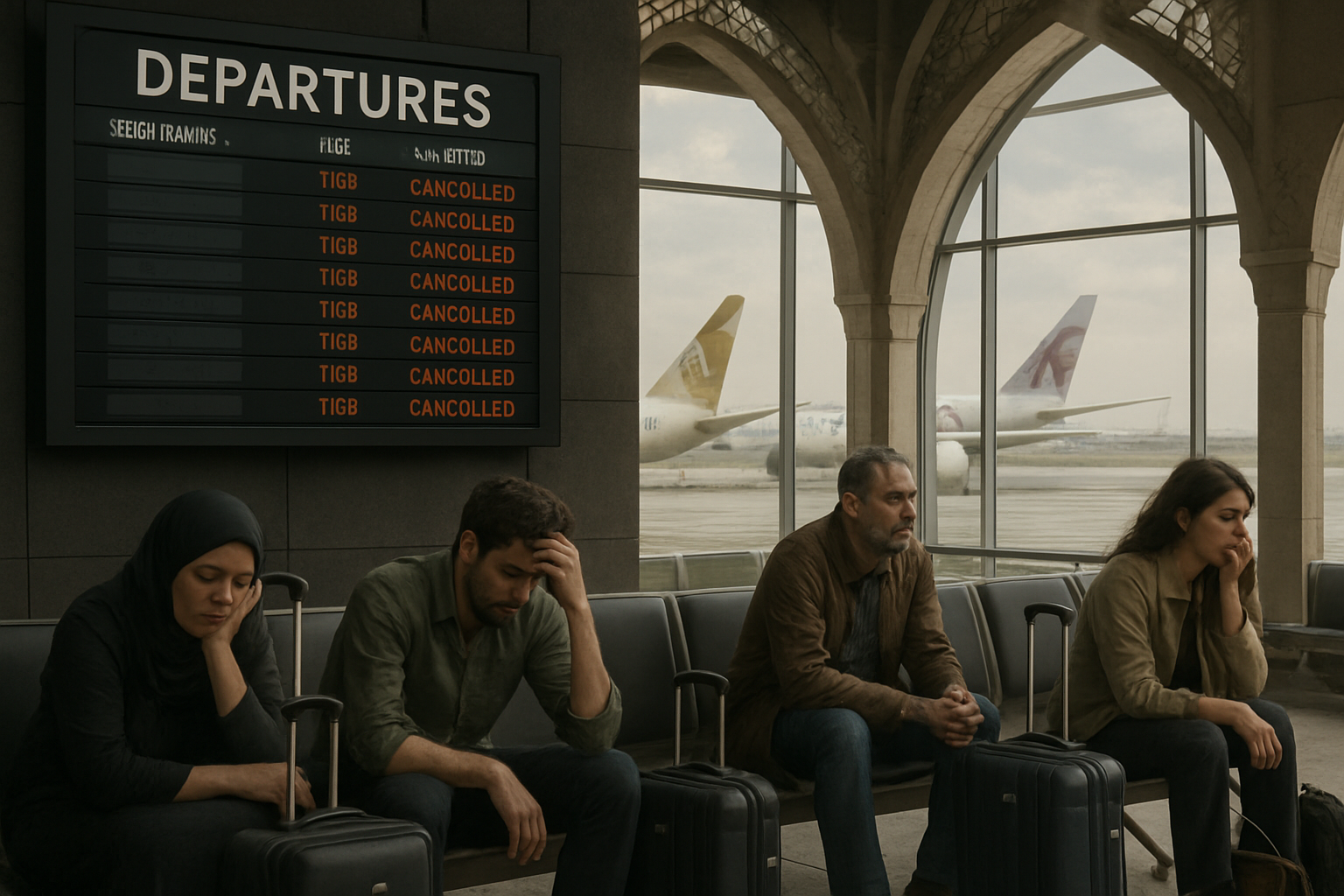
The global travel and tourism industry is experiencing its most severe operational crisis since the COVID-19 pandemic, as regional conflicts in the Middle East have triggered unprecedented aviation disruptions affecting international travel patterns on a scale not seen in modern history.
The crisis began in early March 2026 when escalating conflicts involving Iran, Israel, and the United States led to the simultaneous closure of eight Middle Eastern countries' airspaces - Iran, Iraq, Israel, UAE, Qatar, Syria, Kuwait, and Bahrain. This comprehensive regional shutdown has eliminated critical Europe-Asia flight corridors and severed vital transportation hubs that millions of travelers depend on annually.
Unprecedented Aviation Disruption
Over 18,000 flights have been cancelled worldwide since March 1, 2026, representing the most extensive aviation disruption since the pandemic. Dubai International Airport, the world's busiest with over 86 million passengers annually, remains completely shut down after sustaining missile damage during regional conflicts.
Major carriers including Emirates, Etihad Airways, Air France-KLM, Wizz Air, and Bulgaria Air have suspended operations indefinitely, affecting hundreds of thousands of passengers globally. The aviation crisis has created a "black hole" in international air travel, forcing airlines to implement complex rerouting strategies that dramatically increase costs and journey times.
"Asia has been particularly affected because of its exposure to oil that normally comes through the Strait of Hormuz, which has been blocked by Iran."
— The Japan Times, Aviation Industry Report
Energy Crisis Compounds Travel Woes
The aviation crisis is occurring alongside a parallel energy emergency that has further destabilized the travel industry. Iran's closure of the Strait of Hormuz, through which 40% of global oil transit passes, has sent fuel prices soaring. Jet fuel costs have surged by 122%, jumping from $85-90 to $150-200 per barrel, forcing airlines to implement emergency fare surcharges across the globe.
Air France-KLM has added 50 euros to long-haul economy tickets, while Norwegian Airlines deployed 125 additional flights to meet demand after SAS cancelled over 1,000 flights due to unsustainable fuel costs. Oil prices have breached $100 per barrel for the first time since 2014, with analysts warning of potential spikes toward $200 per barrel if the crisis continues.
Massive International Evacuations
The crisis has triggered the largest coordinated international evacuation since the Arab Spring of 2011, with over 500,000 citizens extracted from Middle East conflict zones. Australia has 115,000 nationals trapped in the region, while Germany is coordinating the evacuation of 30,000 stranded tourists.
The European Union activated Cyprus's ESTIA evacuation plan for the first time in its history, coordinating the extraction of over 2,000 EU and third-country nationals from the UAE. This watershed moment in EU crisis management demonstrates both the capabilities and limitations of international cooperation during volatile situations.
Individual travelers have faced extreme costs and challenges. Swedish traveler Emily Grosser paid $560 for alternative routing from Paris to Australia after her Dubai connection was cancelled, exemplifying the financial burden placed on ordinary passengers caught in the crisis.
Tourism Industry Transformation
The crisis is fundamentally reshaping global tourism patterns, creating clear winners and losers across different regions. European destinations are emerging as primary beneficiaries as travelers seek safer alternatives to traditional routes through Middle Eastern hubs.
Croatia is positioning itself advantageously as a safer European alternative, with tourism experts predicting strong seasons despite the global uncertainty. Spain, which already leads Europe with 513.6 million tourist nights annually, is capturing additional redirected demand from travelers avoiding conflict-affected regions.
Conversely, destinations dependent on Middle Eastern aviation connections face severe challenges. New Zealand's tourism recovery is threatened since approximately one-third of European travelers typically use Middle Eastern hubs to reach the Pacific nation. The Caribbean faces a "perfect storm" of both Middle East disruptions and Cuba's aviation isolation, creating unprecedented challenges for the region's tourism industry.
Travel Insurance Gaps Exposed
The crisis has exposed critical gaps in travel insurance coverage, as standard policies exclude war-related cancellations, leaving individual travelers financially exposed. This vulnerability is driving a fundamental shift in travel purchasing behavior, with a movement away from independent travel toward package tours that offer comprehensive coverage frameworks.
Austrian European Consumer Centre confirmed that travelers with regional "anxiety" have no recourse unless they book organized tours, highlighting fundamental flaws in current protection systems. This revelation is accelerating changes in how travelers approach trip planning and insurance coverage.
Long-term Industry Implications
The March 2026 crisis represents a watershed moment for the global travel industry, forcing fundamental questions about the balance between global connectivity and security-conscious travel patterns. Enhanced security screening, mandatory conflict-coverage insurance, and pre-approval systems for high-risk destinations are likely to become standard features of international travel.
The aviation industry is facing urgent calls for route diversification to reduce over-dependence on Middle Eastern hubs for Europe-Asia connectivity. With Russian and Ukrainian airspace already closed due to ongoing conflicts, the additional closure of Middle Eastern routes has created unprecedented challenges for maintaining global air connectivity.
Airlines are implementing emergency protocols including enhanced fuel loading to avoid refueling in affected zones, complex rerouting through Caribbean stopovers for trans-Pacific routes, and dramatically increased operational costs that are being passed on to consumers through higher fares and reduced services.
Economic Ripple Effects
The crisis extends far beyond aviation, affecting global supply chains that depend on Persian Gulf logistics networks. Manufacturing sectors including automotive, electronics, and textiles are experiencing severe disruptions due to the region's role as a critical trade hub connecting Asia and Europe.
Stock markets have crashed globally, with Pakistan's KSE-100 experiencing its largest single-day decline in history at -8.97%. The economic impact demonstrates how regional conflicts in strategic locations can instantly become global humanitarian and economic challenges affecting energy markets, supply chains, and fundamental transportation networks.
Recovery Uncertainty
Unlike weather-related disruptions that follow predictable patterns, the recovery timeline for this crisis depends entirely on military and diplomatic resolution of the underlying conflicts. Airlines are conducting daily operational reviews but cannot make long-term scheduling decisions while multiple airspaces remain closed due to security concerns.
Even when flights resume, clearing the backlog of cancelled flights and stranded passengers could take weeks. The aviation industry is calling for enhanced resilience planning and international cooperation frameworks to protect civilian air travel during geopolitical crises.
"A river snakes through the city, as much a landmark as the monuments along its banks. This is the City of Light, but it's not Paris."
— Tourism New Zealand, Alternative Destination Marketing
Future of Global Travel
The crisis is forcing the travel industry to confront fundamental questions about its future direction. The choice now lies between maintaining robust systems that enable global mobility despite security challenges, or evolving toward safer but more fragmented regional travel patterns that prioritize security over connectivity.
Consumer behavior is shifting toward last-minute bookings and flexible arrangements, forcing travel companies to develop more agile business models. Technology integration, including AI-powered travel planning and real-time security monitoring, is becoming essential for operators seeking to maintain customer confidence in an increasingly volatile world.
The success or failure of current crisis management efforts will influence tourism and aviation policies for decades to come, establishing precedents for how the industry navigates the intersection of global connectivity and security concerns in an increasingly multipolar and unpredictable world.
As the situation continues to evolve, the travel industry faces its greatest operational test since World War II, with implications for international mobility that extend far beyond the current crisis, potentially reshaping how humanity approaches global travel in the 21st century.