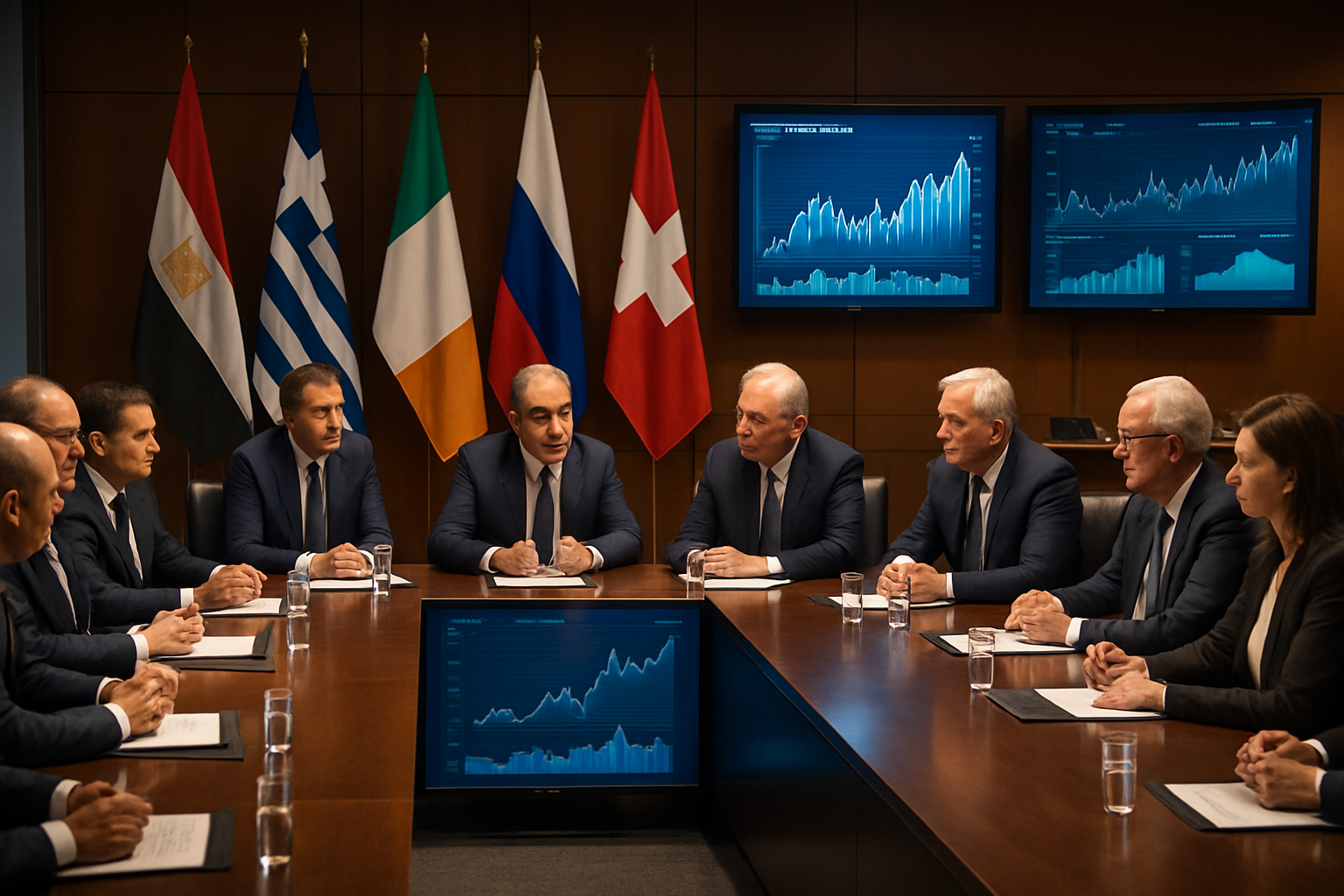
Economic developments across Egypt, Greece, Ireland, Russia, and Switzerland reveal a complex global financial landscape where traditional monetary policies meet innovative market strategies, as nations navigate persistent energy volatility and unprecedented shifts in real estate investment patterns.
The convergence of regional economic pressures has created a watershed moment in global business development, with five distinct national approaches demonstrating how different institutional frameworks respond to universal challenges. From Egypt's real estate remittance surge to Greece's commercial property renaissance, these developments represent broader shifts in international investment flows and monetary policy coordination.
Egypt's Real Estate Revolution Through Diaspora Investment
Egyptian real estate markets are experiencing a fundamental transformation as overseas remittances increasingly flow into property investments. According to industry analysis from the Real Estate Development Chamber, Egyptian expatriate transfers are demonstrating unprecedented momentum toward real estate acquisition, representing a strategic shift in how diaspora communities maintain economic connections with their homeland.
Engineer Mohamed Khattab, a member of the Real Estate Development Chamber at the Federation of Industries, projects that Egypt's real estate sector will capture a significant share of these international transfers. This trend reflects broader patterns observed across emerging markets where expatriate communities seek tangible assets in their countries of origin amid global financial uncertainty.
The phenomenon aligns with historical data showing increased diaspora investment during periods of global economic volatility. Egypt's position as a major labor-exporting nation, with millions of citizens working in Gulf states, Europe, and North America, creates substantial remittance flows that traditionally supported consumption but are increasingly channeled toward property investment.
Greece's Commercial Real Estate Renaissance
Greek commercial real estate markets are experiencing a significant transition toward maturity and stability. The commercial property sector, particularly in logistics, quality offices, and big-box retail, shows declining yields—a positive indicator of increased investor confidence and market sophistication.
This yield compression reflects a fundamental shift in how international investors perceive Greek commercial assets. Following years of economic restructuring post-financial crisis, Greek commercial real estate is now attracting institutional-grade capital seeking competitive returns in a stabilizing European economy.
The logistics sector particularly benefits from Greece's strategic position as a Mediterranean gateway, while office markets in Athens and Thessaloniki demonstrate renewed corporate confidence. Big-box retail developments indicate consumer spending recovery and modern retail infrastructure investment, suggesting broad-based economic improvement beyond traditional tourism sectors.
Ireland's Banking Sector Competitive Challenges
Irish financial markets face significant structural challenges that highlight broader questions about banking competition and consumer protection. Analysis suggests that enhanced bank competition could substantially improve conditions for Irish depositors, who currently face limited options in a concentrated banking market.
The introduction of a new savings scheme reflects ongoing policy efforts to address Ireland's particular fiscal challenges. However, concerns emerge about the distributional effects of such policies, with critics arguing that new savings incentives may disproportionately benefit high-income taxpayers while being funded through broader tax bases.
Ireland's banking sector concentration creates what economists describe as insufficient competitive pressure, resulting in deposit rates and service terms that may not fully benefit consumers. This situation exemplifies broader European challenges where banking sector consolidation has reduced competitive dynamics in national markets.
Russia's Financial Market Volatility
Russian financial markets opened Monday morning with significant downward pressure, as the Moscow Exchange Index declined to 2,756.07 points by 7:10 a.m. Moscow time. This early-session volatility reflects broader uncertainty affecting emerging market equities amid ongoing geopolitical tensions and energy market disruptions.
The index movement occurs within a context of continued sanctions pressure and limited international investment flows. Russian markets remain largely isolated from global financial integration, with domestic investors and limited international partners comprising the primary market participants.
Despite isolation from Western financial systems, Russian markets continue operating with domestic institutional support and alternative international partnerships. The Central Bank of Russia maintains monetary policy independence, though external constraints limit traditional economic policy tools.
Switzerland's Investment Stability Amid Global Turbulence
Swiss analysis of German equity markets reveals a sophisticated approach to crisis-resistant investment strategies. Despite rising energy prices from ongoing Middle East conflicts, Swiss financial experts have identified five German stocks with particularly robust business models capable of maintaining performance during turbulent periods.
This analysis reflects Switzerland's traditional role as a global financial center focused on stability and risk management. Swiss investment strategies emphasize companies with strong fundamentals, diversified revenue streams, and operational resilience—characteristics particularly valuable during periods of energy price volatility and geopolitical uncertainty.
The focus on German equities demonstrates continued European integration despite broader global fragmentation. Swiss financial institutions maintain sophisticated capabilities for cross-border investment analysis, leveraging their position as a neutral financial hub to serve international clients seeking stability-focused strategies.
Global Construction and Technology Constraints
All five nations face universal challenges from the global construction crisis, where rising material costs have created negative developer profit margins worldwide. This crisis constrains new housing and commercial development despite strong underlying demand.
Memory chip shortages have driven semiconductor prices sixfold higher due to AI development demand, affecting smart building technologies that have become standard requirements for modern developments. Companies including Samsung, SK Hynix, and Micron operate at full capacity but cannot meet demand for building management systems, adding 20-30% to construction technology costs until new fabrication facilities come online in 2027.
These supply-side constraints create market dynamics where existing properties gain value due to limited new competition, while buyers face reduced inventory and higher prices. The technological bottleneck particularly affects commercial developments requiring advanced building management systems, energy efficiency technologies, and smart infrastructure integration.
Investment Strategy Evolution
Market participants across all five nations demonstrate a fundamental shift toward country-specific investment analysis rather than broad regional or sector themes. Success increasingly depends on understanding local conditions, institutional capabilities, regulatory environments, and political dynamics rather than following global investment trends.
This localization trend reflects reduced international policy coordination compared to the post-2008 financial crisis period. Central banks pursue increasingly divergent policies based on domestic conditions, while governments prioritize national economic objectives over international harmonization.
The shift rewards investors with sophisticated country analysis capabilities while challenging traditional geographic and sector-based approaches. Regional specialization combined with digital innovation emerges as a winning formula for financial institutions and investment managers.
Energy Security and Economic Resilience
The ongoing energy crisis continues to shape economic policy across all five nations, though with different regional impacts. Energy-importing countries like Greece and Ireland face different challenges than energy-exporting nations, while financial centers like Switzerland focus on helping clients navigate energy price volatility.
Egypt benefits from its strategic position in global energy markets while attracting diaspora investment in real estate. Russia's energy exports provide revenue despite sanctions, though market access remains constrained. These divergent energy positions create different economic opportunities and policy constraints.
Energy security concerns drive policy innovation including strategic reserve management, alternative supply chain development, and enhanced domestic production capabilities. Nations with diversified energy portfolios and strong institutional frameworks show greater economic resilience during supply disruptions.
Future Economic Coordination Challenges
The five-nation analysis reveals decreasing effectiveness of traditional international economic coordination mechanisms. Instead of synchronized policy responses, national governments pursue strategies tailored to domestic conditions and priorities.
This trend toward economic nationalism reflects both the limitations of global coordination mechanisms and the political pressures of addressing domestic economic challenges. Success requires balancing international integration benefits with national economic sovereignty and democratic accountability.
Future economic stability likely depends on finding new models for international cooperation that respect national sovereignty while addressing transnational challenges including climate change, technological disruption, and global supply chain vulnerabilities. The approaches demonstrated by these five nations provide templates for navigating economic complexity in an increasingly multipolar world.