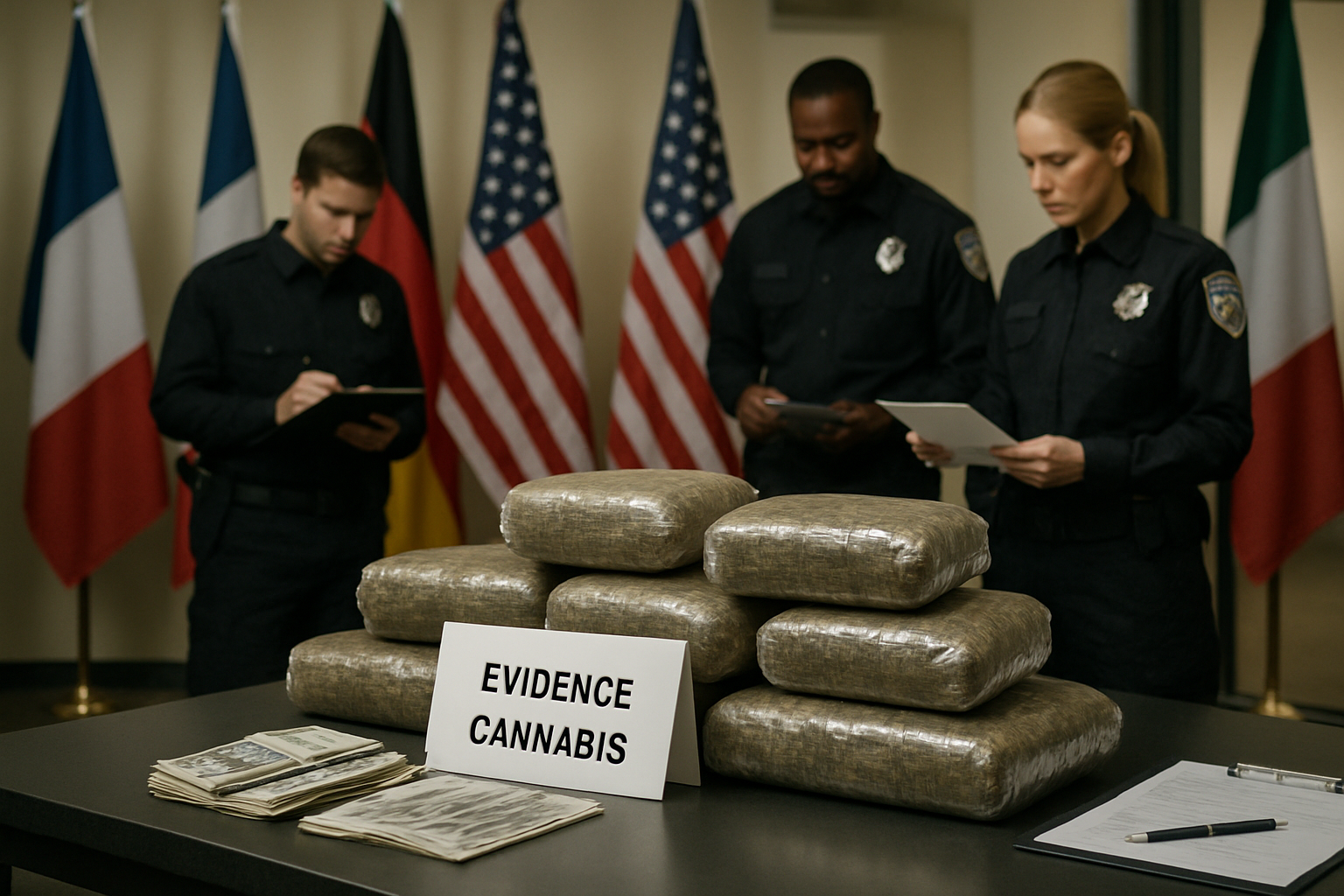
International law enforcement agencies achieved major victories against cannabis trafficking networks on March 25, 2026, with coordinated operations spanning four continents resulting in substantial drug seizures and multiple arrests in the Democratic Republic of Congo, El Salvador, Ireland, and Trinidad and Tobago.
The multi-national operations, conducted simultaneously across different time zones, demonstrate the evolving sophistication of international police cooperation in combating transnational drug trafficking organizations that exploit jurisdictional boundaries and technological loopholes.
Democratic Republic of Congo: Public Cannabis Destruction Raises Environmental Concerns
In the Democratic Republic of Congo's Kasaï-Central province, the National Congolese Police (PNC) conducted a controversial public incineration of seized cannabis at Independence Square in Kananga. The operation, which took place on Tuesday, March 24, involved the destruction of a substantial quantity of marijuana obtained during two separate enforcement actions.
The seized narcotics were initially confiscated during operations at Kananga airport and along the road route leading to Luiza territory, highlighting the strategic importance of transportation hubs in drug trafficking networks. However, the public burning has drawn criticism from environmental groups who denounce the operation as potentially hazardous to public health.
"While authorities present this action as a strong signal against drug trafficking, we must consider the environmental and health implications of such public destruction methods."
— Environmental advocacy groups
El Salvador: Sophisticated Network Dismantled in San Miguel
El Salvador's Security Minister Gustavo Villatoro announced the successful dismantling of a major drug trafficking structure in San Miguel department through coordinated operations by the National Civil Police. The intervention included simultaneous raids at strategic locations targeting criminal networks operating in the country's eastern region.
The operation yielded significant results, with authorities confiscating over 2.5 kilograms of marijuana valued at $8,825, alongside 100 grams of cocaine worth approximately $2,500. Additionally, investigators seized more than $900 in cash, a vehicle, and logistical equipment allegedly used for drug distribution operations.
Three individuals were arrested during the operation: José Geovanny Colato García, Iris Yamileth Gutiérrez de Umaña, and María Maura Pérez Hernández. All suspects have been transferred to judicial authorities for formal proceedings, marking another success in El Salvador's ongoing transformation from one of the world's most violent countries to a regional security model.
Ireland: Marketing Executive Granted Bail After Major Cannabis Seizure
In Ireland, law enforcement made a significant arrest following the seizure of cannabis worth €110,000 at the offices of Bauer Media, which serves as the operational base for prominent radio stations including Newstalk and Today FM. A marketing executive in his 30s was subsequently charged in connection with the substantial drug seizure.
The case has attracted considerable attention due to the high-profile location of the seizure and the professional background of the suspect. The Dublin court granted bail to the accused, allowing the case to proceed through the Irish judicial system while highlighting the reach of drug trafficking into legitimate business environments.
This seizure adds to Ireland's ongoing efforts to combat sophisticated international drug trafficking networks that utilize the country's strategic maritime position as a gateway to European markets.
Trinidad and Tobago: Maritime Smuggling Operation Intercepted
Trinidad and Tobago's Customs and Excise Division achieved a major breakthrough with the arrest and charging of one person following the seizure of a significant marijuana shipment during routine operations at a Port of Spain Customs Bonded Area on Wednesday, March 18, 2026.
Officers from the Preventive Branch conducted a detailed examination of a shipment presented for clearance, during which they discovered four packages containing green plant-like material concealed within the cargo. Field tests confirmed the substance as cannabis, with an estimated street value of $424,490.
The suspect was detained at the scene and subsequently faced formal charges before appearing in a Magistrates' Court. This case underscores the critical role of Caribbean nations as transit points for South American narcotics destined for North American and European markets.
Enhanced International Cooperation Framework
These operations occur within the context of enhanced international cooperation mechanisms established throughout 2026, including the "Shield of the Americas" coalition involving 17 nations across Latin America and the Caribbean, alongside strengthened European law enforcement coordination.
The simultaneous nature of these operations across multiple continents reflects sophisticated intelligence sharing protocols and real-time coordination capabilities that enable law enforcement agencies to strike against criminal networks before they can adapt or relocate their operations.
Intelligence agencies report that modern drug trafficking organizations demonstrate state-like capabilities, employing encrypted communications, compartmentalized international structures, and advanced surveillance systems that often surpass traditional law enforcement resources constrained by jurisdictional boundaries.
Technological Arms Race
Criminal organizations have adapted to digital technologies faster than many law enforcement agencies, utilizing encrypted messaging applications, cryptocurrency transactions, and sophisticated logistics networks that span multiple countries. This technological sophistication requires corresponding advancement in international cooperation mechanisms and shared intelligence systems.
Law enforcement agencies are responding with enhanced digital forensics capabilities, AI-assisted analysis systems, and real-time communication networks that enable rapid coordination across jurisdictions. However, the pace of criminal innovation continues to present persistent challenges requiring sustained investment in technological capabilities and international cooperation frameworks.
Economic Impact and Prevention Strategies
The combined street value of drugs seized in these operations exceeds $1.5 million, representing significant revenue elimination for criminal networks while disrupting supply chains that fuel addiction and violence in communities worldwide.
Beyond enforcement actions, successful approaches increasingly combine enhanced police operations with community engagement programs, educational initiatives addressing underlying recruitment conditions, and economic development opportunities that provide alternatives to criminal activity.
Prevention-focused strategies demonstrate measurable cost reductions through decreased crisis intervention needs, improved educational outcomes, and enhanced workplace productivity in communities where comprehensive approaches address root causes rather than relying solely on reactive enforcement.
Regional Security Implications
These operations highlight the global nature of cannabis trafficking networks that exploit regional vulnerabilities and jurisdictional gaps. The Caribbean region remains particularly critical as a transit point for South American narcotics, while African nations increasingly serve as both source and transit locations for drugs destined for European and North American markets.
European authorities recognize the need for enhanced regulatory harmonization and information sharing protocols, as criminal organizations exploit jurisdictional differences with sophisticated legal and financial resources that challenge traditional enforcement approaches.
"Modern criminal organizations operate without respect for national boundaries, requiring corresponding evolution in our international cooperation mechanisms."
— International law enforcement officials
Future Challenges and Strategic Response
While these enforcement successes demonstrate effective international cooperation, criminal organizations continue to evolve faster than institutional adaptation. Leadership eliminations often result in organizational splintering rather than decreased activity, creating multiple smaller but potentially more violent groups competing for territorial control.
Success in combating sophisticated transnational drug trafficking networks requires sustained political commitment across electoral cycles, adequate specialized resources, and comprehensive strategies that address underlying criminal recruitment conditions including poverty, corruption, weak governance, and limited economic opportunities.
The March 2026 operations represent a critical test of international cooperation mechanisms against criminal organizations with state-like capabilities. Their ultimate success will determine whether democratic institutions can maintain public safety and the rule of law while preserving fundamental rights in an interconnected but fragmented global environment.
As criminal networks continue to demonstrate unprecedented technological sophistication and international reach, law enforcement agencies must balance enhanced security measures with the protection of civil liberties and constitutional principles that define democratic societies.