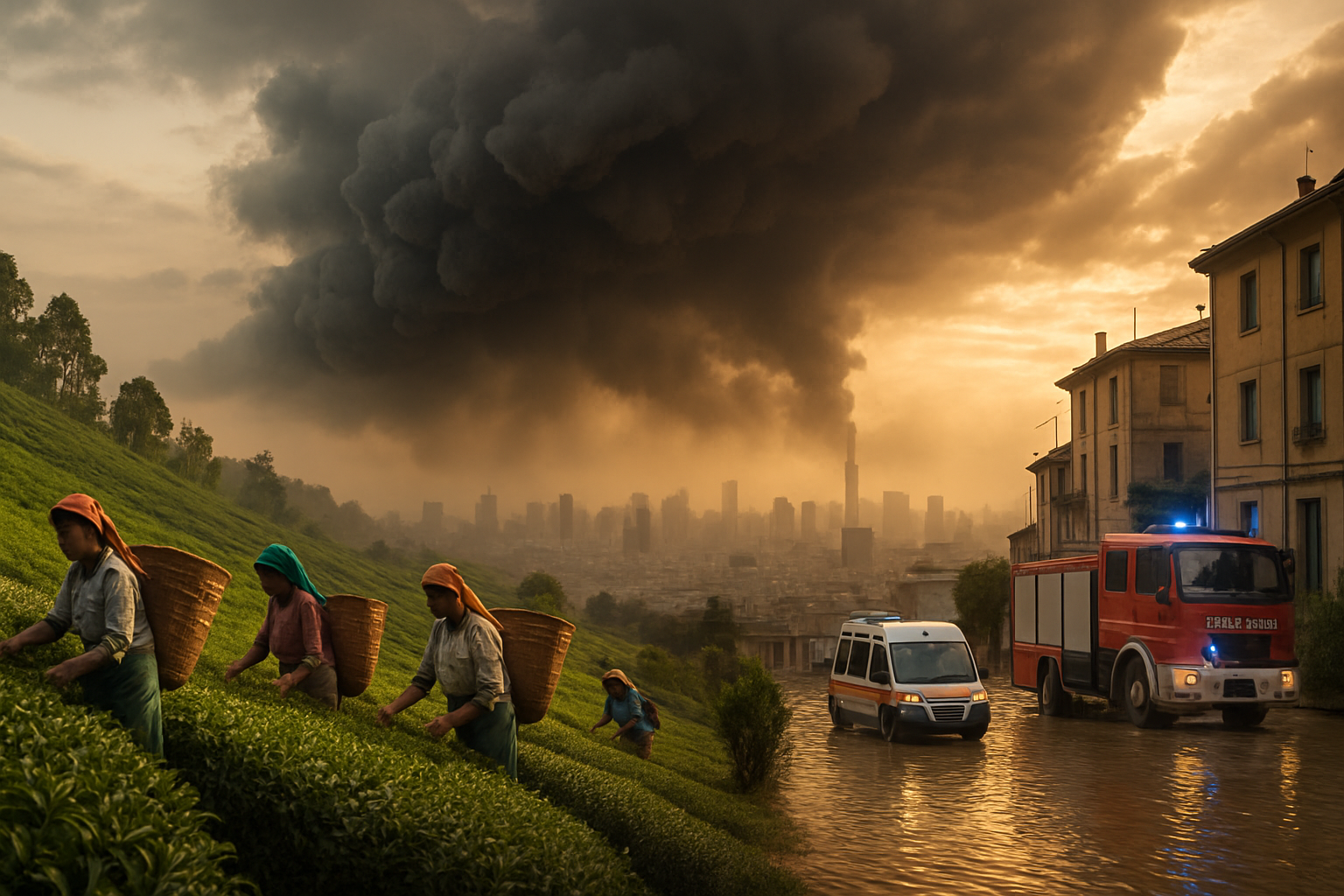
A convergence of environmental catastrophes is devastating communities worldwide as climate change accelerates beyond scientific predictions, with India's prized Darjeeling tea harvest threatened by extreme drought, Northern Thailand choking under record pollution levels, and Italy's southern regions battered by catastrophic flooding.
The crisis unfolds as Earth endures an unprecedented 22nd consecutive month of global temperatures exceeding 1.5°C above pre-industrial levels—the longest sustained warming streak in recorded human history, according to recent climate data analysis.
Darjeeling's Tea Heritage Under Threat
In the Himalayan foothills of West Bengal, India's iconic Darjeeling tea industry faces an existential crisis as an extremely dry winter has severely compromised the quality and quantity of the renowned tea harvest. Estate owners report that the distinctive flavor profile that made Darjeeling tea famous worldwide is at risk as climate change makes weather patterns increasingly erratic.
Tea pickers at the Rohini Tea Estate continue their centuries-old tradition, but their work has become increasingly challenging. Most of the women who pluck tea leaves have grown up watching their parents do the same job, but the next generation shows less interest in continuing the Darjeeling tea tradition amid deteriorating working conditions.
"The weather has become so unpredictable that we can no longer rely on traditional seasonal patterns that have guided tea cultivation for generations."
— Local Estate Manager, Darjeeling region
The drought's impact extends beyond immediate harvest losses. The delicate balance of moisture, temperature, and timing that creates Darjeeling's signature flavor is being disrupted, potentially altering the character of this world-renowned tea permanently.
Thailand's Toxic Air Crisis
Simultaneously, Northern Thailand is experiencing its worst air pollution crisis in decades, with the city of Chiang Mai choking under severe haze that leaves residents with burning, bloodied noses. Pon Doikam, a coconut seller in Chiang Mai, told reporters that the pollution is so severe it's unprecedented even for longtime residents who have witnessed previous pollution episodes.
The dangerous levels of fine particles are linked to serious respiratory diseases and have prompted health warnings across the region. The pollution demonstrates how environmental degradation compounds existing climate challenges, creating compound disasters that overwhelm traditional response capabilities.
Italy's Southern Floods Devastate Communities
Southern Italy faces its own environmental emergency as Pressure System Erminio has brought extreme rainfall, flooding, and landslides to the region. In Apulia, homes have been cut off from the outside world as infrastructure fails under the weight of unprecedented precipitation.
The flooding represents a stark example of how climate change is intensifying weather extremes, with regions experiencing both severe droughts and devastating floods within short timeframes. Emergency response teams and military units have been deployed to assist affected communities, but the scale of the disaster highlights the inadequacy of current infrastructure to handle climate-driven extreme weather.
A Planet in Crisis
These simultaneous environmental disasters occur against the backdrop of accelerating global climate change. January 2026 marked the hottest month on record, extending a warming streak that has now persisted for nearly two years straight. Human-induced climate change is completely overriding natural cooling mechanisms, including La Niña effects that would typically provide some temperature relief.
The World Meteorological Organization has confirmed a 50-60% probability of El Niño development between July and September 2026, which could drive global temperatures to unprecedented levels by combining baseline warming with natural cycle amplification.
Agricultural Systems Under Siege
The convergence of droughts, floods, and extreme weather events is placing unprecedented stress on global agricultural systems. Traditional farming cycles that have sustained civilizations for millennia are becoming unreliable as seasonal patterns shift unpredictably.
From the tea gardens of India to crop failures across multiple continents, farmers are struggling to adapt to conditions that change faster than agricultural systems can evolve. The timing mismatches between traditional planting schedules and actual weather patterns are forcing agricultural communities to operate without the seasonal predictability that has historically guided food production.
Infrastructure Breaking Point
Emergency services across multiple continents are operating at or beyond capacity limits as traditional mutual aid mechanisms prove inadequate for simultaneous disasters. Transportation networks, power grids, and communication systems designed for historical climate patterns are repeatedly failing as extreme weather exceeds operational parameters.
The European Union's Civil Protection Mechanism has been repeatedly activated, with Sweden and Denmark receiving €246 million in assistance—the largest coordinated European disaster response on record. However, even these unprecedented measures are proving insufficient for the scale and simultaneity of current environmental challenges.
The Economic Toll
The economic devastation is mounting across multiple sectors. Agricultural operations face billions in losses as extreme weather destroys crops and disrupts supply chains during critical growing seasons. Tourism industries are experiencing extended cancellations and infrastructure damage during peak revenue periods.
Recovery timelines have fundamentally shifted from weeks to months or years, representing a fundamental change in disaster response planning. The concept of "building back better" with climate-resilient infrastructure has evolved from an optional enhancement to an essential survival strategy.
Mental Health and Community Impact
Beyond the physical and economic toll, mental health services report increased demand for support related to climate anxiety and repeated trauma. Families are facing the prospect of losing generational properties multiple times per decade, while small businesses confront extinction threats from recurring environmental disasters.
Vulnerable populations, including elderly residents and children with respiratory conditions, are disproportionately affected by these compounding environmental stresses.
International Cooperation Under Strain
Environmental challenges transcend political boundaries as atmospheric systems, ocean currents, and climate effects operate regardless of borders. Traditional international aid frameworks, designed to help stable regions assist others during isolated emergencies, are breaking down when multiple continents face simultaneous disasters.
Success in addressing these challenges requires unprecedented cooperation, enhanced multi-sector coordination, and sustained financial commitments that recognize environmental protection as essential infrastructure for human prosperity and planetary sustainability.
A Critical Juncture
March 2026 represents a critical watershed moment for global climate preparedness. The choice between reactive crisis management and transformative infrastructure adaptation has become increasingly urgent as the window for effective climate action narrows rapidly.
Current conditions may be establishing a "new normal" of extreme weather frequency and intensity that will permanently challenge traditional emergency response frameworks. Additional weather systems developing in the Atlantic and Pacific regions suggest this crisis pattern may persist for weeks or months, potentially marking a turning point toward a new baseline of climate volatility.
"The tools, knowledge, and cooperation frameworks exist for comprehensive environmental protection, but success depends on unprecedented speed and coordination through sustained international cooperation."
— Climate Policy Expert
Looking Forward
The convergence of extreme weather events, infrastructure vulnerabilities, and emergency response limitations in early 2026 underscores the urgent need for coordinated international action. The question is no longer whether transformative climate action is needed, but whether humanity can organize and implement solutions rapidly enough to maintain planetary habitability during Earth's most environmentally challenging period in recorded history.
Ecological systems are approaching critical thresholds that could trigger irreversible changes affecting global food security, climate stability, and human settlements. The choices made in the coming months will be potentially decisive for global climate resilience strategies that will affect generations to come.
As communities from India's tea gardens to Thailand's cities and Italy's flood zones grapple with these unprecedented challenges, their experiences provide both warnings and potential solutions for a planet struggling to adapt to the new realities of accelerated climate change.