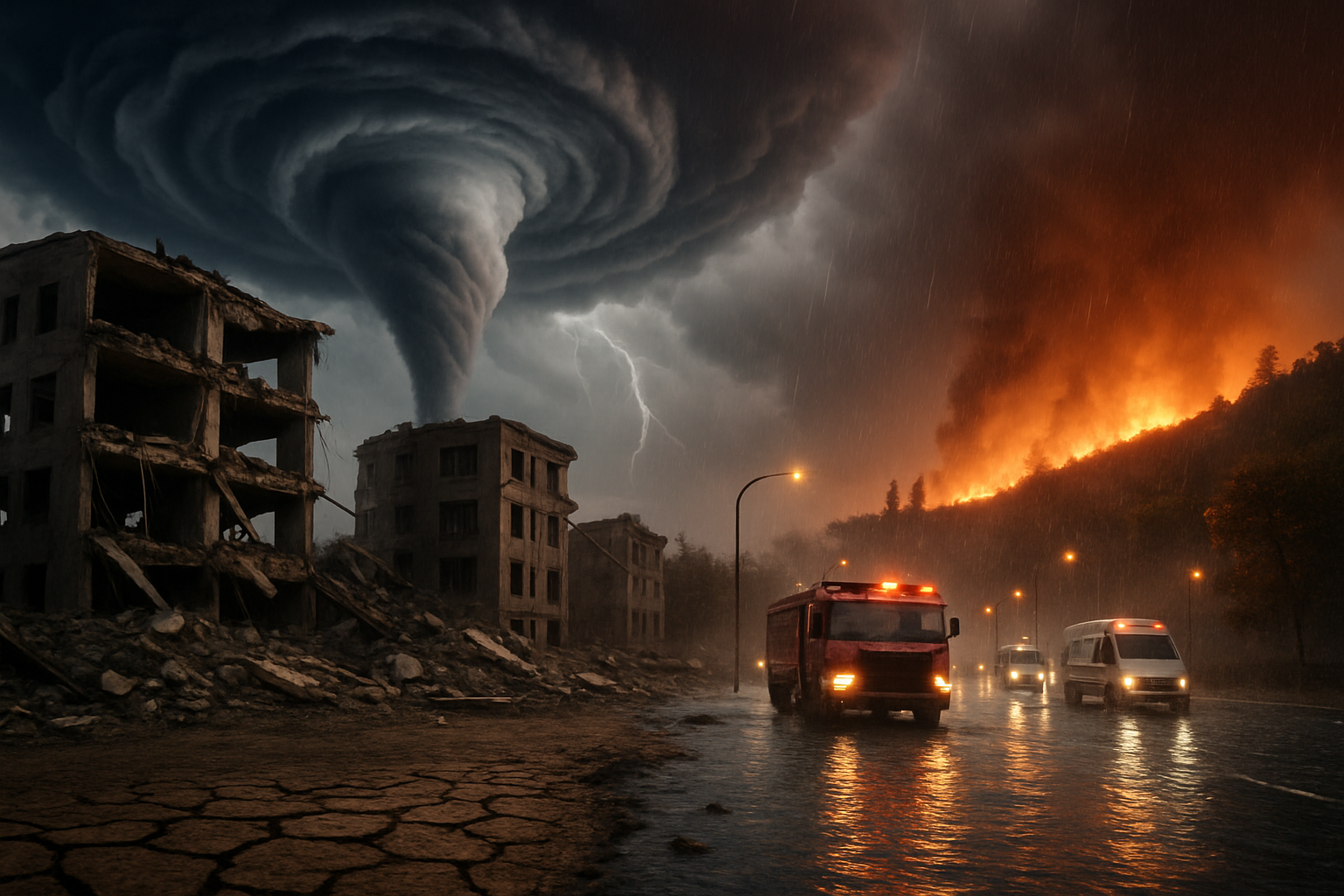
Multiple nations face catastrophic extreme weather disasters as global temperatures potentially enter their 24th consecutive month above critical climate thresholds, marking an unprecedented convergence of environmental crises that is overwhelming international emergency response systems and forcing a fundamental reassessment of climate adaptation strategies.
The latest wave of environmental devastation spans four countries currently battling simultaneous extreme weather events, highlighting what climate scientists describe as the "new normal" of compound disasters that challenge traditional emergency response frameworks designed for sequential rather than concurrent global emergencies.
Colombia Faces Deadly Heatwave Emergency
Colombian meteorological authorities (IDEAM) issued urgent health warnings as extreme temperatures reached 39°C (102°F) in Caribbean coastal regions, with heat sensations climbing even higher due to humidity. The Caribbean departments of Cesar, Atlántico, and Sucre are experiencing what officials describe as dangerous heat levels that severely limit daily activities and pose serious health risks to vulnerable populations.
The Colombian emergency represents the latest manifestation of what researchers now identify as a global pattern affecting over 2.5 billion people worldwide, where extreme heat makes routine outdoor work, basic movement, and essential daily activities dangerous or impossible during peak temperature periods.
New Zealand Braces for Cyclone Vaianu Impact
New Zealand faces an imminent threat as Cyclone Vaianu, a Category 2 tropical cyclone, approaches the North Island with potentially life-threatening conditions. The MetService has issued urgent warnings for Auckland, Hamilton, and Tauranga regions, with particular concern for the flood-saturated Northland area that remains vulnerable after repeated extreme weather events throughout 2026.
The cyclone follows weeks of Tropical Cyclone Maila's devastation across Far North Queensland and represents what emergency management experts now classify as "compound disasters" - multiple emergency types occurring simultaneously across vast geographic areas, fundamentally challenging traditional resource allocation and mutual aid mechanisms.
Sweden Experiences Unprecedented Wildfire Risk
Swedish meteorological services (SMHI) have issued rare April wildfire warnings as unusually dry conditions create extreme fire danger across multiple regions. The warnings represent a concerning departure from traditional seasonal patterns, with conditions typically associated with summer months now appearing months earlier due to altered precipitation patterns and elevated temperatures.
Sweden Also Reports Unusual Seismic Activity
Adding to Sweden's environmental challenges, a magnitude 3.1 earthquake struck south of Lycksele on Saturday, marking what seismologist Björn Lund from Uppsala University describes as "unusually large" seismic activity for the region. "There are typically only one to two earthquakes of this magnitude per year in Sweden," Lund explained, highlighting the rarity of such geological events in the traditionally stable Scandinavian region.
Climate Context: 24th Month of Unprecedented Warming
These simultaneous disasters occur as Earth potentially enters its 24th consecutive month of temperatures exceeding 1.5°C above pre-industrial levels - the longest sustained extreme warming period in recorded human history. January 2026 remains the hottest month ever documented, with human-induced climate change completely overriding natural cooling mechanisms, including La Niña effects that historically provided temperature relief.
The World Meteorological Organization projects a 50-60% probability of El Niño development during July-September 2026, which could drive unprecedented global temperatures by combining baseline warming with natural cycle amplification during an already record-breaking warming streak.
"We're witnessing what climate scientists call the 'climate volatility paradox' - sustained global warming that enables both temperature records and devastating regional extremes through disrupted atmospheric circulation and polar vortex instability."
— Dr. Sarah Chen, European Centre for Medium-Range Weather Forecasts
Emergency Response Systems at Breaking Point
Traditional mutual aid mechanisms designed for sequential regional disasters are proving inadequate for simultaneous multi-continental emergencies. Emergency services across affected regions are operating at or beyond capacity limits, while transportation networks, power grids, and communication systems built for historical climate patterns repeatedly fail when extreme weather exceeds operational parameters.
The EU Civil Protection Mechanism has been repeatedly activated, with the recent €246 million assistance package for Sweden and Denmark representing the largest coordinated European response on record. However, officials acknowledge this response remains insufficient for the scale and simultaneity of current global challenges.
Australian Fire Emergency Services Authority (AFAC) has identified this fundamental shift from isolated regional disasters to "compound disasters," where multiple emergency types occur concurrently, fundamentally challenging resource allocation and traditional emergency response capabilities designed for historical weather patterns.
Infrastructure Crisis: Building Back Better Becomes Essential
The concept of "building back better" with climate-resilient infrastructure has evolved from an optional enhancement to an essential survival strategy. Recovery timelines have permanently shifted from weeks to months or years, representing a fundamental change in disaster response approaches as communities face repeated extreme weather events.
Traditional seasonal patterns that have guided infrastructure design, agricultural planning, and emergency preparedness for centuries are no longer reliable frameworks in this permanent climate volatility era. Current conditions provide a preview of what may become routine in the 2030s without comprehensive climate adaptation investment.
Economic and Social Devastation Mounting
The economic impact spans multiple sectors simultaneously. Agricultural operations face billions in losses from extreme weather destroying crops and disrupting supply chains during critical growing seasons. Tourism industries experience extended cancellations and infrastructure damage during peak revenue periods. Families face the prospect of losing generational properties multiple times per decade, while small businesses confront extinction threats from recurring disruptions.
Mental health services report increased demand for climate anxiety and repeated trauma support. Vulnerable populations, including elderly residents and those with respiratory conditions, require extended support as social services strain under the frequency and intensity of extreme weather events.
International Cooperation Reaches Critical Juncture
Environmental challenges transcend political boundaries through atmospheric systems, ocean currents, and climate effects that operate regardless of borders. The simultaneity of disasters is testing cooperation mechanisms developed under the assumption that stable regions could assist others during isolated emergencies. With multiple continents facing simultaneous disasters, traditional cooperation frameworks require fundamental restructuring.
Successful responses are demonstrating the need for sophisticated integration of cutting-edge technology with traditional ecological knowledge and community-based management. Advanced monitoring through satellite imagery, environmental DNA sampling, and AI-powered analysis must be combined with generations of traditional environmental knowledge to achieve maximum effectiveness.
April 2026: A Watershed Moment for Climate Action
Climate scientists and policy experts identify April 2026 as a potential watershed moment for global climate preparedness, representing a critical choice between reactive crisis management and transformative infrastructure adaptation. The window for effective climate action is narrowing as ecological systems approach critical thresholds that could trigger irreversible changes affecting global food security, climate stability, and human settlements.
Additional weather systems developing across Atlantic and Pacific regions suggest that current crisis conditions may persist for weeks or months, potentially establishing a "new normal" characterized by extreme weather frequency and intensity that permanently challenges traditional emergency response frameworks.
"The tools, knowledge, and cooperation frameworks exist for comprehensive environmental protection, but success depends on unprecedented speed of coordination and sustained international cooperation with political commitment recognizing environmental protection as essential infrastructure for human prosperity and planetary sustainability."
— Environmental Policy Expert, Emergency Response Analysis
Technology and Traditional Knowledge Integration
Successful adaptation strategies are emerging from hybrid approaches that integrate traditional knowledge with modern technology. Estonia's combination of agricultural wisdom with advanced climate monitoring, Australia's integration of Indigenous fire management with sophisticated meteorological forecasting, and Finland's "transformative adaptation" moving beyond reactive emergency response to proactive systems for permanent climate volatility demonstrate pathways forward.
These models offer resilience through multiple adaptation pathways for complex, interconnected environmental challenges, providing templates that could be scaled globally while respecting cultural diversity and leveraging technological capabilities.
The Decisive Climate Action Decade
The convergence of extreme weather events across continents during April 2026 represents a critical test of humanity's adaptive capacity to protect essential environmental systems during Earth's most challenging environmental period in recorded history. The question is no longer whether transformative action is needed, but whether humanity can organize and implement solutions rapidly enough to maintain planetary habitability.
Current developments are potentially decisive for environmental protection approaches in the decades ahead, influencing biodiversity protection, climate adaptation, and sustainable development strategies that will affect generations. The choices made in the coming months regarding climate resilience strategies, infrastructure investment, and international cooperation may prove decisive for global environmental protection during what experts describe as the decisive climate action decade.
As extreme weather events continue to converge across continents with unprecedented frequency and intensity, the international community faces an urgent imperative to fundamentally restructure emergency response systems, accelerate climate adaptation investments, and forge new cooperation frameworks capable of addressing the interconnected environmental challenges that define our rapidly changing planet.