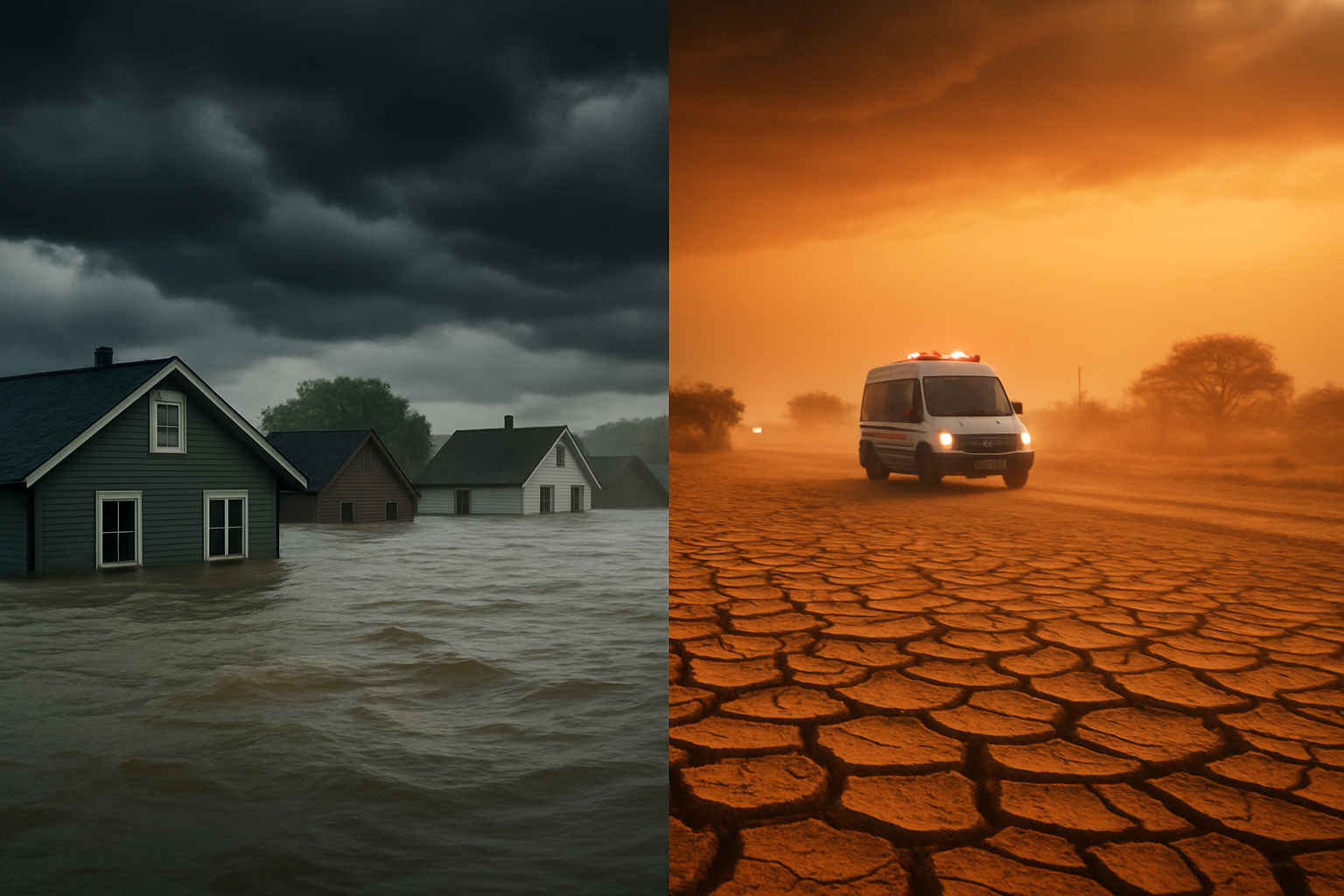
The global climate crisis has reached a critical breaking point as extreme weather events devastate communities across four continents simultaneously, marking the 20th consecutive month that temperatures have exceeded the crucial 1.5°C pre-industrial threshold—the longest sustained warming period in recorded human history.
From deadly flooding claiming two children's lives in Papua New Guinea's Bogia district to dangerous heat waves reaching 45°C in Burkina Faso, emergency services worldwide are operating beyond their designed capacity limits while grappling with an unprecedented convergence of environmental disasters.
Australia Faces Relentless Flooding Crisis
Australia continues to battle severe weather conditions as the wet autumn season shows no signs of abating. Multiple states remain under flood warnings, with Queensland experiencing particularly devastating impacts. The Bureau of Meteorology has warned that March will bring more rain across large parts of the country, extending what has already become a catastrophic start to the autumn season.
Emergency services are managing simultaneous bushfire risks and major flooding across vast geographical areas, demonstrating what experts now term "compound disasters"—where multiple emergency types occur concurrently rather than sequentially. This fundamental shift is straining traditional mutual aid mechanisms that historically relied on resource sharing between unaffected regions.
"We're seeing a shift from isolated regional disasters to multiple simultaneous incidents across different specialties. Our traditional response frameworks weren't designed for this level of concurrent emergency management."
— Australian Fire and Emergency Services Authority (AFAC)
West Africa Braces for Extreme Heat
In Burkina Faso, the National Meteorological Agency (ANAM) has organized emergency preparedness workshops in anticipation of dangerous heat waves expected to reach up to 45°C between March and May 2026. Working alongside the Burkina Faso Red Cross, meteorologists are developing prevention strategies to protect vulnerable populations from what could become life-threatening temperature extremes.
The workshops focus on three critical areas: presenting seasonal temperature forecasts, developing community-based advice for extreme heat situations, and conducting emergency response simulations. This proactive approach represents a shift from reactive crisis management to preventive community protection strategies.
Pacific Island Nations Face Mounting Pressures
Papua New Guinea is experiencing the tragic human cost of climate volatility, with recent flooding in the Bogia district claiming two children's lives and destroying 43 homes. The devastating impact highlights the particular vulnerability of Pacific Island communities to extreme weather events, where limited infrastructure and geographic isolation compound the challenges of emergency response and recovery.
Meanwhile, New Zealand's MetService has warned of potential thunderstorms as complex weather systems converge across the country, adding to the region's ongoing meteorological instability. The nation's position in the Pacific makes it particularly susceptible to rapidly changing weather patterns driven by altered ocean currents and atmospheric circulation.
Climate Science Confirms Unprecedented Warming
The World Meteorological Organization has confirmed that January 2026 marked the 20th consecutive month of global temperatures exceeding 1.5°C above pre-industrial levels—a milestone that represents the longest sustained extreme warming period in recorded human history. This sustained warming is now fundamentally overriding natural climate variability, including the cooling effects typically associated with La Niña conditions.
Scientists warn of a 50-60% probability of El Niño development during July-September 2026, which could drive global temperatures into unprecedented territory by combining baseline warming with natural cycle amplification. This "climate volatility paradox" enables simultaneous global heat records and devastating regional extreme weather through disrupted atmospheric circulation and polar vortex patterns.
Infrastructure Systems Breaking Down
Emergency services across multiple continents report operating at or beyond capacity limits as traditional mutual aid mechanisms designed for sequential disasters prove inadequate for simultaneous global emergencies. Transportation networks, power grids, and communication systems built for historical climate patterns are repeatedly failing as extreme weather events exceed their operational parameters.
The European Union's Civil Protection Mechanism has been activated repeatedly throughout early 2026, with Sweden and Denmark providing €246 million in assistance—representing the largest coordinated European weather response on record. However, even these enhanced cooperation frameworks struggle when multiple regions face disasters simultaneously, preventing the regional compensation that traditionally manages localized emergencies.
Economic and Social Devastation Mounts
The economic implications extend far beyond immediate emergency response costs. Agricultural sectors are experiencing mounting losses as extreme weather destroys crops and disrupts supply chains during critical growing seasons. Tourism industries face extended cancellations and infrastructure damage, while families across affected regions are losing generational homes and businesses face potential extinction.
Mental health services report increased demand as communities struggle with repeated climate-related trauma. Recovery timelines have shifted from the traditional weeks to months or even years, representing a fundamental change in how societies must approach disaster response and preparation.
The Need for Transformative Adaptation
Climate scientists and emergency management experts emphasize that current conditions provide a preview of routine 2030s circumstances without immediate and comprehensive climate adaptation investment. The choice between reactive crisis management and proactive climate resilience building has become increasingly critical as extreme weather events test human adaptive capacity beyond traditional limits.
"Building back better" with climate-resilient infrastructure has evolved from an optional enhancement to an essential survival strategy for communities facing repeated extreme weather events. Traditional seasonal patterns that guided infrastructure design, agricultural planning, and emergency preparedness for centuries are no longer reliable frameworks for the future.
International Cooperation at the Breaking Point
Environmental challenges transcend political boundaries as atmospheric systems, ocean currents, and climate effects operate regardless of national borders. Traditional disaster response frameworks that assume some regions will remain stable enough to assist others during emergencies are breaking down when multiple continents face simultaneous crises.
Success in addressing the accelerating climate crisis requires unprecedented international cooperation, enhanced multi-sector coordination, and financial commitments that recognize environmental protection as essential infrastructure for human prosperity and planetary sustainability. The window for effective climate action continues to narrow as ecological systems approach critical thresholds that could trigger irreversible changes affecting global food security, climate stability, and human settlement patterns.
A Decisive Moment for Humanity
March 2026 represents a watershed moment in global climate preparedness—the convergence of extreme weather events, infrastructure vulnerabilities, and emergency response limitations underscores the urgent need for coordinated international action. The choices made in the coming months may prove decisive for global climate resilience strategies that will affect generations to come.
The tools, knowledge, and cooperation frameworks exist for comprehensive environmental protection, but success depends on achieving unprecedented speed and coordination through sustained international cooperation, enhanced political commitment, and recognition that environmental protection is essential infrastructure for both human prosperity and planetary sustainability.
As weather systems continue developing across multiple ocean basins and authorities maintain high alert status globally, the current crisis may establish a "new normal" characterized by extreme weather frequency and intensity that permanently challenges traditional emergency response frameworks. The question is no longer whether transformative climate action is needed, but whether humanity can organize and implement solutions rapidly enough to maintain planetary habitability during Earth's most environmentally challenging period in recorded history.