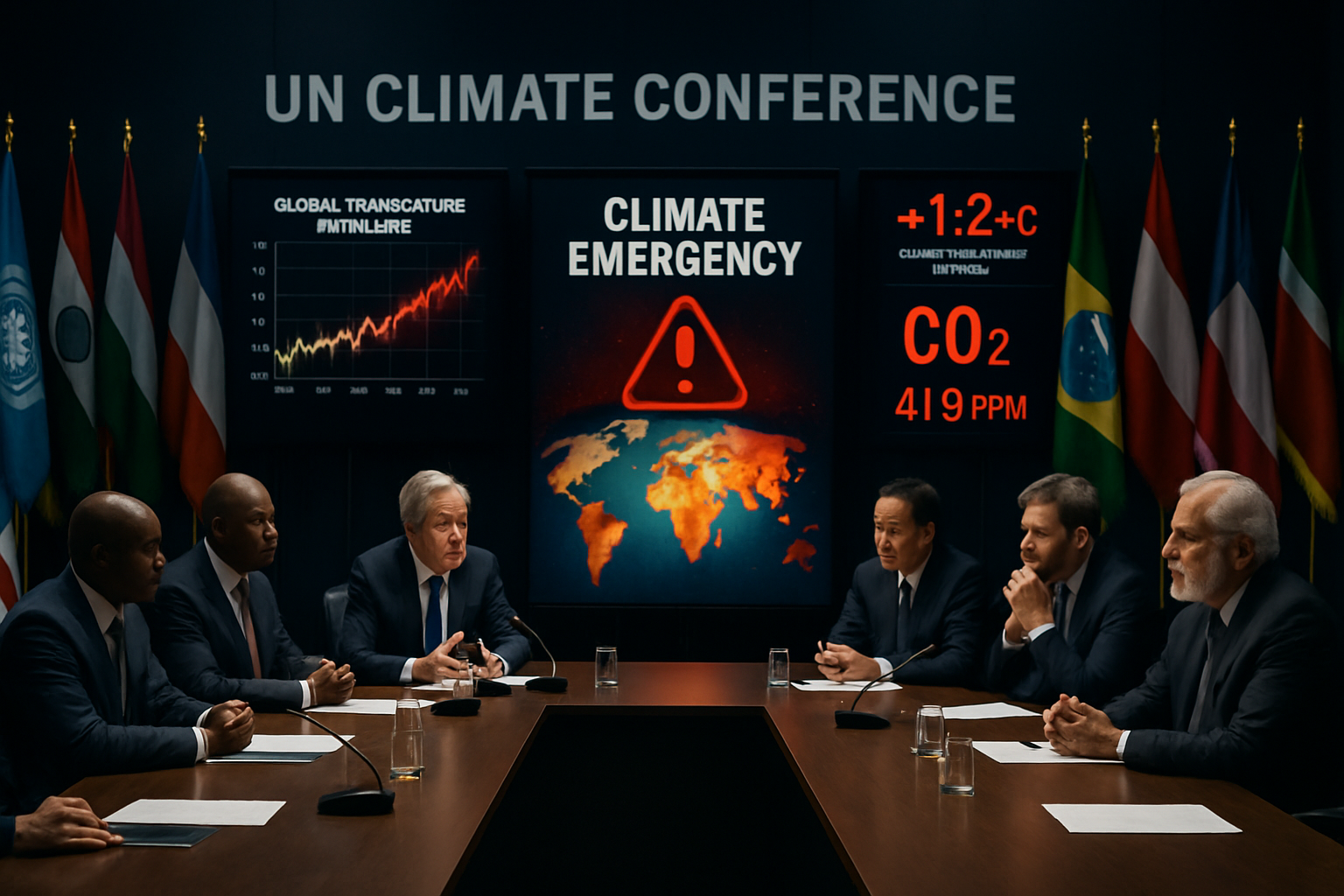
The United Nations has declared a global climate emergency as Earth enters its most critical environmental phase in recorded human history, with the World Meteorological Organization confirming 22 consecutive months of temperatures exceeding 1.5°C above pre-industrial levels—the longest sustained extreme warming streak ever documented.
UN Secretary-General António Guterres warned that "the global climate is in a state of emergency" as the WMO released its landmark annual report revealing that the planet is being "pushed beyond its limits." The assessment comes as simultaneous environmental crises converge across continents, overwhelming international emergency response systems designed for sequential rather than concurrent disasters.
Unprecedented Temperature Records Signal Climate System Breakdown
The WMO's first-ever measurement of Earth's energy imbalance reveals dangerous heat accumulation as greenhouse gases reduce the planet's ability to release energy to space. The decade 2015-2025 now ranks as the hottest ever recorded, with 2025 achieving an average temperature of 1.43°C above the 1850-1900 baseline.
January 2026 stands as the hottest month in recorded human history, extending a warming streak that has completely overridden natural climate variability, including La Niña cooling effects that typically moderate global temperatures. Climate scientists report that human-induced warming has fundamentally altered atmospheric systems beyond natural recovery mechanisms.
"Every key climate indicator is flashing red. The Earth is being pushed beyond its limits."
— António Guterres, UN Secretary-General
The "climate volatility paradox" now enables simultaneous global heat records and devastating regional extremes through disrupted polar vortex patterns and altered Atlantic circulation. The WMO projects a 50-60% probability of El Niño development during July-September 2026, potentially driving unprecedented temperatures by combining baseline warming with natural cycle amplification.
Marine Ecosystems Face Catastrophic Collapse
Research analyzing 33,990 fish populations reveals that marine ecosystems are experiencing unprecedented collapse, with a 7.2% decline in fish populations for every 0.1°C of ocean warming. This translates to a 20% annual biomass reduction across the Mediterranean, North Atlantic, and Northeast Pacific regions between 1993-2021.
Antarctic ice loss equivalent to the area of Vienna occurs annually, with total ice retreat of 12,820 square kilometers since 1996. The accelerating loss of critical frozen water reserves contributes significantly to global sea level rise, affecting coastal communities worldwide.
Ocean warming is particularly threatening as CO2 concentrations have reached their highest levels in over 2 million years, creating compound environmental effects that traditional conservation approaches struggle to address.
Migratory Species in Unprecedented Decline
A UN summit on migratory species opened in Brazil amid alarming warnings that nearly half of all migratory species are in decline. Scientists report that the long journeys of whales, fish, birds, and other animals are being severely disrupted by climate change and human activity, creating risks for entire ecosystems, food supplies, and coastal economies.
Traditional migration routes developed over millennia are experiencing fundamental disruption as changing precipitation patterns, temperature extremes, and extreme weather frequency affect species across diverse ecosystems. The timing mismatches between dependent species create potential cascade effects throughout forest and wetland ecosystems.
In Finland, unprecedented biological disruption has been recorded with the earliest tick season in history extending to northern Oulu regions typically unaffected until summer. Wildlife responses are occurring weeks or months ahead of traditional timing, with migratory birds arriving in early March versus the typical late April-May schedule.
Emergency Response Systems Overwhelmed Globally
Traditional mutual aid mechanisms designed for sequential regional disasters are proving inadequate for multiple continents facing simultaneous extreme weather events. The EU Civil Protection repeatedly activated emergency protocols, with Sweden-Denmark receiving €246 million in assistance—the largest coordinated European response on record—yet insufficient for the scale and simultaneity of current challenges.
Emergency services are operating at or beyond capacity limits globally as transportation networks, power grids, and communication systems designed for historical climate patterns repeatedly fail when extreme weather exceeds operational parameters. The Australian Fire Emergency Services Authority has identified a shift from isolated disasters to "compound disasters"—multiple emergency types occurring concurrently, fundamentally challenging traditional resource allocation.
Recovery timelines have shifted from weeks to months or years, fundamentally altering disaster response approaches. "Building back better" with climate-resilient infrastructure has evolved from an optional enhancement to an essential survival strategy for communities facing repeated extreme weather events.
Economic and Social Devastation Mounting
Agricultural operations face mounting billions in losses as extreme weather destroys crops and disrupts supply chains during critical growing seasons. Traditional planting and harvesting schedules no longer align with actual weather patterns, forcing farmers to operate without the seasonal predictability that has historically guided food production.
Tourism industries experience extended cancellations and infrastructure damage during peak seasons, while families face losing generational homes and businesses confront extinction threats. Mental health services report increased demand for climate anxiety and repeated trauma support, as vulnerable populations are disproportionately affected.
The economic multiplier effects extend beyond direct environmental sectors, with ecosystem service valuation revealing that intact natural systems often provide economic benefits exceeding resource extraction profits. Wetlands prevent billions in flood damage, forests regulate water and climate patterns, and biodiversity hotspots support pharmaceutical research and eco-tourism worth hundreds of billions annually.
International Cooperation at Breaking Point
Environmental challenges increasingly transcend political boundaries as atmospheric systems, ocean currents, and species migrations connect ecosystems globally, making unilateral adaptation efforts insufficient. The simultaneity of disasters is testing cooperation mechanisms developed under the assumption that stable regions could assist others during isolated emergencies.
Traditional North-South aid frameworks are evolving toward peer-to-peer cooperation as developing nations emerge as environmental solution providers. However, funding sustainability remains difficult for developing nations where immediate economic pressures often override long-term environmental considerations.
Success factors consistently include community ownership and engagement, transparent governance frameworks, economic incentives that make protection financially viable, and integration of traditional ecological knowledge with modern conservation science.
Technology and Traditional Knowledge Integration
The most successful environmental responses demonstrate sophisticated synthesis of cutting-edge technology with traditional ecological knowledge and community-based management. Advanced monitoring systems including satellite imagery, environmental DNA sampling, and AI-powered analysis provide unprecedented capabilities for species tracking, habitat assessment, and threat detection.
Maximum effectiveness is achieved by combining generations of traditional knowledge with community stewardship practices. Examples include Estonian agricultural wisdom enhanced by climate monitoring, Australian Indigenous fire management integrated with advanced meteorological forecasting, and Finnish transformative adaptation creating proactive systems for permanent climate volatility.
Critical Action Window Rapidly Narrowing
March 2026 represents a watershed moment in global climate preparedness, presenting a choice between reactive crisis management and transformative infrastructure adaptation. Current conditions provide a preview of routine circumstances expected in the 2030s without immediate comprehensive climate adaptation investment.
The environmental action window is rapidly narrowing as ecological systems approach critical thresholds that could trigger irreversible changes affecting global food security, climate stability, and human settlements. Tools, knowledge, and cooperation frameworks exist for comprehensive environmental protection, but success depends on unprecedented speed of coordination and sustained international cooperation.
Additional weather systems developing in Atlantic and Pacific regions have authorities on high alert globally, with conditions potentially persisting for weeks, establishing a "new normal" characterized by extreme weather frequency and intensity that permanently challenges traditional emergency response frameworks.
Strategic Significance for Humanity's Future
The convergence of extreme weather events, infrastructure vulnerabilities, and emergency response limitations underscores the urgent need for coordinated international action. The question is no longer whether transformative climate action is needed, but whether humanity can organize and implement solutions rapidly enough to maintain planetary habitability during Earth's most environmentally challenging period in recorded history.
Environmental protection must be recognized as essential infrastructure for human prosperity and planetary sustainability. Success requires enhanced multi-sector coordination, increased financial commitments, and sustained political commitment that transcends electoral cycles.
The choices made in the coming months will be potentially decisive for global climate resilience strategies affecting generations. The integration of cutting-edge technology with traditional ecological wisdom offers pathways for maintaining planetary habitability, but the window for effective action continues to narrow as ecological systems approach critical thresholds.
"We are in a phase critical to our planet's climate history. The tools and knowledge exist for comprehensive environmental protection, but we need unprecedented speed and coordination in our response."
— Dr. Petteri Taalas, WMO Secretary-General
March 2026 may prove to be a decisive moment determining whether conservation efforts can keep pace with accelerating environmental change during this critical climate action decade. The convergence of innovation, cooperation, and political commitment offers hope for maintaining planetary habitability, but immediate action is essential to address the climate emergency before irreversible tipping points are reached.