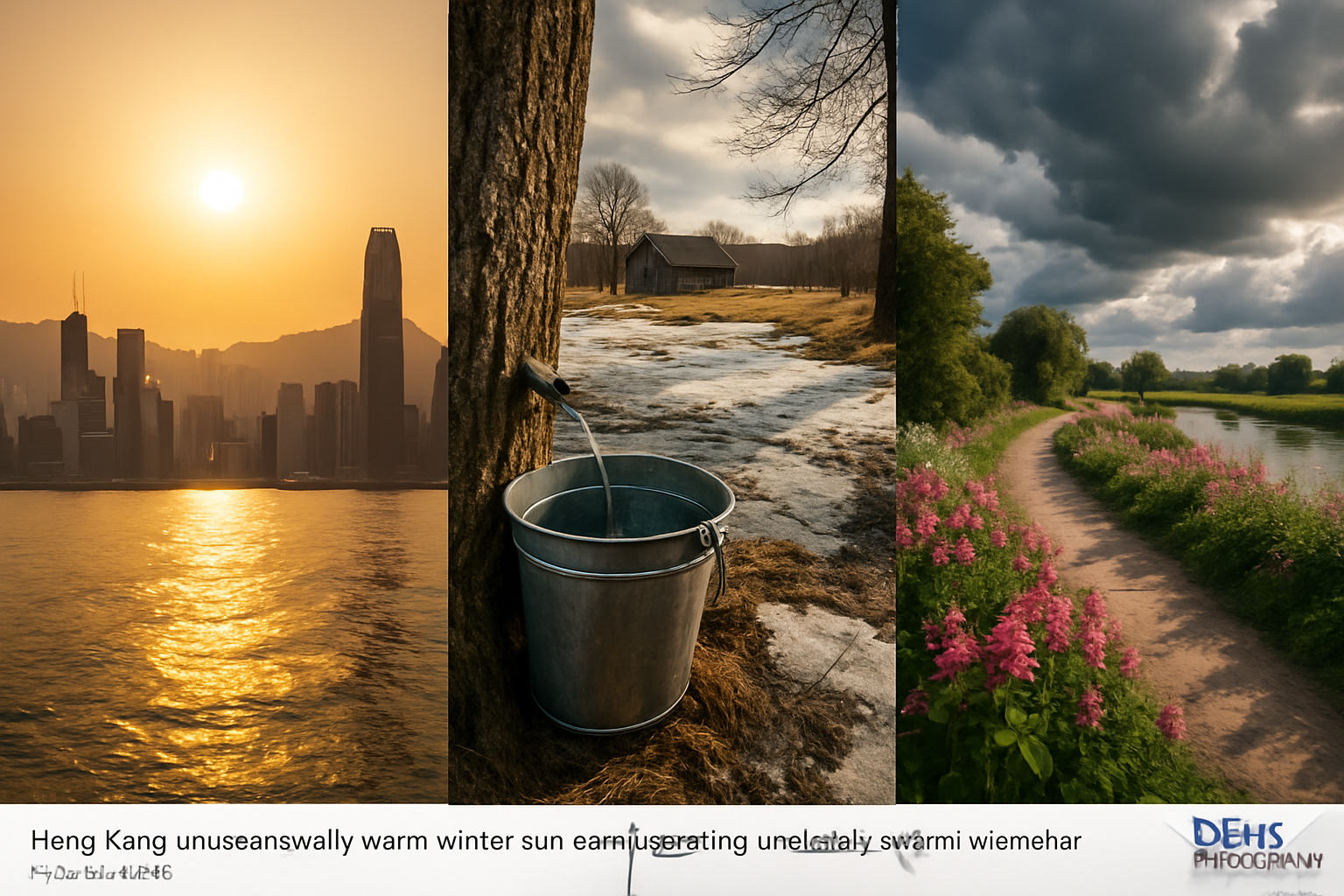
Unprecedented weather patterns are emerging across the globe as Hong Kong records its warmest winter in history, Estonia experiences an unusually early spring with maple sap season beginning ahead of schedule, and the Netherlands marks its hottest March 2nd since measurements began—all during what scientists confirm as the 19th consecutive month of global temperatures exceeding 1.5°C above pre-industrial levels.
The convergence of these remarkable meteorological events across three continents represents more than isolated regional anomalies. Climate scientists are increasingly viewing these simultaneous departures from seasonal norms as evidence of accelerating climate system disruption, with traditional weather patterns giving way to what researchers describe as "climate volatility" on a global scale.
Hong Kong Breaks Winter Temperature Records
Hong Kong's Observatory announced that the city experienced its warmest winter on record between December 2025 and February 2026, with mean temperatures reaching 19.3 degrees Celsius (67 Fahrenheit)—a full two degrees above normal levels. The unseasonably warm February proved particularly striking, averaging 20.1 degrees Celsius, three degrees above historical norms.
According to the Hong Kong Observatory, the record-breaking warmth resulted from a weaker-than-normal northeast monsoon over southern China throughout most of February. This atmospheric pattern disruption reflects broader changes in regional circulation systems that meteorologists are linking to global climate change acceleration.
"Together with the well-above-normal temperatures throughout the winter season, this represents a fundamental shift in our regional climate patterns."
— Hong Kong Observatory, February 2026
The temperature anomaly in Hong Kong aligns with broader Asian climate trends, where winter seasons are becoming increasingly unpredictable. The implications extend beyond mere comfort levels, affecting everything from energy consumption patterns to agricultural planning and public health preparations.
Estonia's Premature Spring Signals Ecosystem Changes
Meanwhile, in Estonia, signs of spring are appearing weeks ahead of schedule as the recent thaw creates conditions that market gardeners in central Estonia describe as unprecedented for early March. The country's maple sap season has begun following the first above-freezing temperatures, with observers noting that both maple sap flow and insect activity have commenced simultaneously—a convergence that typically occurs over a more extended timeline.
Estonian meteorologists report that a prolonged cold spell came to an abrupt end, setting both natural systems and human activities in motion earlier than historical patterns would predict. The premature arrival of migratory birds, including cranes, further underscores the ecosystem-wide nature of these seasonal shifts.
Market gardeners across central Estonia report soil conditions and temperature patterns that normally wouldn't occur until late March or early April. This acceleration of spring conditions has significant implications for agricultural planning, with farmers needing to adjust planting schedules and crop selection strategies to accommodate the changing seasonal timeline.
Netherlands Records Historic March Temperature
The Netherlands added its own meteorological milestone to this global pattern when March 2nd became officially the warmest such date ever measured in the country's recorded history. Dutch meteorological services confirmed that temperatures across the nation far exceeded historical averages for early March, continuing a pattern of temperature anomalies that have characterized the 2025-2026 winter season.
The record-breaking warmth in the Netherlands comes as the country joins a broader European pattern of temperature extremes. Weather forecasters indicate that more record-breaking conditions may be on the horizon as the traditional spring season approaches, with warming trends showing no signs of moderation.
Global Climate Context: 19 Months Above Critical Thresholds
These regional weather anomalies occur within a broader context of unprecedented global warming. January 2026 has been confirmed as the hottest month in recorded human history, extending an extraordinary streak of 19 consecutive months in which global temperatures have exceeded 1.5°C above pre-industrial levels.
According to NOAA analysis, there is now a 50-60% probability of El Niño development during the July-September period, which could potentially drive global temperatures to even more extreme levels. This potential El Niño formation, occurring on top of an already overheated climate system, represents what scientists describe as "compound climate effects" that could trigger cascading environmental impacts worldwide.
"Human-induced climate change is now overriding natural climate variability, including La Niña cooling effects that would typically moderate global temperatures. We're witnessing climate patterns that exceed our historical forecasting experience."
— NOAA Climate Analysis, March 2026
The sustained warming trend demonstrates that human-induced climate change has fundamentally altered Earth's atmospheric systems beyond natural recovery mechanisms. Traditional seasonal patterns that civilizations have depended upon for millennia are shifting in ways that challenge both natural ecosystems and human adaptation strategies.
Interconnected Environmental Systems Under Stress
Climate researchers emphasize that these simultaneous weather anomalies across Hong Kong, Estonia, and the Netherlands are not isolated events but manifestations of interconnected global environmental systems experiencing unprecedented stress. Atmospheric circulation patterns, ocean currents, and seasonal weather systems are all responding to the sustained global temperature elevation in ways that create regional anomalies thousands of miles apart.
The University of Turku in Finland has initiated regular pollen bulletins in response to increased long-distance allergen transport from altered global atmospheric circulation patterns. This seemingly minor development illustrates how climate change creates cascading effects that touch every aspect of environmental and human health systems.
Iceland's meteorological services report extreme storm conditions affecting eastern regions, while New Zealand faces dual phenomena—the year's only lunar eclipse occurring amid ongoing extreme weather challenges. These diverse manifestations across different hemispheres demonstrate what scientists describe as "multiple scales of environmental change" occurring simultaneously.
Economic and Social Implications
The economic implications of these unusual weather patterns extend far beyond the immediate impacts on tourism and agriculture. Early spring conditions in Estonia affect everything from energy consumption to transportation planning, while Hong Kong's record warmth influences regional trade patterns and urban planning strategies.
Agricultural sectors worldwide are reporting the need for fundamental adaptations to crop scheduling, irrigation planning, and pest management as traditional seasonal patterns become increasingly unreliable. The Netherlands' record March temperatures, combined with similar patterns across Europe, are forcing farmers to reconsider crop varieties and planting strategies that have been reliable for generations.
Tourism industries, particularly those dependent on seasonal weather patterns, face increasing uncertainty as traditional climatic expectations no longer provide reliable planning frameworks. Winter sports regions, coastal tourism areas, and agricultural tourism operations all report the need for enhanced flexibility and adaptive management strategies.
Scientific Monitoring and Prediction Challenges
The unprecedented nature of current climate conditions is creating significant challenges for weather forecasting and climate prediction systems. NOAA and the World Meteorological Organization are coordinating global monitoring efforts, but the rapid complexity of climate system changes is outpacing the prediction capabilities required by emergency planners and policymakers.
Traditional meteorological models, based on historical climate patterns, are increasingly inadequate for predicting weather systems operating in conditions that exceed historical experience. This limitation has profound implications for everything from agricultural planning to emergency preparedness and infrastructure design.
Community Resilience and Adaptation Innovations
Despite the challenges posed by these unusual weather patterns, communities across affected regions are developing innovative adaptation approaches that integrate traditional knowledge with modern scientific understanding. Iceland's emergency protocols and Finland's enhanced environmental monitoring systems provide templates for broader climate adaptation applications.
Local responses are increasingly combining traditional ecological knowledge with cutting-edge technology to create hybrid adaptation strategies. Estonian farmers are integrating centuries of agricultural wisdom with modern climate monitoring, while Hong Kong urban planners are incorporating traditional cooling strategies with contemporary sustainable building techniques.
International Cooperation and Response
The global nature of these weather pattern changes is highlighting the need for unprecedented international cooperation in climate monitoring, prediction, and adaptation. The EU Civil Protection Mechanism has been repeatedly activated, with initiatives like the Sweden-Denmark €246M weather assistance program representing new models of coordinated climate response.
However, traditional mutual aid mechanisms designed for sequential regional disasters are proving inadequate when multiple regions face simultaneous climate challenges. This limitation is forcing a fundamental reconsideration of international cooperation frameworks for climate emergency response.
Looking Ahead: The New Climate Reality
Scientists warn that the conditions observed in March 2026 may represent a preview of routine climate patterns for the 2030s without immediate and comprehensive climate action. The choice between reactive crisis management and proactive climate adaptation is becoming increasingly critical as the window for effective climate action continues to narrow.
The convergence of unusual weather patterns across Hong Kong, Estonia, the Netherlands, and dozens of other regions worldwide represents what researchers describe as a potential "turning point" in global climate response. The effectiveness of international cooperation mechanisms, adaptation strategies, and emergency response capabilities will likely determine whether these patterns become manageable challenges or overwhelming crises.
"March 2026 represents a critical juncture in global climate response. The choices made in the coming months will potentially be decisive for global climate stability trajectory for decades ahead."
— International Climate Research Consortium, March 2026
As communities worldwide grapple with weather patterns that exceed historical experience, the need for adaptive infrastructure, enhanced international cooperation, and proactive climate resilience building has never been more urgent. The unusual weather patterns of early 2026 serve as a clear indicator that climate change has moved from future projection to present reality, requiring immediate and coordinated global response.
The simultaneous occurrence of record-breaking temperatures across multiple continents, combined with the disruption of traditional seasonal patterns, underscores that climate change adaptation must shift from treating extreme weather as exceptional events to designing systems for permanent climate volatility. The window for effective climate action is narrowing rapidly, but the diverse experiences across the globe provide both urgent warnings and potential pathways for building climate resilience at the speed and scale required by our rapidly changing planet.