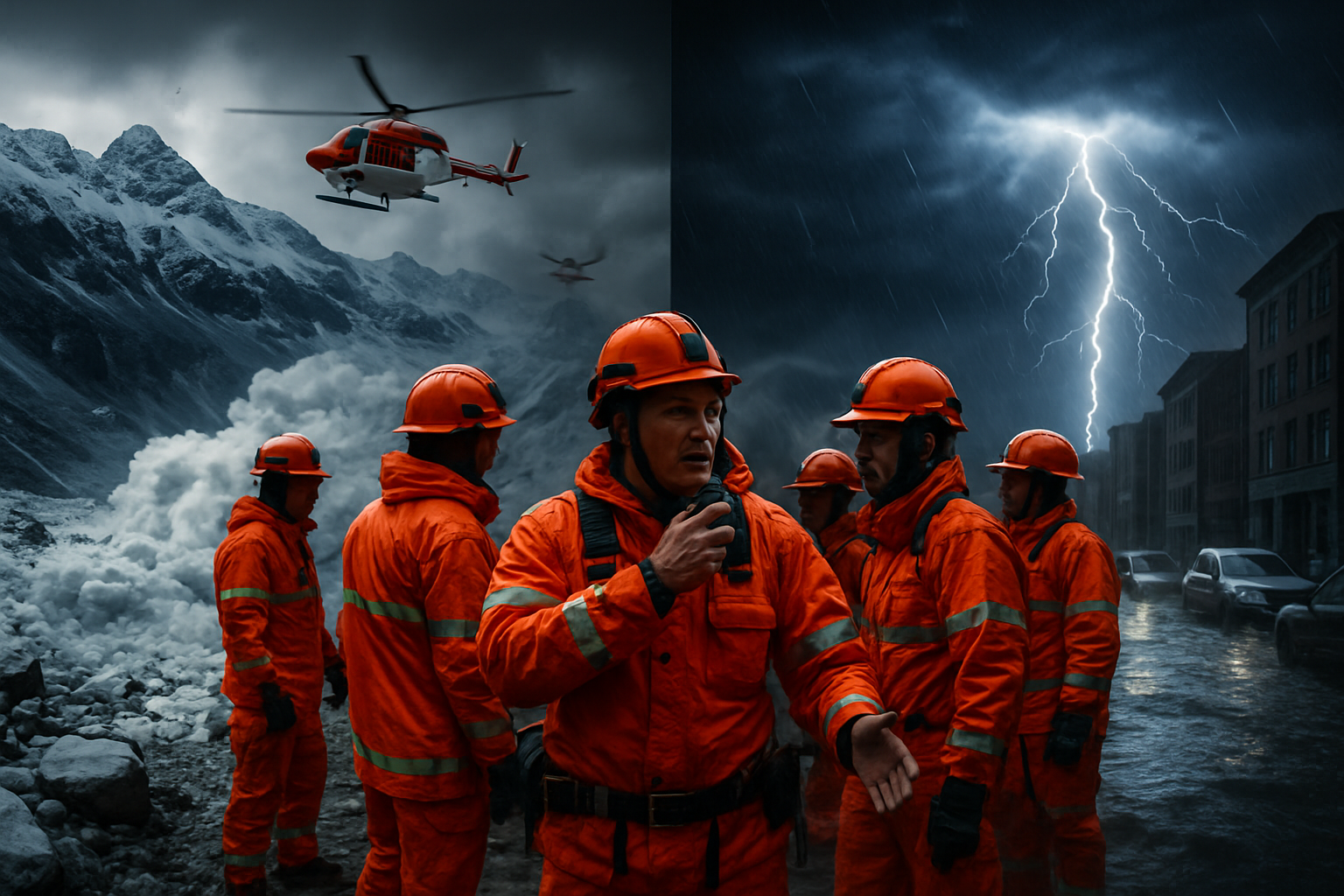
A devastating convergence of extreme weather disasters has struck eight nations across four continents, marking an unprecedented global climate emergency as April 2026 becomes the 23rd consecutive month with temperatures exceeding 1.5°C above pre-industrial levels—the longest sustained period of extreme warming in recorded human history.
From deadly avalanches in the European Alps to powerful tropical cyclones threatening Pacific islands, emergency services worldwide are operating at or beyond capacity limits as traditional disaster response systems buckle under the strain of simultaneous multi-continental crises.
Europe Battles Multiple Weather Emergencies
Iceland's meteorological services have issued an unprecedented 16 separate weather warnings covering the entire country—a first in recent memory. The comprehensive alert system reflects the scale of North Atlantic atmospheric disruption, with very strong winds reaching up to 50 meters per second and heavy snowfall creating "extremely hazardous" conditions that have forced authorities to advise against all non-essential travel.
The crisis extends across multiple European nations. In Italy, two ski mountaineers from Lecco were caught in an avalanche on Switzerland's Fleckistock mountain, with one victim in critical condition after being dragged hundreds of meters by the snow slide. The third member of their group escaped unharmed and managed to alert rescue services.
"Roads will close, some at short notice. Flights will be cancelled. Emergency responders will have heightened readiness in Grindavík and around Svartsengi should eruption escape routes close."
— RÚV Weather Service, Iceland
Slovakia faces dangerous wind conditions following yesterday's severe thunderstorm activity, with meteorologists warning of life-threatening gusts that have already proven deadly in neighboring Germany. The dramatic weather shift brings perilous wind speeds to territories still recovering from lightning strikes and electrical storms.
Pacific Region Under Tropical Cyclone Threat
Papua New Guinea has issued emergency directives for the Bougainville region as two active tropical cyclones churn through Pacific waters. The nation's meteorological services warn of potentially catastrophic impacts as these powerful storm systems approach populated coastal areas, forcing emergency evacuations and preparedness measures.
The dual cyclone threat represents a significant escalation in Pacific storm activity, with authorities describing the atmospheric patterns as highly unusual for the season. Emergency management teams are positioning resources across the affected provinces while coordinating with international disaster response organizations.
Alpine Regions Face Deadly Avalanche Crisis
Norway's mountain regions are experiencing severe avalanche conditions, with four people caught in a snow slide at Hemsedal. Emergency responders are providing life-saving first aid to victims as specialized mountain rescue teams deploy across dangerous terrain to locate one missing person.
The avalanche crisis extends across Alpine regions, building on February 2026's devastating European storm succession that claimed over 35 lives across Portugal, Spain, and France. That earlier crisis required Portugal's largest peacetime rescue operation, deploying 26,500 emergency personnel including 1,975 military personnel and 30 naval vessels.
North Africa Confronts Dust Storm Emergency
Algeria's meteorological services have issued urgent warnings for powerful winds exceeding 90 km/h affecting multiple provinces including Biskra, Ouled Djelal, El Meghaier, Touggourt, and El Oued. The dangerous conditions are generating massive dust storms that pose serious respiratory hazards and reduce visibility to near-zero levels across vast desert regions.
The sandstorm emergency threatens critical infrastructure and transportation networks while posing significant health risks to vulnerable populations. Authorities have advised residents to remain indoors and seek immediate medical attention for any breathing difficulties.
Climate Science and Global Context
The current crisis occurs during what climate scientists describe as a "paradigm shift" in global weather patterns. January 2026 remains the hottest month ever recorded, while the World Meteorological Organization indicates a 50-60% probability of El Niño development during July-September 2026, potentially driving unprecedented global temperatures through a combination of baseline warming and natural cycle amplification.
Dr. Sarah Chen from the European Centre for Medium-Range Weather Forecasts describes the situation as demonstrating sustained warming that enables both temperature records and devastating regional extremes through disrupted atmospheric circulation and polar vortex patterns—a phenomenon climatologists term the "climate volatility paradox."

Emergency Response Systems Overwhelmed
Traditional mutual aid mechanisms designed for sequential regional disasters are proving inadequate for simultaneous multi-continental emergencies. The European Union's Civil Protection Mechanism has been repeatedly activated, with Sweden and Denmark providing €246 million in assistance—the largest coordinated European weather response on record—yet authorities acknowledge this scale remains insufficient for the current simultaneity of disasters.
Transportation networks, power grids, and communication systems designed for historical climate patterns are operating beyond their intended parameters. Emergency services across multiple countries report reaching or exceeding capacity limits, fundamentally challenging resource allocation systems that assume some regions remain stable to assist others during crises.
Infrastructure Vulnerabilities Exposed
The current crisis has exposed critical vulnerabilities in infrastructure systems designed for historical rather than future climate conditions. Recovery timelines have fundamentally shifted from traditional expectations of weeks to months or years, representing what experts describe as a transformational change in disaster response approaches.
The concept of "building back better" has evolved from an optional enhancement to what emergency management officials term an "essential survival strategy" for communities facing repeated extreme weather events. Traditional seasonal patterns that guided infrastructure design, agricultural planning, and emergency preparedness for centuries are no longer reliable frameworks.
Economic and Social Devastation
Agricultural sectors are mounting billions in losses as extreme weather destroys crops and disrupts supply chains during critical growing seasons. Tourism industries face extended cancellations and infrastructure damage during peak revenue periods, while families risk losing generational properties and businesses face extinction threats from recurring disruptions.
Mental health services report increased demand related to climate anxiety and repeated extreme weather trauma. The cumulative psychological impact on communities experiencing multiple disasters within short time periods represents an emerging public health crisis requiring specialized intervention strategies.
"Emergency responders will have heightened readiness should evacuation escape routes close due to extreme weather conditions."
— Emergency Management Authority
International Cooperation at Breaking Point
Environmental challenges transcend national boundaries as atmospheric systems and ocean currents transport climate effects globally, making unilateral adaptation efforts insufficient. The simultaneity of disasters is testing cooperation mechanisms designed for sequential emergencies that assume stable regions can assist isolated incidents.
Success in managing the current crisis requires unprecedented coordination, enhanced international frameworks, and sustained financial commitments to environmental protection as essential infrastructure for human prosperity and planetary sustainability.
Adaptation Watershed Moment
April 2026 represents a critical watershed moment in global climate preparedness, forcing a choice between reactive crisis management and transformative infrastructure adaptation. Current conditions provide a preview of what could become routine circumstances in the 2030s without comprehensive climate adaptation investment.
The window for effective climate action is narrowing as ecological systems approach critical thresholds that could trigger irreversible changes affecting global food security, climate stability, and human settlements. Additional weather systems developing in Atlantic and Pacific regions suggest current crisis conditions may persist for weeks, potentially establishing a "new normal" of extreme weather frequency that permanently challenges traditional emergency response frameworks.
Strategic Implications for Global Resilience
The convergence of extreme weather events, infrastructure vulnerabilities, and emergency response limitations underscores the urgent need for coordinated international action. Tools, knowledge, and cooperation frameworks exist for comprehensive environmental protection, but success requires unprecedented speed of coordination and sustained international cooperation with enhanced political commitment.
The fundamental question is no longer whether transformative climate action is needed, but whether humanity can organize and implement solutions rapidly enough to maintain planetary habitability during Earth's most environmentally challenging period in recorded history.
The choices made in the coming weeks and months will be decisive for global climate resilience strategies, affecting emergency response approaches and climate adaptation that will define human societies' ability to thrive in an era of unprecedented environmental change.