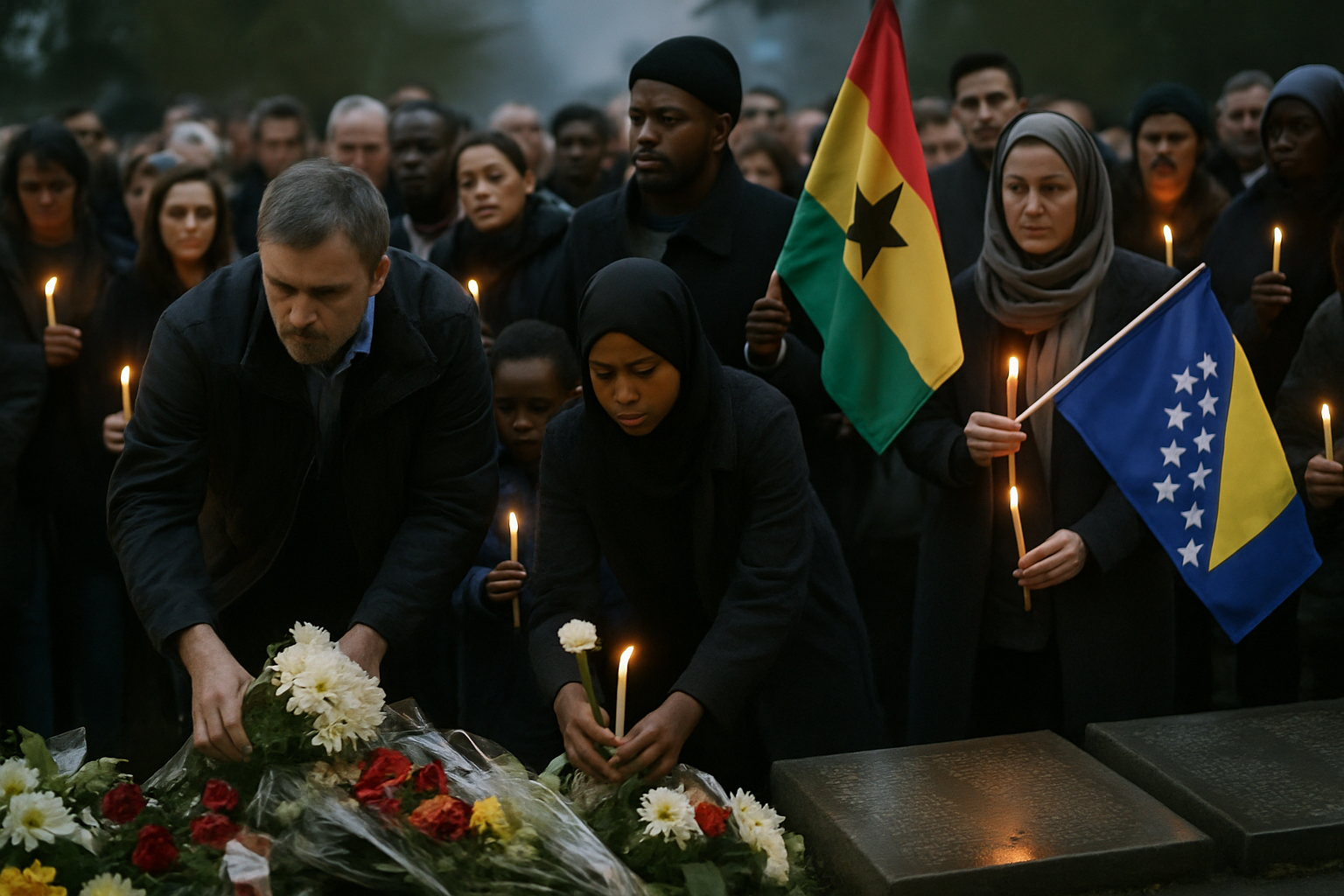
February 5, 2026, witnessed communities across continents coming together to commemorate pivotal moments in their histories, from the tragic Markale massacre in Sarajevo to the revolutionary legacy of Thomas Sankara in Burkina Faso, demonstrating how historical memory serves as both a source of healing and inspiration for future generations.
In Sarajevo, the capital of Bosnia and Herzegovina, thousands gathered at the historic Markale market to mark the 32nd anniversary of one of the most devastating attacks during the siege of the city. The February 5, 1994 mortar attack killed 68 people and wounded 142 others, becoming a defining moment in the Bosnian War that would reshape the course of international intervention in the conflict.
Sarajevo's Enduring Wound: Three Decades of Remembrance
The commemoration began early morning with families of victims, survivors, and government officials gathering at the site where a single mortar shell, fired from Army of Republika Srpska positions on Trebević mountain, forever changed the lives of those seeking basic necessities during the brutal three-year siege.
"This place remains an open wound for Sarajevo," said Senida Karović, President of the Union of Civilian War Victims of Sarajevo Canton, in her emotionally charged address. The ceremony featured the laying of flowers, a minute of silence, and the recitation of Fatiha, reflecting the city's multi-religious character and unified approach to mourning.
The Markale market attack stands as more than a tragic memory—it represents the resilience of Sarajevans who, despite nearly four years of siege conditions, continued their daily struggle for survival. Among the victims were people of all ages who, defying the constant threat of sniper fire and shelling, had ventured out to secure food for their families.
"The pain never fades, but neither does our commitment to ensuring such atrocities never happen again."
— Senida Karović, President of Union of Civilian War Victims
The annual commemoration has become institutionalized as the Day of Remembrance for all killed civilians, serving not only as a memorial to those lost but as an educational tool for younger generations who did not experience the war firsthand.
Burkina Faso's Revolutionary Tribute: Honoring Sankara's Vision
Simultaneously, in Ouagadougou, Burkina Faso's capital, the nation held its fourth military ceremonial tribute to Captain Thomas Sankara and his 12 companions at the Thomas Sankara Memorial. The event brought together representatives from the Presidency of Faso, the Grand Chancellery, and the Commission on Information Technology and Liberties, highlighting the continued reverence for the revolutionary leader assassinated in 1987.
Captain Anderson Medah delivered a tribute emphasizing Sankara's enduring legacy: "Captain Thomas Sankara has been and remains for the Burkinabè the greatest model we have ever had." This solemn moment of reflection underscored how Sankara's ideals of self-reliance, anti-imperialism, and social justice continue to inspire contemporary Burkina Faso.
The memorial ceremony represents a significant shift in how Burkina Faso approaches its revolutionary past. Under the current military leadership of Captain Ibrahim Traoré, the country has increasingly embraced Sankara's legacy as a source of national pride and political legitimacy, particularly as it navigates complex regional security challenges and questions of sovereignty.
The Universal Language of Historical Memory
These concurrent commemorations, taking place thousands of miles apart, illustrate the universal human need to remember, honor, and learn from pivotal historical moments. Whether marking tragedy or celebrating visionary leadership, communities worldwide recognize that historical memory serves multiple crucial functions.
In Sarajevo, the Markale remembrance serves as both personal grief processing and collective commitment to peace. The ceremony ensures that the sacrifice of innocent civilians during the siege is not forgotten, while also educating new generations about the consequences of ethnic division and the importance of multiethnic coexistence.
For Burkina Faso, the Sankara commemoration provides ideological grounding for current political directions while maintaining connection to a leader whose brief four-year presidency (1983-1987) fundamentally transformed the nation's self-perception and international standing.
Contemporary Relevance of Historical Commemoration
Both events occur within contexts that give them particular contemporary significance. Sarajevo's commemoration takes place as Bosnia and Herzegovina continues its European Union accession process, with the lessons of the 1990s war informing current efforts at democratic consolidation and reconciliation.
The Thomas Sankara memorial occurs as Burkina Faso, under military leadership since 2022, faces ongoing security challenges from extremist groups while simultaneously pursuing policies that echo Sankara's emphasis on national sovereignty and resource control. The country's recent record-breaking gold production of 94 tons in 2025, worth over $6 billion, represents the kind of resource management Sankara advocated.
Educational and Institutional Dimensions
Both commemorations demonstrate how historical memory becomes institutionalized through regular ceremonies, memorial sites, and educational programs. The Markale site has been preserved as a place of remembrance, while the Thomas Sankara Memorial in Ouagadougou serves as both a tourist destination and a site of national pilgrimage.
These institutionalized forms of memory serve multiple audiences: they provide spaces for personal and family grief, opportunities for political leaders to demonstrate commitment to particular values, and educational resources for younger generations who did not experience the events firsthand.
Challenges and Criticisms
Historical commemorations are not without controversies. In Bosnia and Herzegovina, debates continue about how to remember the war in ways that promote reconciliation rather than division. Some critics argue that separate ethnic commemorations perpetuate divisions rather than healing them.
Similarly, the elevation of Sankara's legacy in Burkina Faso occurs amid criticism of the current military government's democratic credentials and human rights record. Critics question whether contemporary political leaders genuinely embody Sankara's values or merely appropriate his symbolism for legitimacy.
Regional and International Dimensions
Both commemorations also reflect broader regional dynamics. The Sarajevo ceremony takes place as the Western Balkans region continues integration with European institutions while grappling with persistent ethnic tensions and political instability in some areas.
The Burkina Faso tribute occurs within the context of the Alliance of Sahel States (AES), comprising Niger, Mali, and Burkina Faso, which has distanced itself from traditional Western partners and regional organizations like ECOWAS. The invocation of Sankara's legacy provides ideological justification for these shifting international alignments.
Looking Forward: Memory as Foundation for Future
As these communities gathered to remember their past, they also demonstrated how historical memory serves as a foundation for future aspirations. In Sarajevo, the commitment to "never again" drives continued efforts at peacebuilding, democratic development, and European integration.
In Burkina Faso, the celebration of Sankara's revolutionary ideals provides a framework for contemporary policies aimed at resource sovereignty, social justice, and resistance to external interference. The recent dissolution of political parties in January 2026 reflects the military government's attempt to restructure political life along lines that echo Sankara's critique of traditional party politics.
These February 5, 2026 commemorations remind us that historical memory is not merely about preserving the past but about using that past to inform present choices and future directions. Whether honoring victims of violence or celebrating revolutionary vision, communities worldwide demonstrate that remembrance remains a vital component of collective identity and democratic development.
As both Bosnia and Herzegovina and Burkina Faso continue to navigate complex political transitions—one toward European integration, the other toward greater sovereignty—these commemorative traditions provide stability, continuity, and moral grounding for uncertain times ahead.