An extraordinary surge in international wildlife conservation initiatives spanning Australia, Democratic Republic of Congo, Nicaragua, and Norway demonstrates unprecedented global coordination in environmental protection during the 20th consecutive month of temperatures exceeding critical climate thresholds.
Conservation efforts across four continents are revealing a new paradigm in environmental protection, as nations collaborate on solutions ranging from invasive species management to wildlife rehabilitation programs. These coordinated initiatives emerge during what scientists describe as Earth's most environmentally challenging period in recorded history, with January 2026 marking the hottest month ever documented globally.
Australia's Revolutionary Conservation Alliance
In a historic development, environmental groups and farming organizations in Australia have announced an unprecedented union to combat invasive pests threatening native ecosystems. This unconventional alliance targets species like deer and rabbits that have devastated natural habitats while simultaneously damaging agricultural productivity.
The collaboration represents a fundamental shift from traditional conservation approaches, recognizing that effective environmental protection requires breaking down barriers between different stakeholder groups. Australian conservationists are employing sophisticated monitoring systems that combine satellite tracking, environmental DNA sampling, and community-based stewardship to create comprehensive management strategies.
"This partnership demonstrates that environmental protection and agricultural productivity are not competing interests but complementary goals," explains Dr. Sarah Mitchell, a conservation biologist studying invasive species management. "When farmers and conservationists work together, we can achieve results that neither group could accomplish alone."
Congo's Wildlife Rescue Renaissance
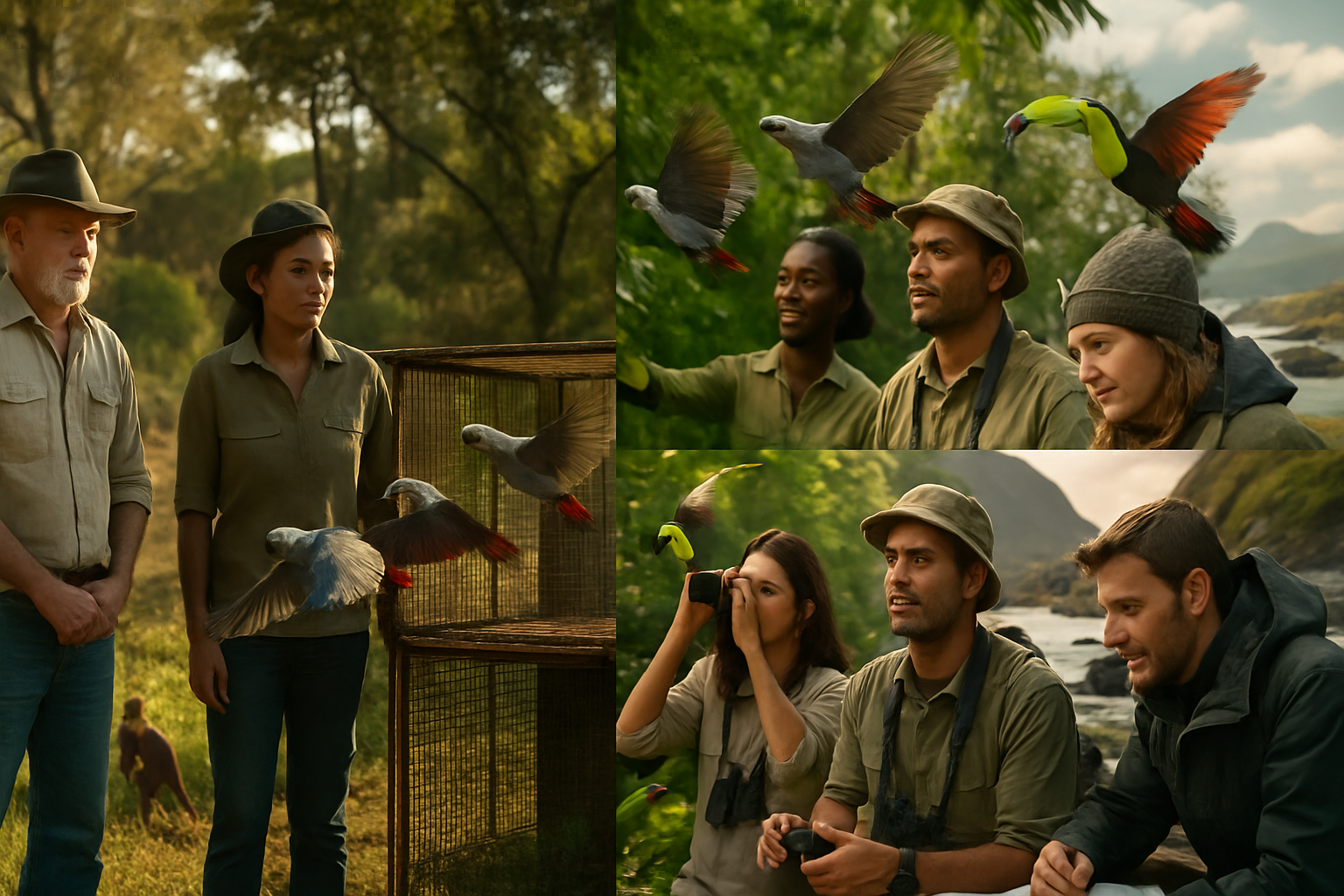
In the Democratic Republic of Congo, a remarkable wildlife rescue operation has captured international attention. Fifteen African grey parrots, rescued from illegal traffickers just days earlier, were successfully released back into their natural habitat at the Dingi rehabilitation center in the Bangengele chiefdom, Kailo territory of Maniema province.
The operation, conducted by the Lukuru Foundation in partnership with the Congolais Institute for Nature Conservation (ICCN), represents a broader conservation renaissance occurring across Africa. The successful rehabilitation and release of these critically endangered parrots demonstrates the effectiveness of combining traditional ecological knowledge with modern veterinary science.
African grey parrots play crucial ecological roles as seed dispersers and indicators of forest health. Their recovery from trafficking operations provides hope for broader biodiversity protection initiatives across Central Africa, where wildlife crime has severely impacted numerous species.
Nicaragua's Citizen Science Breakthrough
Nicaragua's participation in the regional "Centroamerica Big Day" bird count represents a growing trend toward community-based conservation science. Students from multiple universities and members of the guardabarranco movement contributed to this comprehensive survey of local and migratory bird species, marking the country's first participation in this important continental initiative.
The citizen science approach demonstrates how conservation efforts can successfully integrate community engagement with scientific research. By training local observers to identify and count bird species, the program creates valuable long-term monitoring data while building environmental awareness and expertise within communities.
"Community participation in scientific research creates ownership and understanding that traditional top-down conservation approaches often lack."
— Dr. Carlos Mendez, Central American Ornithological Network
Norway's Marine Conservation Challenge
Along Norway's coastline, authorities face a complex conservation challenge as mass sperm whale deaths draw both scientific concern and public attention. The mysterious deaths of multiple marine mammals have prompted intensive research efforts to understand potential causes and prevent future losses.
Norwegian researchers are employing advanced post-mortem techniques, environmental DNA analysis, and comprehensive health assessments to investigate these marine mammal deaths. The work represents part of a broader effort to understand how climate change and human activities affect Arctic marine ecosystems.
These whale deaths occur during a period of unprecedented ocean warming, with marine temperatures reaching record levels that disrupt traditional food webs and migration patterns. The investigation demonstrates the sophisticated monitoring systems essential for protecting marine biodiversity during rapidly changing environmental conditions.
Technology Meets Tradition
Across all these conservation initiatives, a common theme emerges: the most successful programs combine cutting-edge technology with traditional ecological knowledge and community-based management approaches. This synthesis represents a fundamental evolution in conservation methodology.
Australia's invasive species management employs GPS tracking and satellite monitoring alongside decades of farmer experience with land management. Congo's parrot rehabilitation combines modern veterinary protocols with traditional forest knowledge from local communities. Nicaragua's bird surveys integrate smartphone apps and digital databases with indigenous bird identification expertise.
Economic Development Through Environmental Protection
These conservation initiatives demonstrate that environmental protection functions as an economic development strategy rather than a regulatory burden. Countries implementing comprehensive wildlife protection consistently show greater economic resilience and attract sustainable investment across multiple sectors.
Australia's conservation partnerships support growing eco-tourism industries while maintaining agricultural productivity. Congo's wildlife recovery programs attract international research partnerships and conservation funding. Nicaragua's bird monitoring enhances the country's reputation as a sustainable tourism destination.
The economic benefits extend beyond direct conservation sectors, including improved ecosystem services that support agriculture, reduced infrastructure costs through natural disaster prevention, and enhanced public health through cleaner environments.
International Cooperation Framework
Success across these diverse initiatives highlights the critical importance of international cooperation in addressing transnational environmental challenges. Wildlife migrations, ocean currents, and atmospheric systems connect ecosystems globally, making unilateral conservation efforts insufficient for long-term success.
The diversity of approaches across Australia, Congo, Nicaragua, and Norway provides resilience against single-solution dependencies. Knowledge sharing between these nations creates global networks offering multiple adaptation pathways for complex environmental challenges.
Climate Crisis Context
These conservation victories emerge against the backdrop of accelerating climate change, with January 2026 confirmed as the hottest month in recorded history. The sustained warming demonstrates human-induced climate change has fundamentally altered atmospheric systems beyond natural recovery mechanisms.
Conservation efforts must now account for rapidly changing baseline environmental conditions while maintaining long-term sustainability goals. Traditional conservation approaches designed for stable environmental conditions require fundamental evolution to address compound environmental effects from multiple stressors.
Critical Action Window
The coordinated conservation initiatives across four continents represent a critical juncture in global environmental protection. The choice between reactive crisis management and proactive ecosystem service management may determine whether conservation efforts can keep pace with accelerating environmental change during this decisive climate action decade.
Environmental action windows are narrowing rapidly as ecological systems approach critical thresholds that could trigger irreversible changes affecting global food security, climate stability, and human settlements. However, the tools, knowledge, and cooperation frameworks exist for comprehensive protection if implemented with sufficient speed and coordination.
Future Implications
The conservation developments across Australia, Congo, Nicaragua, and Norway provide practical templates for scaling environmental protection globally. These initiatives demonstrate that effective conservation requires sophisticated synthesis of scientific knowledge, community engagement, technological innovation, and international cooperation through locally-appropriate combinations.
Success depends on sustained international cooperation, enhanced multi-sector coordination, and increased financial commitments recognizing environmental protection as essential infrastructure for human prosperity and planetary sustainability. The convergence of innovation, cooperation, and political commitment offers hope for maintaining planetary habitability during Earth's most environmentally challenging period in recorded history.