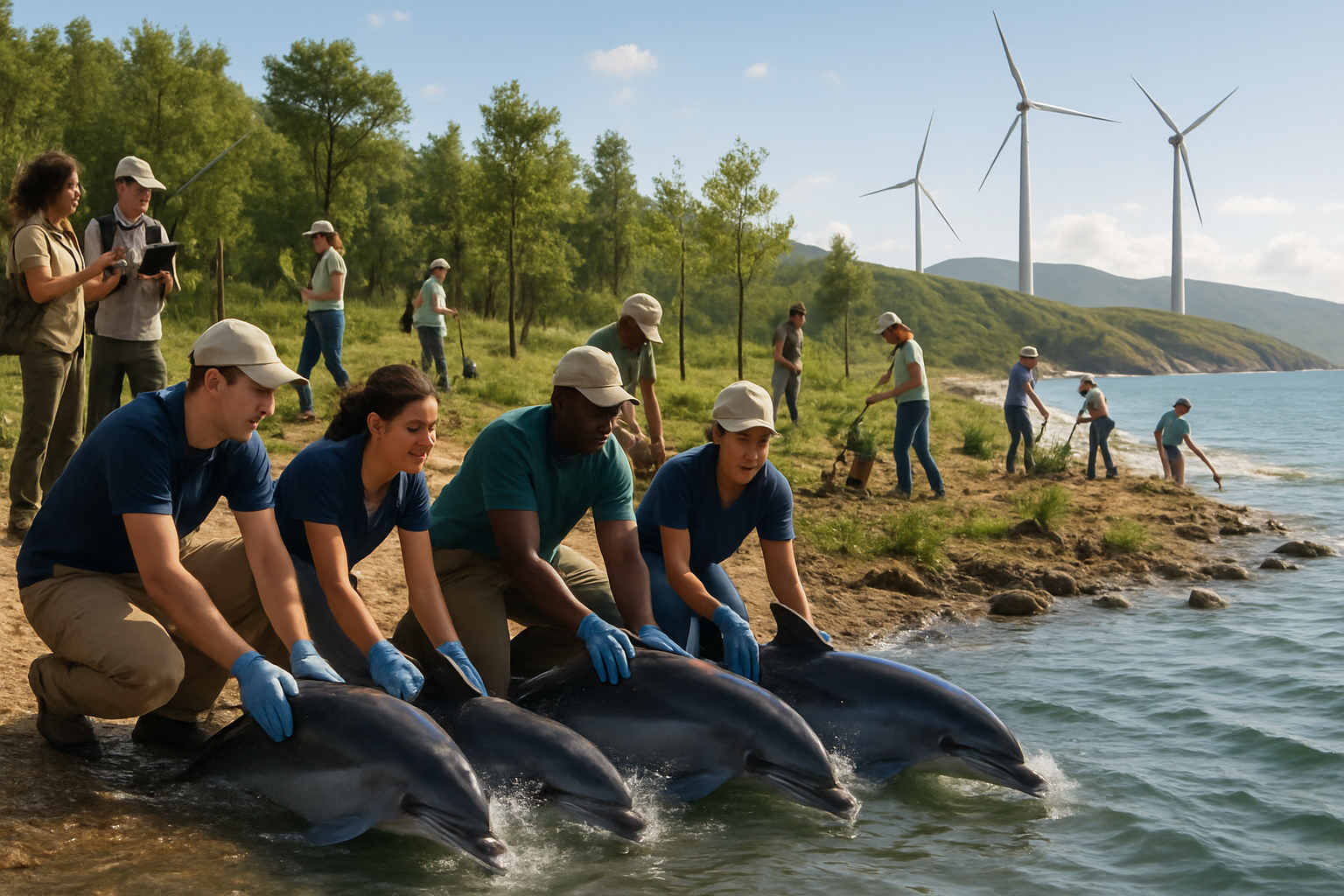
As the world faces its 21st consecutive month of temperatures exceeding 1.5°C above pre-industrial levels, four nations are spearheading a remarkable conservation renaissance that offers both hope and urgent lessons for global environmental protection.
From Bulgaria's Black Sea marine disaster investigation to New Zealand's endangered species recovery, Portugal's circular economy breakthrough, and Serbia's wildlife reintroduction success, these coordinated conservation efforts represent a fundamental evolution from reactive crisis management to proactive ecosystem service management during Earth's most challenging environmental period.
Bulgaria: Marine Ecosystem Crisis Investigation
Bulgarian environmental organization "Green Balkans" is leading a comprehensive investigation into the mysterious death of over 300 Mediterranean storm petrels and 9 dolphins along the northern Black Sea coast. Dimitar Popov from Green Balkans reported that while there are currently no indications of a serious ecological catastrophe, the deaths appear linked to entanglement in fishing nets rather than environmental contamination.
The incident, occurring in the Shabla, Durankulak, and Ezerets regions, highlights the vulnerability of marine ecosystems during unprecedented climate warming. "From what we observed, the most serious indication is that they became victims of entanglement in fishing nets," Popov explained, noting that water samples from the Basin Directorate are still being analyzed.
This marine crisis reflects broader patterns documented in recent environmental memory analyses, where Mediterranean marine ecosystems face mounting pressures from shipping, pollution, and climate-driven habitat changes during sustained global warming.
New Zealand: Endangered Species Breakthrough
In a remarkable conservation victory, endangered whio (blue ducks) have returned to New Zealand's Rees Valley after a 50-year absence. The rare sighting of a pair during a routine trapline installation north of Glenorchy represents years of dedicated conservation work combining traditional ecological knowledge with modern wildlife management techniques.
The whio, known internationally as the blue duck, is among New Zealand's most endangered waterfowl species. Their return to Rees Valley demonstrates the effectiveness of New Zealand's comprehensive conservation approach, which integrates advanced technology including environmental DNA sampling and satellite tracking with traditional Māori environmental stewardship practices.
This success builds on New Zealand's broader conservation renaissance, including recent achievements such as the Otago Peninsula's possum-free declaration and shore plover recovery programs that have reversed centuries of habitat destruction through sophisticated community-based management approaches.
Portugal: Circular Economy Transformation
Portugal has launched its ambitious 2030 Action Plan for Circular Economy (PAEC 2030), marking a critical shift toward sustainable resource management despite arriving a year behind schedule. The comprehensive framework aims to extend product lifecycles, reduce landfill pressure, and align Portugal with European environmental regulations.
The plan addresses Portugal's significant waste management challenges, where the country still buries half of its residual waste despite European Union targets for dramatic reduction. PAEC 2030 represents evolution from traditional waste disposal toward systematic circular economy approaches that treat waste as valuable resources through innovative market mechanisms.
However, implementation faces persistent questions about financing and execution in a country where waste generation patterns often outpace infrastructure development. The success of PAEC 2030 will serve as a crucial template for other European nations struggling to balance economic development with environmental sustainability during the accelerating climate crisis.
Serbia: Wildlife Conservation Triumph
Serbian media reports highlight an extraordinary wildlife conservation success in Uganda's Kidepo National Park, where rhinoceros populations have returned after more than 40 years of absence. The species had been completely eliminated by poachers seeking their valuable horns, but coordinated international conservation efforts have achieved remarkable recovery results.
This rhinoceros reintroduction represents the culmination of sophisticated conservation medicine, community engagement, and international cooperation that characterizes the global conservation renaissance of 2026. Advanced genetic screening, satellite monitoring, and community-based protection programs have created conditions enabling species recovery even in regions previously devastated by wildlife crime.
The success builds on broader conservation momentum across Africa, including recent breakthroughs in Democratic Republic of Congo's forest elephant protection and Zimbabwe's world-first DNA forensic wildlife prosecutions that are transforming anti-poaching efforts through scientific evidence.
Climate Crisis Context
These conservation initiatives emerge during an unprecedented environmental crisis. January 2026 marked the hottest month in recorded history, extending a streak of 21 consecutive months exceeding critical climate thresholds. This sustained warming has overridden natural climate variability, including La Niña cooling effects that typically moderate global temperatures.
The compound environmental effects create additional ecosystem stress that traditional conservation approaches struggle to address effectively. Rising sea levels threaten coastal ecosystems, changing precipitation patterns affect forest regeneration, and increased extreme weather disrupts marine food chains and wildlife migration patterns developed over millennia.
Technology-Tradition Integration Revolution
The most successful conservation programs demonstrate sophisticated synthesis of cutting-edge technology with traditional ecological knowledge and community-based management systems. This integration represents a fundamental departure from purely technological or traditional approaches toward comprehensive, scientifically rigorous, and culturally sensitive frameworks.
Advanced tools including environmental DNA sampling, satellite monitoring, AI-powered threat detection, and GPS tracking provide unprecedented capabilities for species monitoring, habitat assessment, and rapid threat response. However, maximum effectiveness is achieved when these technologies are combined with generations of traditional knowledge and community stewardship practices.
Bulgaria's marine investigation utilizes advanced water chemistry analysis alongside traditional fishing community knowledge. New Zealand's whio recovery employs sophisticated genetic analysis combined with traditional Māori environmental principles. Portugal's circular economy integrates modern market mechanisms with traditional resource management practices. Serbia's rhinoceros conservation leverages international scientific cooperation with local community protection networks.
Economic Development Strategy
Modern environmental protection increasingly functions as an economic development strategy rather than a regulatory burden. Countries implementing comprehensive wildlife and ecosystem protection consistently demonstrate greater economic resilience and attract sustainable investment across multiple sectors including eco-tourism, environmental technology manufacturing, and green services.
Bulgaria's marine conservation enhances Black Sea tourism prospects and positions the country as a regional environmental monitoring leader. New Zealand's species recovery programs support a multi-billion-dollar conservation economy encompassing eco-tourism, research partnerships, and environmental technology development. Portugal's circular economy framework creates employment in environmental services while reducing costly waste disposal and resource imports. The African rhinoceros conservation success generates substantial revenue through nature-based tourism and international research collaboration.
Economic analyses consistently show that environmental degradation costs—including healthcare expenses from pollution, infrastructure damage from extreme weather, and tourism losses from ecosystem destruction—often exceed the investments required for proactive environmental protection.
International Cooperation Imperative
The transnational nature of environmental challenges demands unprecedented international cooperation. Ocean currents carry marine pollution across continents, atmospheric systems transport particulate matter and climate effects globally, and species migrations connect ecosystems regardless of political boundaries, making unilateral conservation efforts insufficient.
Success requires coordinated policy frameworks, shared monitoring systems, collaborative enforcement mechanisms, and innovative financing that recognizes the economic value of ecosystem services. The diversity of approaches across Bulgaria, New Zealand, Portugal, and Serbia provides resilience against single-solution dependencies while offering multiple adaptation pathways for addressing complex environmental challenges.
Knowledge sharing creates global networks where successful conservation approaches can be adapted to different contexts while respecting local conditions and cultural priorities. This evolution from traditional North-South aid relationships toward peer-to-peer cooperation recognizes that developing nations are increasingly becoming environmental solution providers rather than merely aid recipients.
Critical Action Window
March 2026 represents a critical juncture in global environmental protection, presenting a choice between reactive crisis management and proactive ecosystem service management. This decision may ultimately determine whether conservation efforts can keep pace with accelerating environmental change during this decisive climate action decade.
The environmental action window is narrowing rapidly as ecological systems approach critical thresholds that could trigger potentially irreversible changes affecting global food security, climate stability, and human settlements. However, the tools, knowledge, and cooperation frameworks for comprehensive environmental protection exist, as demonstrated by the diverse initiatives across these four nations.
Implementation challenges remain significant, particularly regarding funding sustainability in developing nations where immediate economic pressures often override long-term environmental considerations. Technical capacity building requires sustained investment in education, training, and institutional development. Climate change compounds these challenges by disrupting project timelines and requiring adaptive management approaches that can respond rapidly to changing conditions.
Templates for Global Scaling
The coordinated conservation initiatives across Bulgaria, New Zealand, Portugal, and Serbia provide practical templates for scaling environmental protection globally. These programs demonstrate that effective conservation requires comprehensive approaches that address multiple challenges simultaneously while building local capacity and fostering international cooperation.
Bulgaria's marine crisis response offers models for rapid environmental threat assessment combining scientific analysis with community knowledge. New Zealand's species recovery programs provide frameworks for long-term conservation success through technology-tradition integration. Portugal's circular economy transformation demonstrates systematic approaches to sustainable resource management. Serbia's wildlife conservation success shows how international cooperation can achieve remarkable species recovery even in challenging circumstances.
Success factors consistently include community ownership and engagement, transparent governance structures, economic incentives that make protection financially viable, and sophisticated integration of traditional ecological knowledge with modern conservation science.
Future Implications
The environmental developments of March 2026 may prove decisive for conservation approaches in the decades ahead, potentially influencing global biodiversity protection, climate adaptation, and sustainable development strategies for generations. These initiatives test humanity's adaptive capacity to protect essential natural systems during Earth's most challenging environmental period in recorded history.
Success depends on sustained international cooperation, enhanced multi-sector coordination, and increased financial commitments that recognize environmental protection as essential infrastructure for human prosperity and planetary sustainability. The integration of cutting-edge technology with traditional ecological wisdom offers pathways for maintaining planetary habitability, but requires immediate and coordinated global action with maximum urgency.
As the world faces its longest sustained warming streak in human history, these four nations demonstrate that remarkable conservation achievements remain possible through comprehensive approaches that combine scientific innovation, community engagement, economic viability, and international cooperation. Their success provides both inspiration and practical guidance for the massive coordinated effort required to address environmental challenges at the speed and scale that our current crisis demands.