Two contrasting conservation stories emerge from different corners of the globe as environmental protection efforts face unprecedented challenges during the 24th consecutive month of temperatures exceeding 1.5°C above pre-industrial levels—the longest sustained warming streak in recorded human history.
In the rainforests of Costa Rica, a revolutionary approach to forest conservation is proving that effective environmental protection requires far more than simply planting trees. Meanwhile, in England, gaps in wildlife designation systems are exposing critical vulnerabilities in protecting the nation's most precious natural areas from development pressures.
Costa Rica's Forest Management Revolution: Beyond Simple Tree Planting
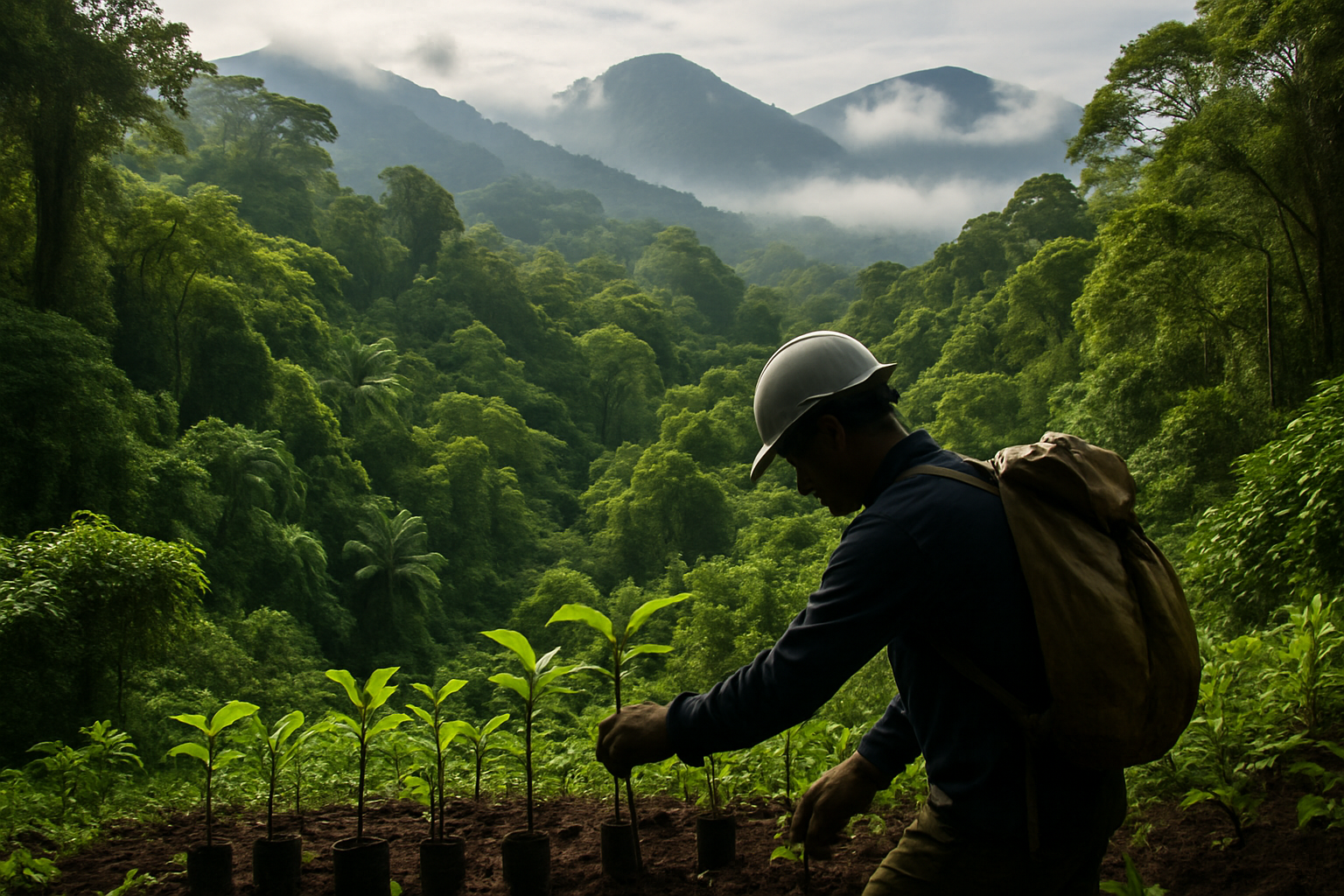
Jennifer Leigh Smith, founder of Community Carbon Trees, has pioneered a forest management model that challenges conventional reforestation wisdom. Leading a dedicated team of up to 33 people, her organization has demonstrated that the secret to saving Costa Rica's rainforests lies not in the initial planting, but in the meticulous care that follows.
"Planting a tree is just the first step; the real challenge is ensuring it survives until the canopy closes," Smith explained, highlighting a critical gap in many global reforestation efforts. Her approach emphasizes post-planting care, strategic pruning, and comprehensive forest management—treating regeneration as both a financial commitment and a long-term scientific endeavor.
The methodology represents a sophisticated integration of cutting-edge technology with traditional ecological knowledge. Environmental DNA sampling, satellite monitoring, and AI-powered analysis work alongside generations of indigenous forest stewardship wisdom, creating comprehensive frameworks that combine scientific rigor with cultural sensitivity and community ownership.
"Regeneration is, above all, a financial and time commitment that requires sustained dedication to ecosystem restoration rather than short-term tree counting."
— Jennifer Leigh Smith, Community Carbon Trees
England's Conservation Crisis: The SSSI Designation Drought
While Costa Rica advances forest protection, England faces a troubling conservation challenge. Natural England, the government's primary wildlife watchdog, has failed to designate any new Sites of Special Scientific Interest (SSSIs) since 2023, according to exclusive reporting from The Guardian.
SSSIs represent nationally and internationally important areas for rare wildlife and habitats, providing crucial legal protection against development pressures. Without these designations, endangered species face significant risks of habitat loss to commercial and residential development projects.
The designation freeze occurs during a critical period when environmental protection requires rapid scaling and enhanced coordination. As climate change accelerates, creating additional protected areas becomes essential for maintaining habitat connectivity and providing climate refuges for vulnerable species.
Technology-Tradition Integration: The Future of Conservation
Both conservation efforts highlight a fundamental evolution in environmental protection methodology. The most successful conservation programs worldwide demonstrate sophisticated synthesis of cutting-edge technology with traditional ecological knowledge and community-based management systems.
Costa Rica's approach employs advanced monitoring systems, genetic analysis, and digital tracking while respecting traditional forest stewardship practices developed by indigenous communities over generations. This integration creates adaptable frameworks that leverage global technological capabilities while maintaining local cultural autonomy and environmental sensitivity.
England's conservation challenges, by contrast, reveal the limitations of purely bureaucratic approaches that fail to integrate community engagement with systematic environmental protection. The SSSI designation system requires revitalization through enhanced community involvement, streamlined assessment processes, and adaptive management strategies responding to rapidly changing environmental conditions.
Economic Development Through Environmental Protection
Contemporary conservation increasingly functions as an economic development strategy rather than a regulatory burden. Costa Rica's comprehensive forest management has positioned the country as a global leader in eco-tourism, attracting millions of visitors annually and generating substantial revenue for local communities while funding ongoing conservation efforts.
Countries implementing comprehensive environmental protection consistently demonstrate greater economic resilience and attract sustainable investment across multiple sectors, including environmental technology, green services, and nature-based tourism. The economic benefits extend beyond direct conservation activities to include improved public health, enhanced agricultural productivity through ecosystem services, and reduced infrastructure costs through natural disaster prevention.
Ecosystem service valuation reveals that intact natural systems often deliver greater long-term economic benefits than resource extraction activities. Forests provide water regulation, carbon sequestration, and climate stability worth billions annually, while biodiversity hotspots support pharmaceutical research and premium eco-tourism that generates sustainable employment for local communities.
Climate Crisis Context: Unprecedented Environmental Urgency
These conservation initiatives emerge during Earth's most challenging environmental period in recorded history. January 2026 marked the hottest month ever recorded, extending an unprecedented warming streak that has completely overridden natural climate variability, including La Niña cooling effects that typically moderate global temperatures.
The sustained temperature elevation demonstrates that human-induced climate change has fundamentally altered atmospheric systems beyond natural recovery mechanisms. This creates compound environmental effects that traditional conservation approaches struggle to address: rising sea levels threaten coastal ecosystems, changing precipitation patterns affect forest regeneration, and increased extreme weather frequency disrupts marine and terrestrial habitats.
Conservation strategies must now account for rapidly changing baseline conditions while maintaining long-term sustainability goals. The challenge requires adaptive management approaches that can respond to environmental changes occurring faster than many species' natural adaptation capabilities.
International Cooperation: Essential for Planetary-Scale Challenges
Environmental challenges transcend political boundaries through ocean currents, atmospheric systems, and species migrations that connect ecosystems globally, making unilateral conservation efforts insufficient. Success requires unprecedented international cooperation, coordinated policy frameworks, shared monitoring systems, collaborative enforcement, and innovative financing mechanisms that recognize ecosystem services' economic value.
Knowledge sharing between programs like Costa Rica's forest management and England's protected area systems creates global networks that strengthen local conservation capacity while contributing to planetary sustainability. The diversity of approaches provides resilience against single-solution dependencies, offering multiple adaptation pathways for addressing complex environmental challenges spanning biological, physical, and human systems.
The evolution from traditional North-South aid relationships toward peer-to-peer cooperation recognizes that developing nations are increasingly becoming environmental solution providers rather than aid recipients, leveraging local innovation and indigenous knowledge systems that offer globally applicable insights.
Critical Action Window: The Decisive Climate Action Decade
Environmental scientists consistently warn that the window for effective conservation action is narrowing rapidly as ecological systems approach critical thresholds that could trigger potentially irreversible changes affecting global food security, climate stability, and human settlements.
The choice facing the international community is between reactive crisis management and proactive ecosystem service management. Costa Rica's forest management success demonstrates that comprehensive environmental protection frameworks exist and can achieve remarkable results when implemented with sufficient community engagement, technological innovation, and sustained financial commitment.
Tools, knowledge, and cooperation frameworks for comprehensive environmental protection exist, as demonstrated by diverse international initiatives achieving remarkable results during Earth's most challenging environmental period. However, success depends on sustained international cooperation, enhanced multi-sector coordination, and increased financial commitments that recognize environmental protection as essential infrastructure for human prosperity and planetary sustainability.
Conservation Renaissance: A Turning Point for Global Environmental Protection
The contrasting experiences of Costa Rica's forest recovery revolution and England's conservation gaps illustrate both the potential and the challenges facing global environmental protection efforts. Costa Rica's success provides practical templates for scaling environmental protection globally through coordinated approaches that address multiple challenges while building local capacity and fostering international cooperation.
Effective conservation requires a sophisticated synthesis of scientific knowledge, community engagement, technological innovation, and international cooperation through locally-appropriate combinations rather than isolated approaches. The integration of cutting-edge technology with traditional ecological wisdom creates adaptable frameworks that respect cultural diversity while leveraging global capabilities for maximum conservation impact.
The convergence of scientific innovation, community engagement, economic viability, and international cooperation integration suggests the emergence of a global "conservation renaissance"—a fundamental evolution toward proactive ecosystem service management that emphasizes community participation and technological integration.
"The window for effective environmental action is narrowing, but the convergence of innovation, cooperation, and political commitment offers hope for maintaining planetary habitability during humanity's most environmentally challenging period."
— International Conservation Assessment, 2026
Future Implications: Templates for Planetary Sustainability
The environmental developments of 2026 may prove decisive for conservation approaches in the decades ahead, influencing global biodiversity protection, climate adaptation, and sustainable development strategies for generations. Costa Rica's forest management model and the urgency revealed by England's designation gaps provide complementary lessons for comprehensive environmental protection scaling.
Success in maintaining planetary habitability during this unprecedented environmental challenge period requires coordinated global action with maximum urgency. The conservation initiatives spanning multiple continents demonstrate humanity's growing capacity for protecting essential natural systems during Earth's most challenging environmental period, offering both hope and urgent templates for the massive coordinated effort required.
The choice between reactive crisis management and transformative environmental infrastructure development will determine whether conservation efforts keep pace with accelerating environmental change during this decisive climate action decade. The stakes could not be higher: the fundamental relationship between humanity and the natural world, and the maintenance of planetary systems that support all life on Earth.