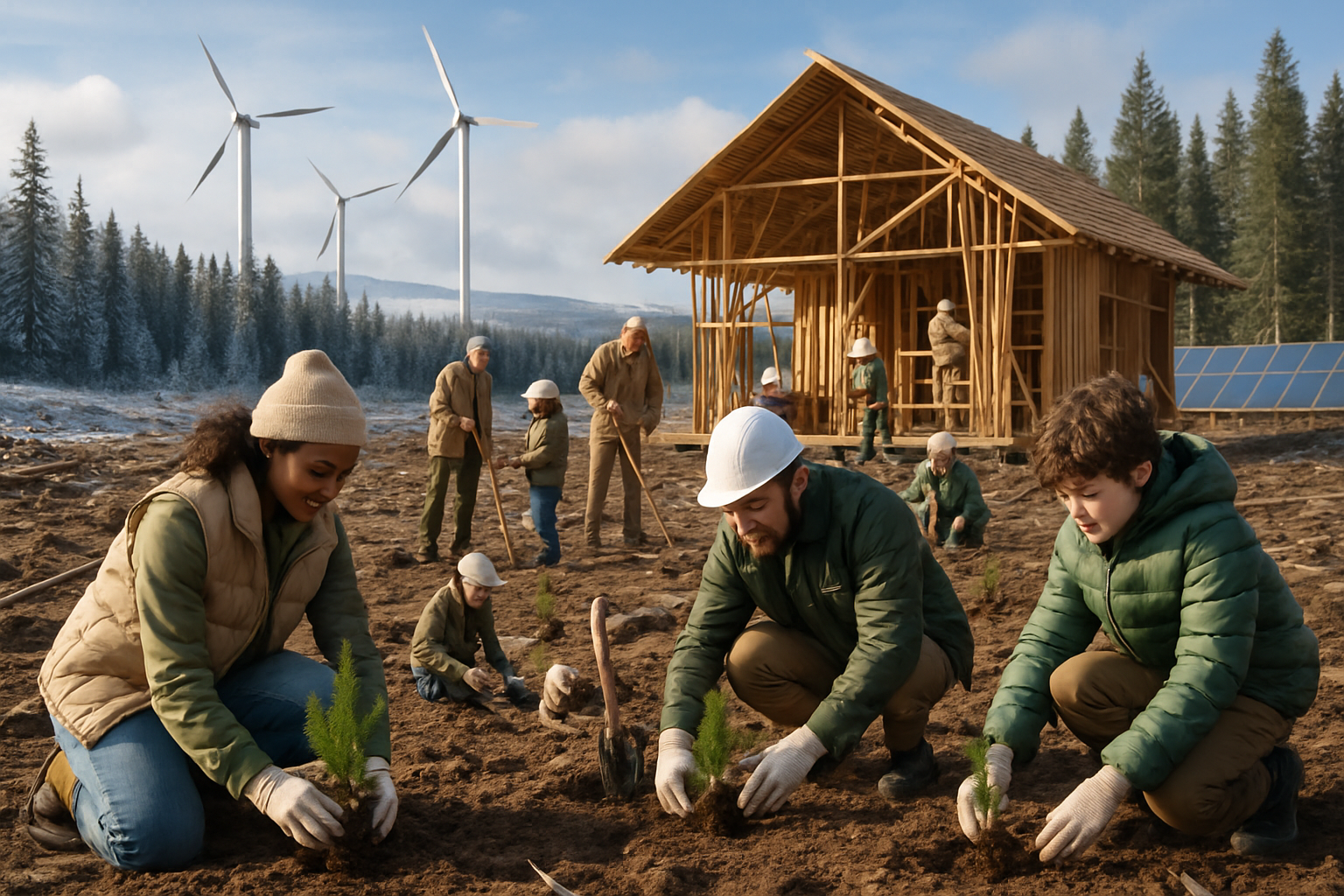
A remarkable convergence of conservation initiatives spanning three continents showcases the world's accelerating response to environmental challenges, as Finland advances forest protection programs, Luxembourg pioneers experimental reforestation, and Mozambique launches the largest mangrove restoration project in East Africa during Earth's 18th consecutive month exceeding 1.5°C above pre-industrial levels.
The coordinated environmental action emerges against a backdrop of unprecedented climate urgency, with January 2026 confirmed as the hottest month in recorded history. These initiatives represent a fundamental evolution from reactive crisis management toward proactive ecosystem service management, integrating cutting-edge technology with traditional ecological knowledge and community-based stewardship.
Finland's Forest Conservation Renaissance
Finland's robust METSO forest conservation program continues to demonstrate overwhelming public support, with applications reaching critical levels across multiple regions. In Etelä-Pohjanmaa alone, 161 applications await processing, while Pohjanmaa shows 76 applications and Keski-Pohjanmaa records 49 pending requests. This surge in conservation interest reflects growing recognition among landowners of the economic and ecological value of preserving biodiversity-rich forest habitats.
The program's success builds upon Finland's constitutional commitment to sustainable forestry management, where private landowners voluntarily participate in conservation agreements that balance economic returns with environmental protection. Despite funding limitations preventing the program from meeting all conservation targets, the overwhelming response demonstrates a fundamental shift in how Finnish communities view forest stewardship.
"The METSO program represents the evolution of conservation thinking in the Nordic region, where environmental protection becomes an economic development strategy rather than a regulatory burden."
— Finnish Forest Service Official
Luxembourg's Urban Forest Innovation
In a groundbreaking initiative that bridges education and environmental restoration, students from Luxembourg's Bëschspillschoul actively participated in establishing a new experimental forest within the capital city. This collaborative project, involving the Ministry of Environment, Climate and Biodiversity, the Nature and Forest Administration (ANF), and the Luxembourg Institute of Science and Technology (LIST), represents a sophisticated approach to urban ecosystem management.
The experimental forest serves as both a living laboratory for climate adaptation research and an educational platform for future environmental stewards. Advanced monitoring systems track tree growth patterns, carbon sequestration rates, and biodiversity development under varying climate conditions, providing crucial data for scaling urban reforestation efforts across Europe.
The project demonstrates Luxembourg's commitment to becoming a regional leader in sustainable urban planning, integrating scientific research with community engagement to create resilient green infrastructure capable of withstanding accelerating climate change impacts.
Mozambique's Mangrove Revolution
The most ambitious component of this global conservation surge unfolds along Mozambique's Indian Ocean coastline, where the TUI Care Foundation has launched an unprecedented mangrove restoration program in partnership with the Peace Parks Foundation. The initiative targets the restoration of over 150 hectares of degraded mangrove forest while planting more than 500,000 trees across critical coastal ecosystems.
This massive undertaking extends far beyond simple tree planting, incorporating comprehensive community development programs that engage local schools, support community-managed enterprises, and enhance nature-based tourism opportunities. The holistic approach recognizes that successful conservation requires addressing the economic needs of local communities while protecting essential ecosystems.
Mangrove forests represent some of Earth's most productive ecosystems, serving as nurseries for marine life, natural barriers against coastal erosion and storm surge, and among the most effective carbon sequestration systems on the planet. The restoration of 150 hectares in Maputo National Park alone could sequester thousands of tons of carbon dioxide while protecting coastal communities from increasingly severe climate impacts.
Technology Meets Tradition
These conservation initiatives demonstrate the sophisticated integration of advanced technology with traditional ecological knowledge that characterizes modern environmental protection. Finnish forest management combines satellite monitoring and genetic analysis with generations of sustainable forestry practices. Luxembourg's experimental forest employs environmental DNA tracking and digital sensors alongside established European silviculture techniques.
Mozambique's mangrove restoration utilizes GPS mapping and drone surveillance while building upon traditional coastal management systems developed by fishing communities over centuries. This synthesis represents a fundamental maturation in conservation methodology, moving beyond either purely technological or purely traditional approaches toward comprehensive frameworks that harness the strengths of both systems.

Economic Engine for Sustainable Development
The global conservation surge of 2026 fundamentally challenges traditional perceptions of environmental protection as an economic burden. Finland's forest conservation program attracts eco-tourism and research collaboration while providing sustainable income for rural communities. Luxembourg's urban forest initiative enhances property values and positions the nation as a leader in green technology and sustainable urban planning.
Mozambique's mangrove restoration creates employment opportunities in restoration, monitoring, and eco-tourism while protecting coastal infrastructure worth millions of dollars from storm damage. Countries implementing comprehensive environmental protection consistently demonstrate greater economic resilience and attract sustainable investment across multiple sectors.
The economic multiplier effects extend beyond direct conservation activities to encompass green technology manufacturing, environmental services, sustainable agriculture, and climate-adapted tourism. This represents a fundamental paradigm shift where environmental protection becomes the foundation for prosperity rather than an obstacle to growth.
Climate Context and Urgency
These conservation initiatives unfold during a period of unprecedented environmental pressure. January 2026's confirmation as the hottest month in recorded history, extending an 18-month streak of temperatures exceeding 1.5°C above pre-industrial levels, demonstrates that human-induced climate change has fundamentally altered Earth's atmospheric systems beyond natural recovery mechanisms.
The persistence of extreme temperatures despite La Niña cooling conditions—which typically moderate global temperatures—indicates that traditional climate patterns no longer provide predictable baselines for environmental planning. This creates additional urgency for conservation programs while simultaneously complicating their implementation as rapidly changing conditions disrupt traditional ecosystem relationships.
The convergence of conservation innovation with accelerating climate change represents a race between human adaptive capacity and environmental degradation. Success in scaling these initiatives globally may determine whether civilization can maintain essential ecosystem services during the critical climate action decade of the 2020s.
International Cooperation and Knowledge Transfer
The coordination evident across Finnish forest conservation, Luxembourg urban innovation, and Mozambican coastal restoration reflects the emerging architecture of 21st-century environmental diplomacy. Knowledge sharing, technology transfer, and innovative financing mechanisms enable smaller nations to implement sophisticated conservation programs while contributing to global environmental stability.
This represents an evolution from traditional North-South aid relationships toward peer-to-peer cooperation where developing nations become environmental solution providers rather than passive aid recipients. Mozambique's mangrove restoration techniques could inform coastal protection strategies across tropical regions, while Luxembourg's urban forest methods offer templates for cities worldwide.
The success of these programs depends not only on local implementation but on sustained international cooperation, enhanced coordination across scales and sectors, and increased financial commitments that recognize environmental protection as essential infrastructure for both human prosperity and planetary sustainability.
Implementation Challenges and Success Factors
Despite remarkable achievements, significant challenges persist across all three conservation initiatives. Funding sustainability remains critical, particularly for developing nations where immediate economic pressures can override long-term environmental considerations. Technical capacity building requires sustained investment in education, training, and institutional development.
Climate change itself disrupts conservation project timelines and outcomes, requiring adaptive management approaches capable of responding to rapidly changing environmental conditions. The diversity of conservation approaches—from Nordic forest management to Mediterranean urban planning to tropical coastal restoration—provides resilience against single-solution dependencies while offering multiple pathways for addressing complex environmental challenges.
Success factors consistently include community ownership and engagement, transparent governance frameworks, economic incentives that make protection financially viable, and the integration of traditional ecological knowledge with modern conservation science. These elements must be present regardless of geographic location or specific conservation target.
Strategic Significance for Global Conservation
The February 2026 conservation surge represents a critical juncture in the evolution of global environmental protection strategy. The choice between reactive crisis management and proactive ecosystem service management may determine whether conservation efforts can keep pace with accelerating environmental change during the decisive climate action decade.
Finland, Luxembourg, and Mozambique provide diverse templates for comprehensive environmental protection that addresses multiple challenges while building local capacity and fostering international cooperation. Their success demonstrates that effective conservation is achievable with proper planning, community engagement, and international support.
However, the window for effective environmental action continues to narrow as ecological systems approach critical thresholds. The coordination, innovation, and commitment evident in these three nations must be rapidly scaled globally through unprecedented international cooperation and financial investment.
Future Implications and Pathways
The conservation initiatives launched in February 2026 may prove decisive for the trajectory of global environmental protection in coming decades. The tools, knowledge, and cooperation frameworks demonstrated by Finland, Luxembourg, and Mozambique exist for comprehensive environmental protection, but success depends on rapid implementation at scale.
These programs offer hope and practical guidance for the massive environmental protection effort required to maintain planetary habitability. They demonstrate that coordinated international action, technological innovation, and community engagement can achieve remarkable results even under challenging environmental conditions.
The choice facing the global community is whether these pioneering efforts can be scaled and coordinated rapidly enough to address environmental challenges at the speed and scale required. The conservation renaissance of 2026 provides both the inspiration and the practical roadmap for planetary sustainability, but its ultimate success depends on immediate and sustained global action.
"February 2026 may mark the turning point where humanity demonstrated the capacity for coordinated environmental action matching the scale of our planetary challenges. The question now is whether we can maintain this momentum when Earth's future depends on it."
— International Conservation Strategist