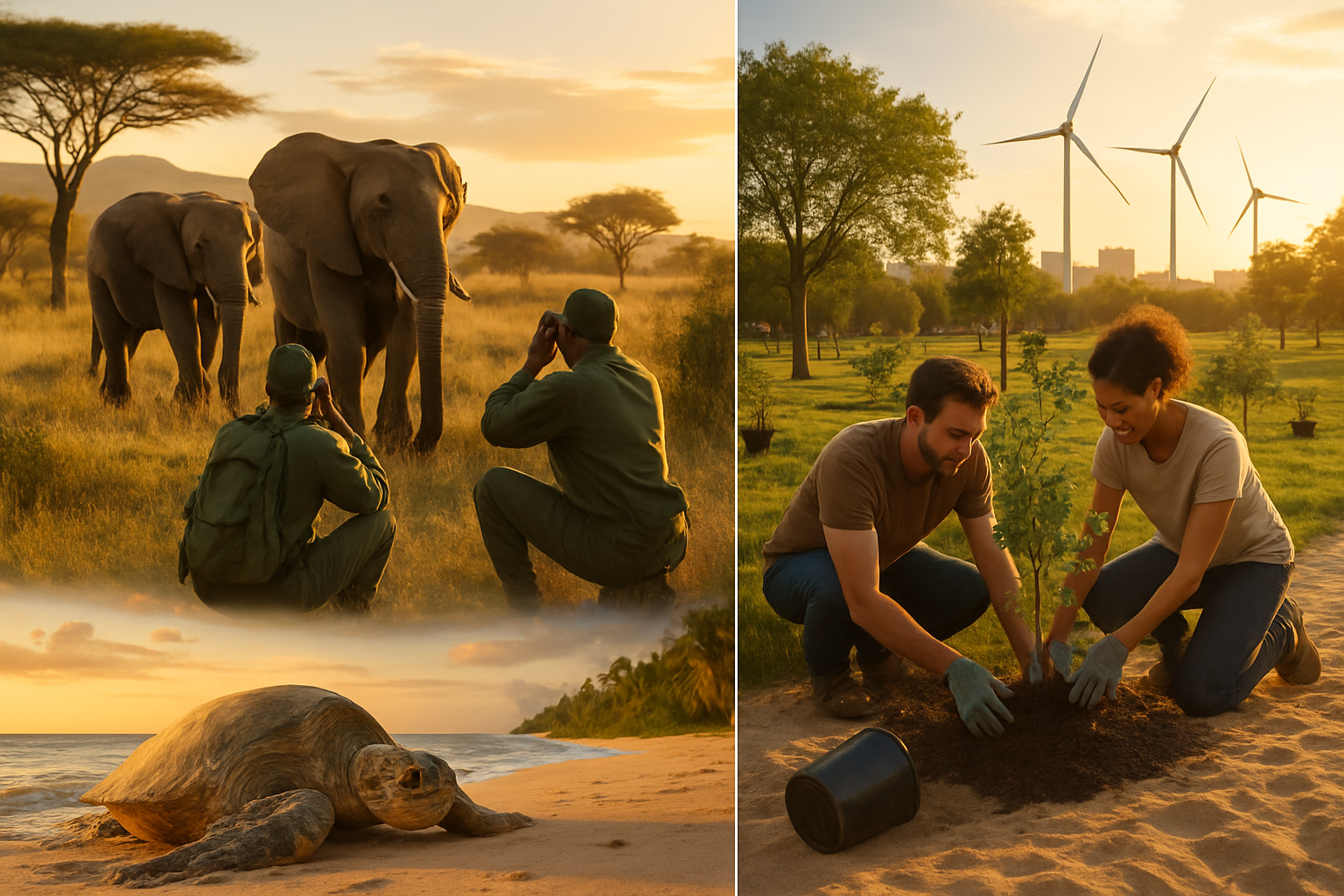
A surge of coordinated conservation victories across four continents marks a pivotal moment in global environmental protection, as nations demonstrate unprecedented cooperation in combating wildlife crime, restoring endangered species, and implementing innovative protection strategies during Earth's most challenging climate period.
From ivory trafficking arrests in the Democratic Republic of Congo to butterfly species recovery in the United Kingdom, the first week of March 2026 has delivered a series of environmental breakthroughs that signal a fundamental shift toward proactive ecosystem management during the 19th consecutive month of global temperatures exceeding 1.5°C above pre-industrial levels.
Central Africa Strikes Back Against Wildlife Crime
The Democratic Republic of Congo's Institut congolais pour la conservation de la nature (ICCN) has delivered a significant blow to ivory trafficking networks with the arrest of two traffickers near Kindu in Maniema province. The operation, conducted in collaboration with security services, represents the evolution of conservation law enforcement from reactive measures to systematic anti-trafficking strategies.
According to ICCN authorities, this arrest illustrates the persistent "wildlife criminality" that threatens the region's biodiversity. The successful operation demonstrates the growing capacity of African conservation agencies to deploy sophisticated enforcement techniques, building on recent breakthroughs including Zimbabwe's world-first lion DNA forensic prosecution that connected poachers to specific animals through national genetic databases.
"This arrest illustrates the wildlife criminality that has become too frequent and seriously threatens regional biodiversity."
— ICCN Official Statement
Kazakhstan's Conservation Infrastructure Milestone
In Central Asia, Kazakhstan has achieved a remarkable conservation milestone with the Ile-Alatau National Park celebrating three decades of environmental protection. Established on February 22, 1996, the park has grown from its original 164,450 hectares to become one of the nation's most important protected areas, safeguarding the Zailiysky Alatau mountain ecosystems while promoting sustainable tourism.
The anniversary marks a broader transformation in Kazakhstan's environmental approach, building on the success of the Przewalski's horse reintroduction program and the recent discovery of 711 potential springs through the National Hydrogeological Service. This systematic resource mapping demonstrates how developing nations are becoming environmental solution providers rather than aid recipients.
The park's success integrates traditional ecological knowledge with modern conservation science, employing satellite monitoring and environmental DNA sampling while respecting indigenous stewardship practices that have sustained mountain ecosystems for centuries.
Europe's Remarkable Species Recovery
The United Kingdom has achieved one of Europe's most significant conservation victories with the confirmation that the large tortoiseshell butterfly is no longer extinct in British territory. Early spring sightings across Kent, Sussex, Hampshire, Dorset, Cornwall, and the Isle of Wight mark the first time in decades that this colorful species has emerged from hibernation as a resident population.
Britain's native butterfly count has now increased to 60 species, representing a rare example of extinction reversal during the current biodiversity crisis. The recovery demonstrates how sophisticated conservation approaches combining habitat restoration, climate adaptation, and community engagement can achieve remarkable results even for species previously considered lost.
This success builds on broader European conservation momentum, including Croatia's recent establishment of Zagorske Gore as the nation's 13th nature park and Netherlands' advanced marine rescue infrastructure that recently saved harbor porpoises from Wadden Sea mudflats.
Urban Conservation Innovation
Latvia's urban conservation movement has gained international attention as the Āgenskalns Neighborhood Association mobilizes to protect Mazais Arkādijas parks (Little Arcadia park) in Rīga from planned development. The campaign represents a growing recognition that urban green spaces serve as critical biodiversity refuges and climate adaptation infrastructure.
The initiative demonstrates how community-led conservation can challenge traditional development patterns, arguing that historically and culturally significant urban ecosystems provide essential services including air purification, temperature regulation, and habitat connectivity that far exceed the value of commercial development.
Technology Meets Tradition
The convergence of cutting-edge technology with traditional ecological knowledge has emerged as a defining characteristic of successful 21st-century conservation. Kazakhstan's spring inventory utilizes advanced hydrogeological science enhanced by centuries of community knowledge about seasonal water patterns. The UK's butterfly recovery employed environmental DNA sampling and climate modeling while respecting traditional habitat management practices.
This synthesis represents a fundamental departure from either-or approaches toward comprehensive frameworks that combine scientific rigor with cultural sensitivity. Conservation programs that integrate satellite monitoring, genetic analysis, and AI-powered threat detection with indigenous stewardship practices consistently demonstrate superior long-term effectiveness compared to purely technological or traditional approaches.
Economic Engine of Environmental Protection
Modern conservation increasingly functions as an economic development strategy rather than a regulatory burden. Kazakhstan's national park system attracts eco-tourism and research partnerships while positioning the nation as a regional environmental leader. The UK's species recovery enhances the country's environmental credentials, supporting a multi-billion-pound conservation economy that includes eco-tourism, environmental technology, and sustainable investment.
Countries implementing comprehensive environmental protection demonstrate greater economic resilience and attract sustainable investment across sectors from green technology manufacturing to climate-adapted agriculture. The economic multiplier effects of conservation extend far beyond direct environmental sectors, improving public health outcomes, agricultural productivity through ecosystem services, and reducing infrastructure costs through natural disaster prevention.
Climate Crisis Context
These conservation victories emerge during an unprecedented period of global environmental stress. January 2026 marked the hottest month in recorded history, extending a 19-month streak of temperatures exceeding critical climate thresholds. This sustained warming override natural variability including La Niña cooling effects, demonstrating that human-induced climate change has fundamentally altered atmospheric systems beyond natural recovery mechanisms.
The conservation initiatives represent sophisticated responses to accelerating climate pressures, requiring innovative integrated solutions that address multiple environmental stressors simultaneously. Traditional conservation approaches designed for stable climate conditions require fundamental evolution toward adaptive management systems capable of responding to rapidly changing environmental conditions.
International Cooperation Evolution
The coordinated nature of March 2026's conservation breakthroughs reflects an evolution in international environmental cooperation. Knowledge sharing between Central African anti-trafficking expertise, Central Asian water management innovation, European species recovery techniques, and urban conservation strategies creates global conservation networks providing resilience against environmental challenges that transcend political boundaries.
This represents a shift from traditional North-South aid relationships toward peer-to-peer cooperation where developing nations emerge as environmental solution providers. Kazakhstan's hydrogeological mapping techniques inform water-stressed regions globally, while the Democratic Republic of Congo's enforcement capabilities provide templates for wildlife crime prosecution across Africa and beyond.
Implementation Challenges and Opportunities
Despite remarkable successes, significant challenges remain in scaling conservation efforts to match the speed and scope of environmental change. Funding sustainability remains critical for developing nations where immediate economic pressures often override long-term environmental considerations. Technical capacity building requires sustained investment in education, training, and institutional development.
Climate change compounds these challenges by disrupting project timelines and requiring adaptive management approaches that can respond to rapidly changing conditions. However, the diversity of conservation approaches emerging globally provides resilience against single-solution dependencies, offering multiple adaptation pathways for different environmental contexts.
Strategic Significance for the Future
March 2026 represents a critical juncture in global environmental protection, marking a potential turning point between reactive crisis management and proactive ecosystem service management. The window for effective environmental action continues to narrow as ecological systems approach critical thresholds that could trigger irreversible changes affecting global food security, climate stability, and human settlement patterns.
However, the tools, knowledge, and cooperation frameworks demonstrated by these conservation initiatives prove that comprehensive environmental protection remains achievable through coordinated international response. Success depends on sustained international cooperation, enhanced multi-sector coordination, and increased financial commitments that recognize environmental protection as essential infrastructure for human prosperity and planetary sustainability.
A Conservation Renaissance
The convergence of wildlife crime enforcement, species recovery, protected area expansion, and urban conservation victories suggests the emergence of a "conservation renaissance" characterized by scientific innovation, community engagement, economic viability, and international cooperation integration.
This movement represents a fundamental evolution from traditional protected area models toward integrated landscape-scale management that addresses climate adaptation, community resilience, and sustainable development simultaneously. The success or failure of this approach during the critical climate action decade may prove decisive in determining conservation strategies for generations to come.
As global environmental challenges accelerate, the coordinated response emerging in March 2026 offers both urgent warnings and grounds for hope. The convergence of human ingenuity, traditional knowledge, technological innovation, and international cooperation provides a foundation for the massive environmental protection effort required to maintain planetary habitability during Earth's most challenging environmental period in human history.