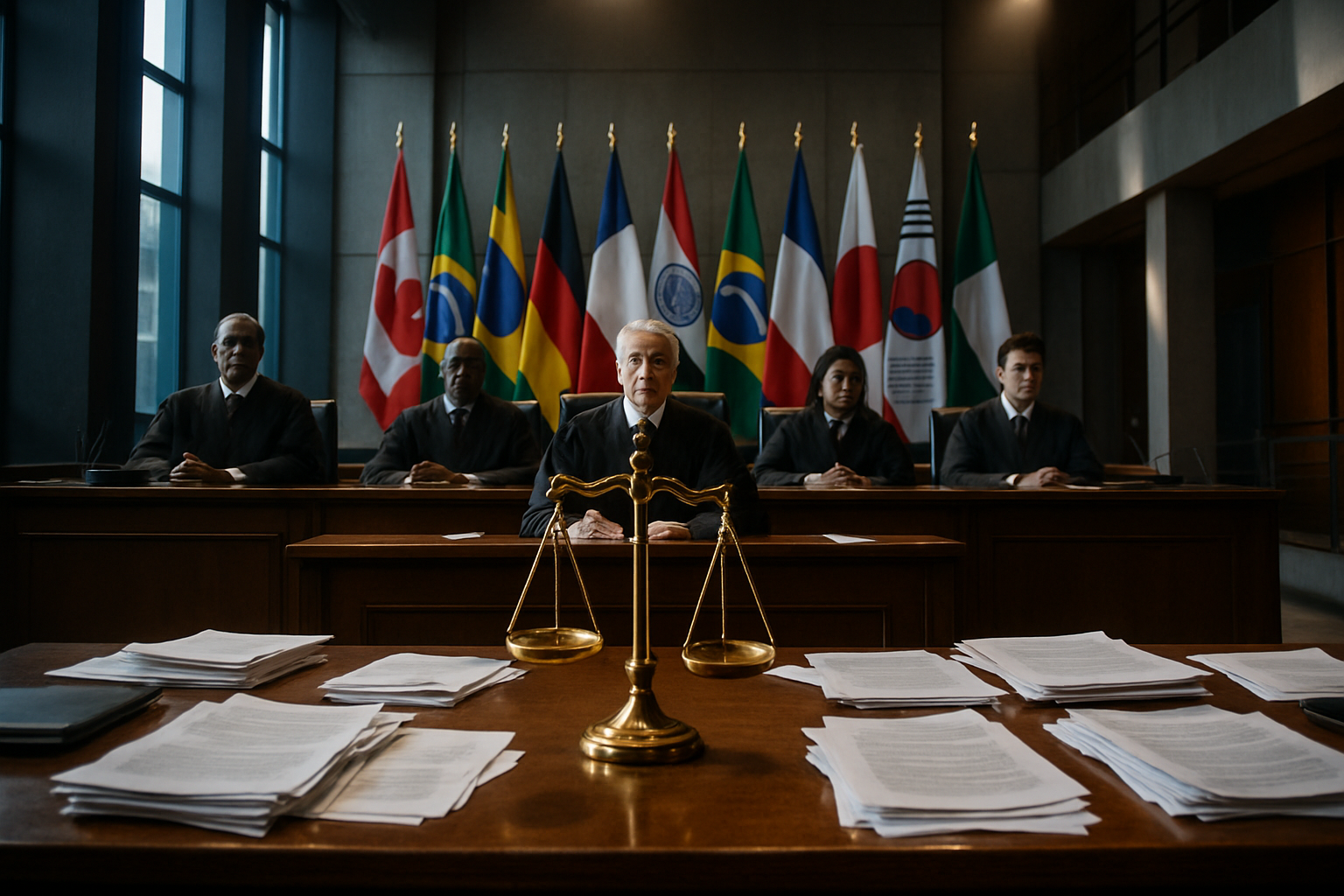
A wave of corruption scandals and financial crime investigations spanning seven countries demonstrates the unprecedented challenges facing democratic institutions as sophisticated criminal networks exploit weak governance structures while transparency advocates demand accountability.
From Bulgaria's shocking medical exploitation case to Trinidad and Tobago's campaign finance crisis, March 31, 2026 marks a critical juncture for global anti-corruption efforts as prosecutors across multiple continents pursue high-profile cases that test the resilience of democratic accountability mechanisms.
Bulgaria's Medical Exploitation Scandal
Bulgarian prosecutors have filed 17 charges against prominent figures including former National Patient Organization chairman Dr. Stanimir Hasardzhiev, model Anastasius Michailidis, actor Rosen Belov, and former French Foreign Legion member Simeon Drianovski. The case centers on allegations of coercion, sexual exploitation, and the production of pornographic materials involving minors.
In a disturbing first for Bulgarian law enforcement, investigators discovered evidence of the so-called "rape drug" being used systematically. The investigation, initiated by victim reports in September 2025, reveals a pattern of exploitation that prosecutors describe as unprecedented in scope and sophistication.
"This case represents the darkest abuse of medical authority and public trust we have encountered in modern Bulgarian history."
— Bulgarian Prosecutor General's Office
Ireland's Police Financial Misconduct
Irish parliamentary committees received shocking testimony about widespread financial irregularities within the Garda Síochána, with more than a dozen cases of money disappearing from police stations documented. One investigation involving €1,100 resulted in criminal proceedings against a serving garda officer.
The revelations expose systemic vulnerabilities in Ireland's law enforcement financial controls, raising questions about institutional oversight and accountability mechanisms that have traditionally been viewed as robust within European Union standards.
Malaysia's Transparency Crisis
Former DAP MP Charles Santiago has demanded full disclosure regarding the controversial shareholding investigation of Malaysian Anti-Corruption Commission (MACC) chief Azam Baki. Santiago criticized the decision to keep investigation reports classified, describing it as perpetuating a "continued culture of secrecy" that undermines public confidence.
Simultaneously, public discourse emphasizes that "silence on corruption is not acceptable," with civil society organizations demanding transparent processes and independent verification of all allegations against senior anti-corruption officials.
Philippines Landmark Convictions
The anti-graft court Sandiganbayan delivered significant convictions against two former Department of Public Works and Highways (DPWH) officials for corruption involving anomalous right-of-way payments in South Cotabato. Former assistant regional director Tomas Rodriguez received convictions on two graft counts and nine falsification charges, while former planning chief David Padlan was convicted on two graft counts and four falsification charges.
The case involves systematic fraud in infrastructure projects from 2007-2009, representing a multi-million peso scheme that diverted funds intended for critical regional development. The convictions demonstrate the Philippines' continued commitment to prosecuting high-level corruption despite political pressures.
Tonga's Historic Land Fraud Investigation
The Tongan government launched a landmark investigation into decades of alleged corruption within the Ministry of Lands, marking what officials describe as a "historic step toward confronting corruption claims that have shadowed the institution for generations."
This sweeping probe follows complaints lodged by senior officials with the Public Service Commission and represents a turning point in Tonga's approach to institutional accountability. The investigation addresses systematic land fraud allegations that have persisted for decades, affecting property rights and governance credibility across the Pacific nation.
Trinidad and Tobago's Campaign Finance Crisis
The Trinidad and Tobago Transparency Institute (TTTI) issued urgent calls for campaign finance reform following the murder of businessman Danny Guerra and subsequent reports linking him to government officials. The institute emphasized the "urgent need" for transparent political financing laws following reports about Guerra's potential political connections.
The case highlights the dangerous intersection between political financing, business interests, and violent crime that has plagued Caribbean democracies. Guerra's death on March 13 shocked the Sangre Grande community and raised serious questions about political accountability and transparency in campaign funding.
Global Context: Institutional Strain
These cases emerge amid what corruption experts describe as the worst global corruption environment in a decade. The 2025 Transparency International Corruption Perceptions Index showed democratic backsliding worldwide, with even traditionally strong performers like the United States recording their lowest-ever scores.
Modern corruption networks demonstrate state-like capabilities, utilizing encrypted communications, compartmentalized international structures, and advanced surveillance systems that often exceed traditional law enforcement resources. This technological sophistication requires unprecedented international cooperation and specialized institutional responses.
International Cooperation Challenges
European law enforcement officials describe current developments as representing the "largest international elite criminal network exposure in recent memory." Enhanced cooperation mechanisms are emerging through specialized corruption courts, intelligence sharing protocols, and coordinated training programs, yet structural obstacles persist.
The cases spanning Bulgaria to Trinidad demonstrate how corruption networks exploit jurisdictional boundaries, diplomatic immunity provisions, and varying legal standards across democratic systems. Success requires sustained political commitment beyond electoral cycles and comprehensive institutional reforms.
Democratic Resilience Under Test
Despite mounting pressures, judicial institutions across these seven nations are demonstrating fundamental resilience in delivering fair and transparent justice regardless of defendants' political or social status. Professional accountability mechanisms are strengthening with expanded transparency requirements and specialized training becoming standard practice.
The willingness to confront historical injustices in Tonga, pursue medical authority abuse in Bulgaria, and prosecute police misconduct in Ireland demonstrates institutional commitment to rule of law principles even when politically costly.
Technology and Modern Corruption
Criminal organizations increasingly exploit legitimate technologies faster than enforcement institutions can adapt. Digital forensics capabilities, AI-assisted analysis, and encrypted communication monitoring are becoming essential investigative tools, yet criminal innovation consistently outpaces institutional countermeasures.
The Philippines case involved sophisticated document falsification, while the Bulgarian scandal utilized digital communications networks. Malaysia's crisis centers on financial transparency in the digital age, highlighting how traditional oversight mechanisms struggle with modern corruption techniques.
Prevention and Reform Requirements
Successful anti-corruption efforts require transparent legal frameworks, sustained political commitment, international cooperation, civil society protection, and innovative accountability approaches. Countries demonstrating progress typically combine enhanced enforcement with community engagement, educational programs, and economic development initiatives.
The integration of technological advancement with human expertise, proactive prevention with responsive enforcement, and local adaptation with global coordination remains essential for addressing root causes beyond reactive operations.
Implications for Global Governance
March 2026 represents a critical test of international cooperation mechanisms against criminal organizations possessing state-like capabilities. The convergence of cases across seven nations challenges traditional concepts of sovereignty and jurisdiction while testing democratic institutions designed for different eras and threats.
Success in achieving accountability while preserving civil liberties and democratic principles will establish crucial precedents for 21st-century governance. Failure could reinforce perceptions of elite impunity, potentially undermining democratic legitimacy and encouraging further corruption in an interconnected world where criminal networks operate without regard for traditional boundaries.
The coming months will test whether democratic institutions can maintain their essential functions while adapting to contemporary realities, preserving rule of law principles that protect constitutional government against increasingly sophisticated transnational criminal threats.