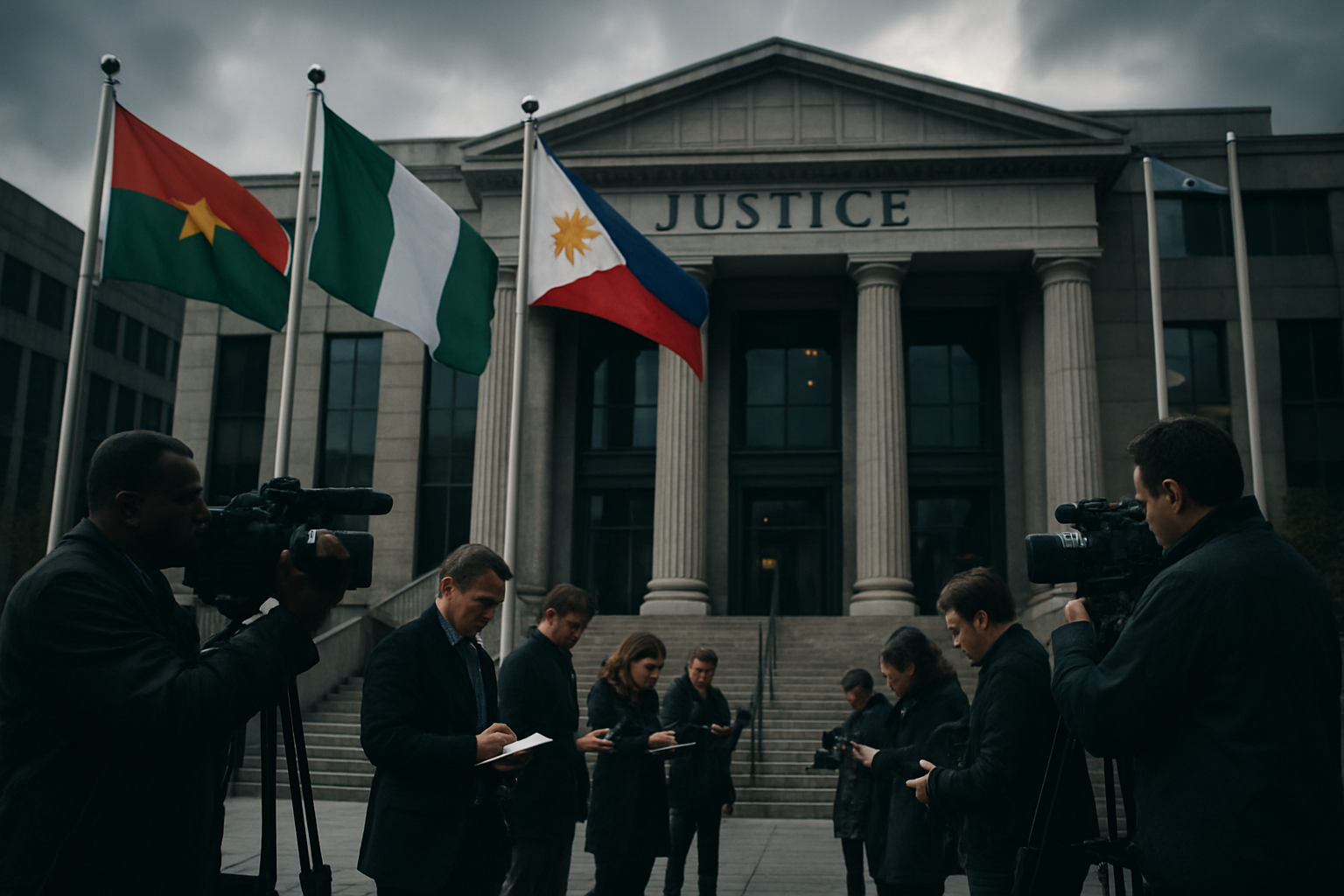
A wave of high-profile corruption and legal cases spanning Canada, Greece, Russia, and Romania has emerged as a defining test of democratic institutions' ability to hold powerful figures accountable, regardless of their political connections or former positions of authority.
These simultaneous proceedings, involving former officials, defense ministers, and prosecutors, represent what legal experts describe as unprecedented strain on global judicial systems while demonstrating the resilience of democratic accountability mechanisms in the face of complex transnational challenges.
Russia's Defense Ministry Corruption Scandal
The most significant case involves former Russian Deputy Defense Minister Ruslan Tsalikov, who served as the first deputy to former Defense Minister Sergei Shoigu from 2015 to 2024. Russian investigators have charged Tsalikov with leading an organized criminal group, money laundering, bribery, and embezzlement spanning from 2017 to 2024.
According to Russia's Investigative Committee, the charges include 12 episodes of embezzlement and two instances of bribery. The case represents one of the most serious corruption allegations to emerge from Russia's defense establishment, traditionally one of the country's most powerful institutions.
"The former deputy defense minister, Ruslan Tsalikov, has been arrested. A decision on pretrial detention is being made."
— Russian Investigative Committee Spokesperson
The arrest occurs amid broader scrutiny of Russia's defense spending and military procurement processes, with international observers noting the timing coincides with ongoing military operations and increased defense expenditure. The charges against Tsalikov could potentially expose systematic corruption within Russia's military-industrial complex.
Canada's Prosecutorial Ethics Crisis
In Canada, a different but equally significant legal drama has unfolded involving former provincial Crown prosecutor Tim O'Brien, who has become both victim and critic in an extraordinary case that exposes internal tensions within the country's prosecutorial system.
O'Brien, now serving as a federal Crown prosecutor, was the victim in a 2023 extortion case that is nearing conclusion. However, his public criticism of how his former provincial colleagues handled his case has raised unprecedented questions about prosecutorial ethics and professional solidarity.
The case centers on O'Brien's allegations that he was "kept in the dark and treated with a lack of respect" by his former colleagues during the investigation and prosecution of his extortion case. This unusual situation of a prosecutor publicly criticizing the handling of a case in which he was the victim has created significant controversy within Canada's legal community.
Legal experts note that such public criticism by one prosecutor of another's work is extremely rare and highlights growing tensions within Canada's Crown prosecution service. The case has prompted discussions about victim rights, prosecutorial independence, and the appropriate boundaries of professional criticism within the legal system.
International Pattern of Corruption Prosecutions
These cases emerge against a backdrop of what international legal observers describe as the "largest international elite criminal network exposure in recent memory." Recent months have witnessed unprecedented coordination among law enforcement agencies across multiple countries, targeting corruption networks that span national boundaries.
From the Jeffrey Epstein files revelations affecting officials across six countries to systematic investigations into political corruption from South Korea to Peru, 2026 has marked a watershed moment for international accountability mechanisms. The current cases in Canada and Russia add to this pattern, demonstrating that no institution—whether civilian prosecutor's offices or military defense ministries—is immune from scrutiny.
Institutional Resilience Under Pressure
Despite the challenges these cases present, they also demonstrate the fundamental resilience of democratic institutions when confronted with corruption allegations. In Canada, the willingness of O'Brien to speak publicly about his concerns, while controversial, reflects the transparency and accountability mechanisms that characterize democratic legal systems.
Similarly, Russia's decision to arrest and charge a former deputy defense minister, despite the sensitive nature of the position and ongoing military operations, suggests that even authoritarian systems face internal pressures to address corruption when it reaches certain levels of visibility or impact.
Technology and Modern Corruption Investigations
Modern corruption investigations increasingly rely on sophisticated technological tools, including digital forensics, financial transaction analysis, and international information sharing systems. The complexity of these cases reflects the evolution of both criminal networks and the law enforcement capabilities designed to combat them.
European law enforcement coordination has reached new levels of sophistication, with specialized courts for corruption and organized crime representing institutional innovations that provide templates for international cooperation. These technological and institutional advances enable prosecutors to tackle complex cases that would have been impossible to pursue effectively just a decade ago.
Democratic Accountability in the Digital Age
The current wave of cases also highlights the tension between public demand for immediate transparency and the need for careful, methodical investigation procedures. Social media and digital communication have created what some experts call a "social media court" where allegations can go viral without proper verification, creating premature judgments that complicate formal legal proceedings.
This phenomenon has been particularly evident in Malaysia, where anti-corruption officials have identified social media speculation as one of the biggest threats to investigation integrity. The challenge facing judicial systems worldwide is maintaining due process while responding to legitimate public demands for accountability and transparency.
Global Implications for Rule of Law
The success or failure of these high-profile cases will have implications far beyond their immediate participants. They serve as crucial tests of whether democratic institutions can maintain their essential functions while adapting to contemporary challenges, from technological disruption to transnational criminal networks.
International cooperation has become essential for effective prosecution of modern corruption cases, as criminal networks increasingly operate across borders and utilize sophisticated financial instruments that transcend traditional jurisdictional boundaries. The enhanced coordination emerging among European law enforcement agencies provides a model for addressing these challenges.
"These cases represent fundamental tests of democratic institutions' capacity to deliver justice fairly while maintaining public trust."
— Dr. Maria Rodriguez, University of Miami Legal Expert
The Road Ahead
As these cases proceed through their respective judicial systems, they will establish important precedents for how democratic institutions handle complex corruption allegations in the 21st century. The outcomes will influence public confidence in legal systems across the democratic world and provide templates for future international cooperation in combating transnational corruption.
The challenge facing judicial systems worldwide is maintaining the delicate balance between accountability demands and institutional stability while preserving the rule of law principles that underpin constitutional government. Success requires sustained political commitment to judicial independence, adequate resource allocation, and continued public support for transparent, fair legal processes.
These cases, spanning from Canadian prosecutorial ethics to Russian defense ministry corruption, represent more than individual legal proceedings—they are tests of democratic resilience in an era of unprecedented global connectivity and complexity. Their resolution will help define the relationship between power, accountability, and justice in the modern world.