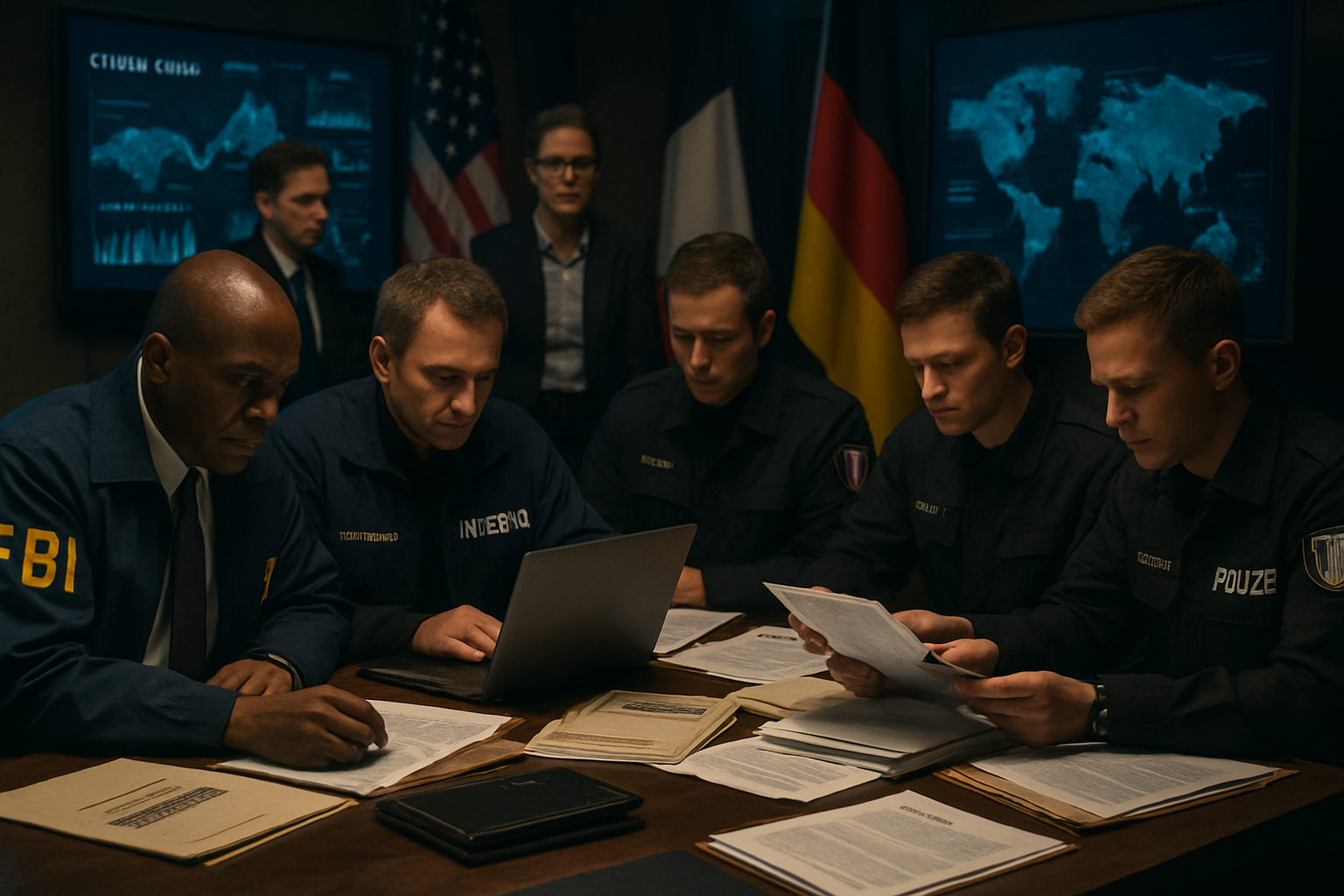
Law enforcement agencies across four continents have launched an unprecedented wave of coordinated criminal investigations, targeting everything from organized crime syndicates to high-level corruption, marking February 2026 as a watershed moment for international police cooperation.
From the Balkans to the Caribbean, from West Africa to Eastern Europe, a complex web of criminal investigations has emerged, revealing the sophisticated nature of modern transnational crime networks and the evolving response of global law enforcement agencies.
Balkan Violence and Justice
The Western Balkans continue to grapple with violent crime and institutional challenges. In Bosnia and Herzegovina, the murder of Marijo Dadić, known as "Pink Panter," a serial thief with multiple convictions, has exposed ongoing criminal networks in the Mostar area. Police have detained four suspects in connection with the killing, while actively searching for two others.
The case highlights the persistent influence of organized crime in the region, where criminal figures often become targets themselves in cycles of violence that challenge law enforcement capabilities.
Meanwhile, in Sarajevo, a tram driver has been arrested and faces a one-month detention proposal following a fatal traffic accident that killed one person and injured four others. The case demonstrates the broader challenges facing Bosnia's judicial system in balancing public safety with individual rights.
Caribbean Drug Enforcement Evolution
The Dominican Republic has become a focal point for international drug enforcement cooperation, with the arrest of a DEA supervisor highlighting the complex intersection of law enforcement and corruption. The arrest, part of an investigation into abuse of the U.S. confidential informant visa program, comes as President Trump's administration unexpectedly shut down the anti-narcotics office in the Caribbean nation.
"This represents a disgusting and dishonorable breach of public trust,"
— Trump Administration Statement
The closure and arrests underscore the delicate balance between international cooperation and sovereignty in drug enforcement operations that span multiple jurisdictions.
West African Crime Networks
Ghana has emerged as a critical battleground against transnational organized crime, with police operations revealing the sophisticated nature of modern criminal networks. In a major breakthrough, authorities dismantled a human trafficking and organized cybercrime syndicate in Pokuase, Greater Accra Region, arresting 22 suspects.
The operation, conducted by the Special Cyber Vetting and Enforcement Team, uncovered what police described as a large-scale cyber fraud hub commonly referred to as a "Yahoo Boys" base. Preliminary investigations revealed a structured hierarchy within the syndicate, including individuals responsible for enforcing control over trafficked victims.
Separately, Ghanaian courts have processed multiple cases highlighting the intersection of fraud and violence. A 34-year-old trader was granted bail after allegedly posing as a military officer to impress a nurse at the 37 Military Hospital, while police investigate the suspicious death of a 34-year-old woman found at her family home under questionable circumstances.
Financial Crime Innovation
The Ghanaian cases illustrate how traditional crimes have evolved to exploit modern technology and social media, with criminals using sophisticated techniques to deceive victims and evade detection. The human trafficking component adds a particularly concerning dimension, as vulnerable individuals are reportedly exploited for cybercrime operations.
European Judicial Cooperation
Ireland's approach to financial crime has gained international attention with the charging of a mother found with €250,000 in her car boot under money-laundering legislation. The woman reportedly told gardaí that the contents of the suitcase could have been "drugs or a dead body for all she knew," highlighting the challenges of proving intent in financial crime cases.
This case exemplifies the evolving nature of money laundering investigations, where circumstantial evidence and suspect behavior often play crucial roles in prosecution strategies.
Caribbean Organized Crime
Jamaica continues to face significant challenges from organized criminal networks, as evidenced in ongoing legal proceedings. The trial of 25 suspected members of the alleged Tesha Miller faction of the Klansman Gang has revealed the sophisticated nature of these organizations and their capacity to challenge law enforcement through legal maneuvering.
Defense attempts to discredit prosecution witnesses have largely failed, with forensic crime scene investigators providing detailed testimony about evidence collection procedures. The case demonstrates the critical importance of maintaining chain of custody procedures and professional investigative standards.
Meanwhile, police operations have yielded significant weapons seizures, including an AK-47 assault rifle and almost 300 rounds of assorted ammunition discovered during a targeted raid in Rockfort, east Kingston. Intelligence indicated the weapons belonged to the Top Temple gang and were being used for both storage and sales operations.
Eastern European Crime Networks
Poland's approach to domestic violence and murder investigations has drawn attention with the arrest of a 46-year-old woman suspected of murdering her partner with knife wounds. The case began when the woman initially told police that her partner had been beaten by someone else, but forensic evidence contradicted her account.
This case highlights the evolution of forensic techniques and their crucial role in modern criminal investigations, particularly in cases where initial witness accounts prove unreliable.
Political Prisoners and Civil Rights
Albania's handling of political dissent has come under scrutiny following the release of 14 protesters arrested during opposition demonstrations on February 10. The Tirana Court set security measures despite prosecution requests for imprisonment, with defense lawyers arguing lack of evidence and demanding immediate release.
The case reflects broader tensions in Albanian society over political accountability and the right to peaceful protest, particularly in the context of the country's EU accession process.
International Cooperation Challenges
The diverse range of cases across these 12 countries reveals both the promise and limitations of international law enforcement cooperation. While information sharing and coordinated operations have become more sophisticated, jurisdictional boundaries and varying legal frameworks continue to present challenges.

Technology has emerged as both an enabler of criminal activity and a tool for law enforcement response. The Ghanaian cybercrime operations demonstrate how criminal networks exploit digital platforms, while forensic advances in countries like Poland show how technology aids investigation and prosecution.
Systemic Challenges
Several patterns emerge from this global survey of criminal investigations. First, the increasing sophistication of transnational criminal networks requires corresponding evolution in law enforcement capabilities. Second, the intersection of corruption and organized crime poses particular challenges for developing democratic institutions.
Third, the role of technology in both facilitating and combating crime continues to expand, requiring specialized expertise and international cooperation. Finally, the importance of maintaining public trust in judicial institutions remains paramount for effective law enforcement.
Looking Forward
The February 2026 wave of criminal investigations represents a critical test of international law enforcement cooperation in addressing 21st-century criminal challenges. Success will depend on sustained political commitment, adequate resources, and continued enhancement of institutional capabilities.
"The challenge is not just to arrest criminals, but to build systems that prevent criminal networks from operating with impunity across borders."
— International Law Enforcement Expert
As these investigations proceed, they will likely establish important precedents for international criminal justice cooperation and demonstrate whether democratic institutions can effectively address the sophisticated criminal networks that threaten global security and stability.
The diversity of cases—from high-tech cybercrime to traditional violent crime, from political corruption to international drug trafficking—illustrates the complex landscape that law enforcement agencies must navigate in an increasingly interconnected world.