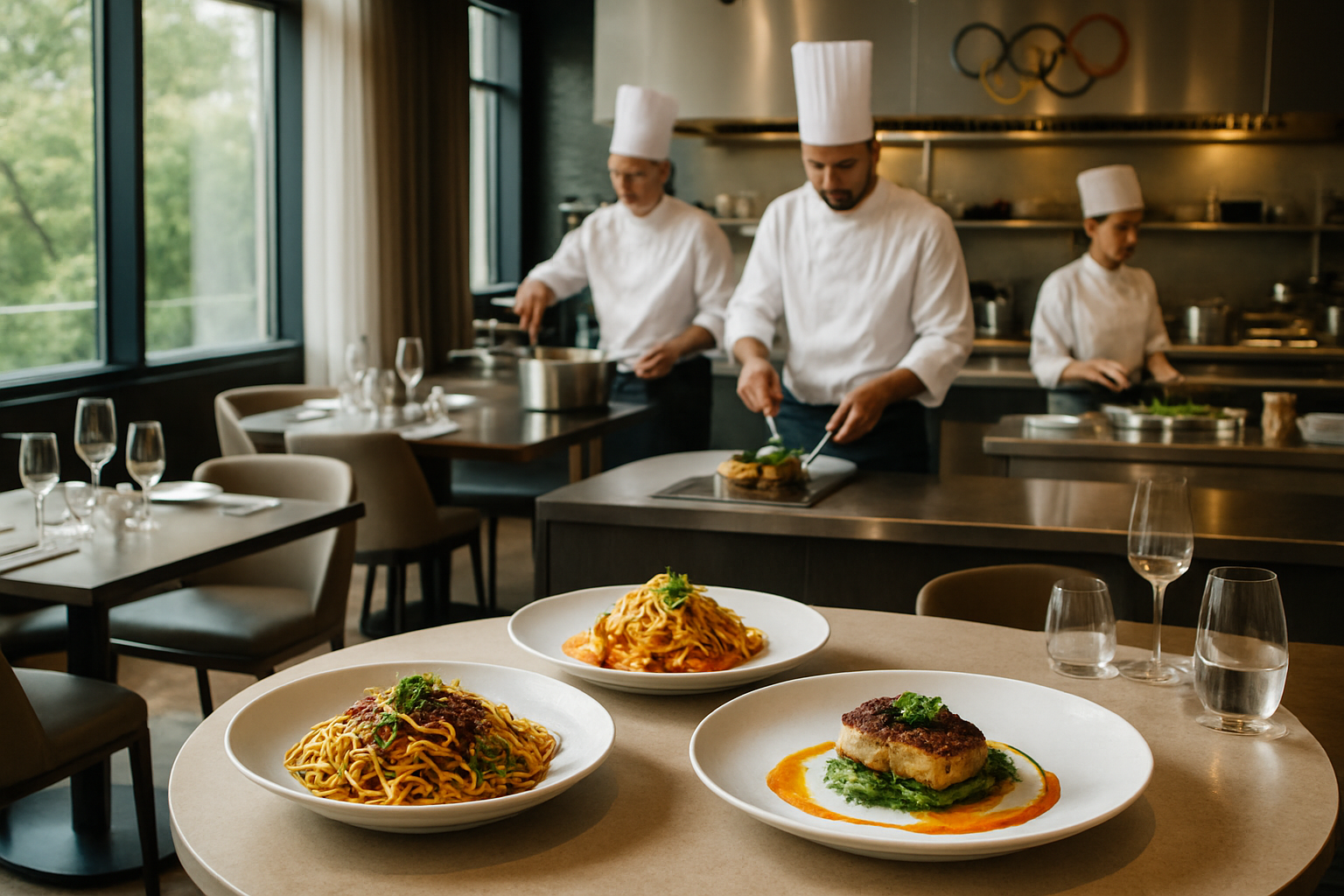
February 2026 has witnessed a remarkable convergence of culinary innovation across three continents, from Portugal's chef-driven restaurant openings to China's traditional noodle industry transformation and Italy's Olympic catering revolution, signaling a new era in global food culture that balances tradition with technological advancement.
Portuguese Coastal Cuisine Embraces Terroir
Chef João Rodrigues has opened Mogo, a groundbreaking restaurant in Tróia that represents his return to more personal, landscape-inspired cuisine. The establishment marks a significant shift toward autoral cooking that draws deeply from the surrounding natural environment—encompassing sea, river, estuary, and dunes. This approach reflects a broader trend in European fine dining where chefs are increasingly connecting their culinary philosophy to specific geographical locations.
Rodrigues' concept aligns with the Nordic culinary movement's expansion into new territories, as documented in recent developments where Nordic-inspired fine dining has reached Brisbane's West End. The Mogo project demonstrates how established chefs are reinterpreting regional ingredients through contemporary techniques while maintaining strong connections to local ecosystems.
Lanzhou Noodles: Traditional Cuisine Meets Global Markets
Meanwhile, in China, the Lanzhou beef noodle industry has achieved unprecedented success through cross-sector integration, generating diversified revenue streams exceeding 12 billion yuan in 2025. According to Yang Bingwen, Director of the Commercial Services Division at the Lanzhou Municipal Bureau of Commerce, the total revenue of the entire industrial chain reached 80 billion yuan, representing a remarkable 33% year-over-year growth.
This transformation extends far beyond traditional restaurant operations, incorporating pre-packaged products, exhibition activities, IP licensing, and brand value creation. The success story illustrates how traditional regional cuisines can evolve into global cultural intellectual properties while maintaining their authentic character.
"Once a must-try culinary landmark of the city and now a cultural IP savored across the globe, Lanzhou Beef Noodles is undergoing a remarkable transformation through cross-sector integration."
— Yang Bingwen, Lanzhou Municipal Bureau of Commerce
The Lanzhou model demonstrates how traditional food culture can embrace modern business practices without losing cultural authenticity. This approach contrasts sharply with the industrial food safety challenges recently experienced in Europe, where French and Luxembourg authorities recalled multiple infant formula brands due to cereulide toxin contamination, highlighting the vulnerabilities in complex industrial food processing.
Olympic Catering: Learning from Past Mistakes
The Milano Cortina 2026 Winter Olympics represents a crucial test case for large-scale event catering, with organizers determined to avoid the food service problems that plagued the Paris 2024 Games. Elisabetta Salvadori, head of food and beverages for the Games, emphasized that food preparation and service must actively enhance athletic performance.
"Food must be actually prepared and served to enhance the performance of the athletes in the Olympics which most of them have worked and trained for years," Salvadori explained, addressing the lessons learned from Paris where several delegations complained about food quantity and quality issues.
The Paris Olympics faced significant criticism over egg rationing and limited protein options, forcing organizers to make late adjustments after athlete grievances. The Milano Cortina approach represents a comprehensive reimagining of sports nutrition at the Olympic level, with menu development and kitchen workflows specifically designed around athletic performance requirements.
Performance-Driven Menu Design
With approximately 2,900 athletes from 92 countries participating in the February 6-22 Games, the catering operation must balance diverse dietary requirements with high-performance nutrition needs. The Italian approach emphasizes traditional Mediterranean ingredients—pasta and pizza have proven particularly popular—while incorporating international options to accommodate the global athlete population.
This focus on performance nutrition reflects broader trends in sports science, where nutrition has become increasingly recognized as a critical component of athletic success. The Games' catering strategy serves as a model for how large-scale food service operations can prioritize both cultural authenticity and functional nutrition.
Global Food Industry Convergence
These three developments—Portuguese terroir-driven cuisine, Chinese traditional food modernization, and Olympic performance nutrition—represent different facets of a global culinary renaissance occurring in early 2026. Each demonstrates how contemporary food culture successfully balances respect for tradition with innovation and technological advancement.
The convergence is particularly evident in the emphasis on local ingredients and cultural authenticity across all three contexts. Whether it's Rodrigues drawing inspiration from Tróia's coastal landscape, Lanzhou noodles maintaining their cultural identity while expanding globally, or the Olympics incorporating Italian culinary traditions into performance nutrition, the common thread is the preservation of cultural authenticity within modern frameworks.
Technology Integration and Traditional Methods
The role of technology in these culinary developments varies significantly but remains constant across all three examples. The Lanzhou noodle industry's success stems partly from sophisticated IP development and exhibition activities, while the Olympic catering operation relies on advanced logistics and nutrition science. Even Rodrigues' restaurant, while focused on traditional cooking methods, operates within contemporary restaurant technology and marketing frameworks.
This technological integration contrasts with recent challenges in European industrial food production, where sophisticated safety protocols failed to prevent contamination issues in infant formula manufacturing. The difference suggests that technology works most effectively in food culture when it enhances rather than replaces traditional knowledge and practices.
Cultural Preservation Through Innovation
All three developments demonstrate successful models for cultural preservation through innovation. The Lanzhou noodle industry's 33% growth occurred precisely because it maintained cultural authenticity while embracing modern business practices. Similarly, Rodrigues' restaurant concept succeeds by deepening rather than abandoning connections to local geography and ingredients.
The Olympic catering approach, while focused on performance enhancement, incorporates Italian culinary traditions as a foundation rather than an obstacle. This approach aligns with broader global trends in cultural heritage preservation, where traditional practices are strengthened rather than displaced by contemporary innovations.
Economic and Social Impact
The economic implications extend beyond individual businesses to broader regional development. The Lanzhou noodle industry's 80 billion yuan total industrial chain revenue demonstrates how traditional food culture can become a significant economic driver. Similarly, Rodrigues' restaurant contributes to Portugal's growing culinary tourism sector, while the Olympic catering operation showcases Italian cuisine on a global stage.
These developments occur within a broader context of global food security challenges and agricultural modernization initiatives across multiple continents, from Caribbean climate-smart agriculture programs to African irrigation development projects. The success of traditional cuisine modernization provides a model for how food culture can contribute to broader economic development while maintaining cultural integrity.
Future Implications
The February 2026 culinary developments suggest several important trends for the global food industry. First, the successful integration of traditional practices with modern technology and business methods appears to be a key factor in sustainable growth. Second, the emphasis on local ingredients and cultural authenticity resonates across different markets and contexts.
Third, the focus on functional benefits—whether performance nutrition for athletes or health-conscious dining for consumers—represents an evolution in how food culture addresses contemporary needs while maintaining traditional foundations. These trends suggest that the future of global cuisine lies not in homogenization but in the sophisticated preservation and modernization of diverse food cultures.
The contrast between successful traditional cuisine modernization and recent industrial food safety challenges also highlights the importance of maintaining human knowledge and oversight in food production systems, regardless of technological sophistication.