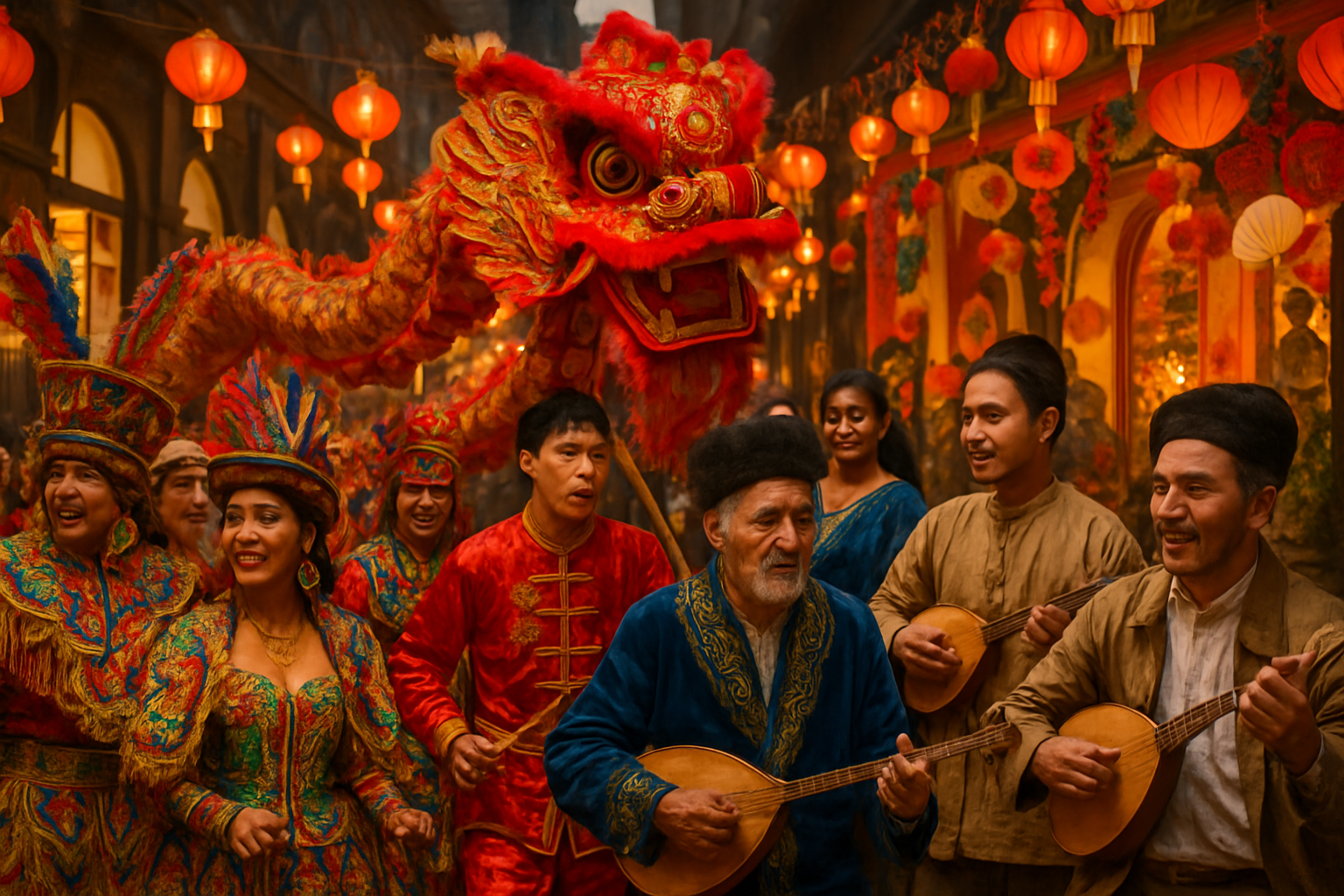
An extraordinary convergence of cultural celebrations has emerged across six nations, from Chinese New Year festivities marking the rare Year of the Fire Horse to groundbreaking art exhibitions and heritage preservation initiatives, demonstrating the emergence of a coordinated global cultural renaissance that transcends borders and celebrates humanity's shared artistic heritage.
Fire Horse Celebrations Create Global Cultural Bridges
The Chinese New Year celebrations marking the Year of the Fire Horse—a rare occurrence happening only once every 60 years—have achieved unprecedented international participation, creating authentic cultural bridges between Chinese and non-Chinese communities worldwide. In Bolivia, the celebrations coincided with the nation's vibrant Carnival season, creating what cultural observers describe as a "perfect storm of cultural energy."
Bolivia's La Razón reported that while the country celebrates with "passionate music and dances" during Carnival, China simultaneously welcomed the Spring Festival on February 17, the most important traditional celebration of the year. The convergence represents a symbolic fusion of Latin American exuberance with Asian spiritual renewal, both emphasizing themes of community, family unity, and hope for prosperity.
"The Fire Horse brings speed, immediacy, and good fortune to our celebrations. This rare celestial event occurs only once every 60 years, making 2026 a truly special moment for cultural exchange."
— Cultural Ministry Officials, Global Fire Horse Celebrations
Malaysia's multicultural society has embraced the Fire Horse celebrations with remarkable enthusiasm, demonstrating successful integration across ethnic lines. The Borneo Post documented how political leaders set aside differences to highlight what they described as the state's "most enduring hallmark—racial harmony and unity." Tourism Minister Datuk Sri Tiong King Sing's visit to Progressive Democratic Party leader homes showcased how Chinese New Year has evolved beyond ethnic boundaries to become a celebration of Malaysian national identity.
Monaco's Cultural Diplomacy Through Celebration
Monaco's approach to Chinese New Year celebrations exemplifies sophisticated cultural diplomacy. The principality marked the arrival of the Year of the Fire Horse with an evening organized by the Monegasque association Monaco-Chine, supported by the Embassy of Monaco in China. Around 100 guests gathered to celebrate, including diplomatic representatives from both nations, reflecting the 30th anniversary of Monaco-China relations celebrated in 2025.
The evening featured traditional cultural performances including lion dances, calligraphy demonstrations, and live Guzheng music, creating what organizers described as an authentic bridge between European and Chinese cultural traditions. This celebration demonstrates how smaller nations can leverage cultural events to strengthen international relationships while enriching their domestic cultural landscape.
Artist María Jesús Contreras: Chilean Talent on Global Stage
Chile's contribution to the global cultural renaissance comes through the remarkable success of illustrator María Jesús Contreras from Temuco, who was selected by luxury French brand Hermès to create artwork for their Chinese New Year campaign. Through her Instagram account, Contreras revealed the significance of this achievement: "Last year I worked all year for this moment. Hermès gave me the enormous responsibility of creating art for the Chinese New Year campaign."
This collaboration represents a fascinating intersection of Latin American artistic talent, European luxury craftsmanship, and Chinese cultural celebration—embodying the global nature of contemporary cultural exchange. Contreras's selection demonstrates how traditional festivals have become platforms for international artistic collaboration, creating opportunities for emerging artists to reach global audiences.
Kazakhstan's Musical Heritage Preservation
Kazakhstan's approach to cultural celebration focuses on preserving and sharing traditional musical heritage. The Astana Times reported that renowned Kazakh singer Dimash Qudaibergen showcased musical instruments from his personal collection at an exhibition titled "Dimash: One Voice – A Thousand Countries" in Almaty. The event took place at the Museum of Folk Instruments named after Ykhlas, where Qudaibergen personally donated instruments to the museum's permanent collection.
The centerpiece of this cultural moment was Qudaibergen's donation of his first dombyra, the traditional Kazakh stringed instrument. This gesture represents more than artistic philanthropy—it demonstrates how contemporary artists can serve as cultural ambassadors, using their international prominence to preserve and promote traditional arts for future generations.
Romania's Renaissance: Brâncuși Returns to Rome
Romania's participation in the global cultural renaissance reaches its zenith with the opening of "Constantin Brâncuși: The Origins of Infinity" at Rome's Mercati di Traiano Museum. This exhibition, running until July 19, 2026, marks 150 years since the sculptor's birth and represents one of the flagship cultural events of the Romania-Italy Cultural Year 2026.
The exhibition features masterworks including "The Prayer," "Mademoiselle Pogany," "Prometheus," "Torso," and a chair from the "Table of Silence" series. These pieces trace Brâncuși's artistic evolution from Romanian folk influences to the simplified forms that redefined modern sculpture worldwide. The exhibition demonstrates how cultural heritage can serve as a foundation for contemporary international cooperation, with Romania and Italy using shared appreciation for artistic excellence to strengthen bilateral ties.
Remarkably, the exhibition offers free admission for Romanian and Moldovan citizens, with audio guides available in Romanian, Italian, and English—a gesture that emphasizes accessibility and cultural inclusivity.
Technology Meets Tradition: The Digital Cultural Revolution
What distinguishes the February 2026 cultural renaissance is the sophisticated integration of technology with traditional practices. Rather than replacing authentic cultural experiences, digital tools are enhancing and amplifying them. Social media platforms have enabled unprecedented global sharing of local celebrations, creating virtual bridges between diaspora communities and their cultural origins.
The Fire Horse celebrations utilized digital platforms to enable global participation without diminishing the essential spiritual and community-building functions of traditional festivals. This represents a mature approach to cultural globalization, where innovation builds upon rather than competes with established traditions.
Economic and Diplomatic Impact
The cultural celebrations and exhibitions documented across these six nations demonstrate culture's role as strategic infrastructure for economic development and international relations. Cultural events have generated substantial tourism increases, enhanced hotel occupancy rates, and boosted retail sales of traditional products and artworks.
Beyond immediate economic benefits, these cultural initiatives create lasting infrastructure—performance groups, cultural organizations, and community networks that operate year-round, serving as bridges between different cultural communities. The success of these programs establishes precedents for 21st-century cultural development that balances innovation with tradition, local authenticity with global appeal.
Challenges and Adaptive Strategies
The global cultural renaissance faces several challenges, including climate change threatening outdoor cultural practices, economic pressures making traditional arts less viable for younger generations, and the need to balance global visibility with local authenticity. However, the February 2026 celebrations demonstrate successful adaptive strategies.
Communities have embraced technology as an enhancement tool rather than a replacement, maintained community leadership in cultural programming, and developed sustainable economic models through cultural tourism and international partnerships. These approaches suggest that traditional cultures can thrive in contemporary global contexts when supported by thoughtful institutional frameworks and international cooperation.
Building Future Cultural Cooperation
The convergence of Chinese New Year celebrations, art exhibitions, and heritage preservation initiatives across six nations represents more than coincidental timing—it demonstrates humanity's capacity for cultural sharing and mutual understanding while respecting authentic traditional practices.
This global cultural renaissance provides practical templates for future international cultural cooperation. The success factors include community engagement with traditional knowledge bearers, economic viability through sustainable funding sources, authentic international collaboration that respects local identity, and technological innovation that amplifies rather than replaces traditional cultural expressions.
The Fire Horse symbolism of energy, perseverance, and progress resonates particularly strongly in the post-pandemic era, offering communities worldwide a framework for renewal and transformation. The rare 60-year occurrence of the Fire Horse year has created a unique opportunity for global cultural unity, demonstrating that traditional festivals can evolve to serve contemporary needs for community building and international understanding.
As these celebrations and exhibitions continue through 2026, they establish foundations for sustained cross-cultural dialogue and cooperation. The February 2026 cultural renaissance represents a watershed moment when communities worldwide recognized culture as essential infrastructure equivalent to transportation, communication, and healthcare systems—fundamental to human flourishing and international peace.
The success of these diverse cultural initiatives across Bolivia, Chile, Kazakhstan, Malaysia, Monaco, and Romania proves that authentic cultural traditions can unite diverse communities through shared experiences of renewal, creativity, and celebration, creating a more interconnected and culturally rich global society.