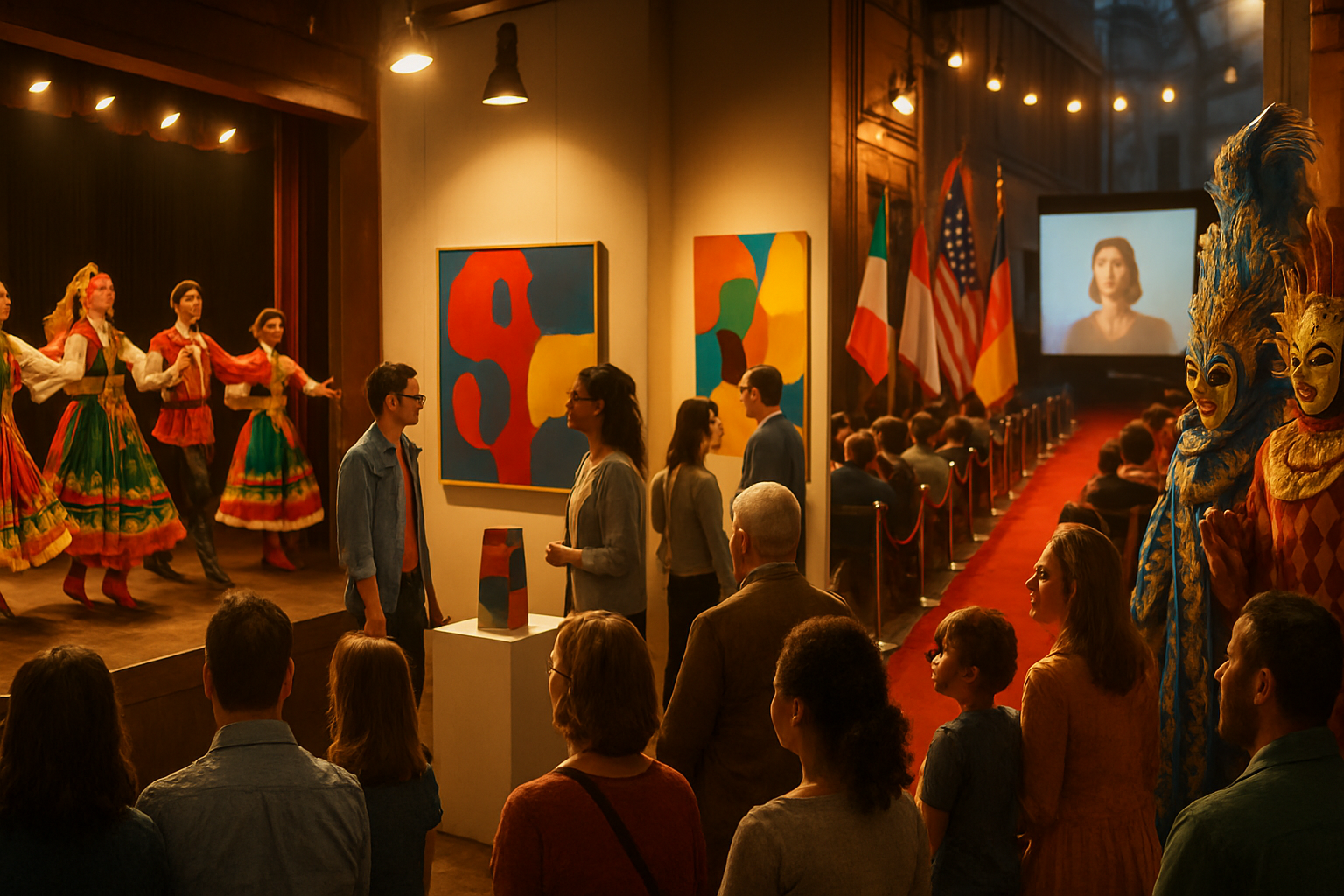
Cultural institutions across the globe are experiencing a renaissance in February 2026, with developments spanning from Cyprus's theatrical revival to Zimbabwe's national gallery restructuring and Latvia's Eurovision preparations, demonstrating a coordinated international effort to preserve heritage while embracing contemporary artistic expression.
The convergence of these cultural initiatives reflects a broader global pattern documented throughout early 2026, where nations are strategically positioning cultural assets as both economic drivers and diplomatic soft power tools. From Malta's Biennale securing Maurizio Cattelan to Finland's revolutionary Fuuga concert hall programming, the cultural landscape is being fundamentally reimagined.
Cyprus: Amateur Theatre Renaissance in Paphos
Cyprus's Stage One Theatre in Paphos exemplifies the grassroots cultural revival sweeping across the Mediterranean. The company's ambitious programming for February and March 2026 demonstrates how local amateur theatre companies are becoming catalysts for community engagement and cultural preservation.
The theatre's "Night at the Musicals" performance has generated such demand that tickets are reportedly sold out, featuring live renditions from globally recognized productions including "Wicked," "Frozen," and "The Greatest Showman." This programming strategy reflects the successful integration of international cultural content with local artistic talent.
"If you haven't already experienced a Farndale play, make sure you see this one."
— Stage One Theatre, Paphos
More significantly, the upcoming production of "Chase Me Up Farndale Avenue S'il Vous Plait" from March 5-7 and 12-14 represents a commitment to British theatrical farce traditions. This six-evening celebration of amateur theatre by Walter Zerlin Jr and David McGillivray demonstrates how local companies are maintaining connections to established dramatic traditions while creating accessible cultural programming for their communities.
The emphasis on Farndale plays—described as "a series of British comedy farces"—illustrates Cyprus's role as a cultural bridge between British theatrical traditions and Mediterranean artistic expression. This programming model has proven successful across Europe, where amateur theatre companies are increasingly recognized as essential cultural infrastructure.
Latvia: Eurovision as Cultural Diplomacy
Latvia's "Supernova" Eurovision selection process, with its second semi-final scheduled for February 7, 2026, represents a sophisticated approach to cultural diplomacy and national branding. The Eurovision Song Contest has evolved far beyond entertainment, becoming a platform for nations to showcase cultural identity and artistic innovation on a continental scale.
The timing of Latvia's selection process aligns with broader European cultural coordination efforts, including the Malta Biennale 2026 and Greece's unified cultural heritage platform. Eurovision serves as both a cultural preservation mechanism—maintaining traditions of national song competitions—and an innovation laboratory for contemporary musical expression.
Latvia's participation demonstrates the successful integration of grassroots cultural programming with international visibility platforms. The "Supernova" format allows for community engagement through national selection while positioning the country strategically in European cultural networks.
Zimbabwe: National Gallery Board Transformation
Zimbabwe's appointment of a new Board of Trustees for the National Gallery by Minister Anselem Nhamo Sanyatwe represents the most significant institutional cultural reform documented in the current global renaissance. This leadership transition signals a fundamental reimagining of how national cultural institutions can serve both preservation and development objectives.
The ministerial announcement, made by the Minister of Sport, Recreation, Arts and Culture, suggests government recognition of visual arts as strategic national infrastructure. This approach aligns with successful models documented in Qatar (Afghan heritage exhibition), Rwanda (creative industry investment), and Ghana's recent cultural policy innovations.
The Board restructuring occurs within Zimbabwe's broader "leaving no one behind" cultural policy framework, which includes community radio station licensing for indigenous language and traditional music preservation. This comprehensive approach demonstrates understanding that cultural preservation requires both institutional leadership and grassroots community engagement.

Global Context: The February 2026 Cultural Renaissance
These three developments represent key components of a documented global cultural renaissance that accelerated in February 2026. The pattern includes technological integration (Singapore's WonderBot 2.0 heritage education), financial innovation (Finland's €90 million Fuuga hall investment), and international cooperation (Egypt-Azerbaijan poetry exchanges).
The success of this cultural renaissance depends on three critical factors: community engagement, economic viability, and institutional support. Luxembourg's traditional crafts revival demonstrates how all three elements can align successfully, while Delhi's wrestling akhadas crisis illustrates the challenges when these factors are absent.
Economic Dimensions
Cultural programming has demonstrated significant economic returns across multiple contexts. Rome's Trevi Fountain €2 entry system generates €6 million annually, while Singapore's tourism exceeded forecasts partly through cultural attractions. The Cyprus theatre programming, Latvia's Eurovision participation, and Zimbabwe's gallery restructuring all represent investments in cultural infrastructure with measurable economic benefits.
The tourism connection remains crucial. Guatemala's "Paseos con Encanto 2026" heritage tourism initiative and Thailand's ICONSIAM Chinese New Year campaigns demonstrate how cultural authenticity drives visitor engagement and revenue generation.
Technology Integration Challenges
The successful cultural institutions are those embracing technology as enhancement rather than replacement. Greece's "Hellenic Heritage" digital ecosystem providing unified access to 108 archaeological sites exemplifies this approach. Similarly, Queensland's Nordic-inspired restaurant success suggests that traditional cultural forms can be amplified through contemporary presentation techniques.
However, the digital transformation poses risks. The youth mental health crisis documented across multiple countries suggests that cultural institutions must provide physical, embodied experiences that digital entertainment cannot replace. The success of amateur theatre in Cyprus and community festivals in St. Vincent demonstrates the irreplaceable value of live cultural engagement.
Preservation vs Innovation Balance
The most successful cultural initiatives documented in February 2026 achieve synthesis between preservation and innovation rather than choosing between them. Poland's "Lalka" film adaptation demonstrates how 19th-century literary heritage can be presented through contemporary cinematic excellence. Similarly, Bolivia's Misk'i T'ikas folklore group uses digital multimedia to preserve traditional folk arts.
This balance requires sophisticated institutional leadership, as evidenced by Zimbabwe's gallery board restructuring. The new appointments suggest recognition that cultural preservation in the 21st century requires both traditional knowledge and contemporary management expertise.
"Cultural heritage requires active nurturing through practical actions, economic investments, intergenerational knowledge transfer—not static preservation but adaptive living traditions."
— Global Cultural Heritage Analysis, February 2026
International Cooperation Models
The February 2026 cultural developments demonstrate increasing international cooperation in cultural programming. Azerbaijan's Egyptian Cultural Center events, Qatar's Afghan heritage exhibition, and Malta's Italian contemporary art programming all exemplify how nations leverage cultural exchange for diplomatic and economic benefits.
Eurovision itself represents one of the most successful models of international cultural cooperation, providing a framework for peaceful competition and cultural exchange. Latvia's participation connects the country to European cultural networks while maintaining national artistic identity.
Future Implications
The developments in Cyprus, Latvia, and Zimbabwe suggest that cultural institutions worldwide are adapting to 21st-century realities while maintaining authentic local expression. The success factors include:
- Community engagement through accessible programming
- Economic sustainability through tourism and event revenue
- Institutional modernization without cultural dilution
- International cooperation for resource sharing and visibility
- Technology integration as enhancement rather than replacement
The global cultural renaissance of February 2026 demonstrates that cultural preservation and contemporary innovation are not competing priorities but complementary strategies for national development and international cooperation. The success of amateur theatre in Cyprus, Eurovision preparation in Latvia, and institutional reform in Zimbabwe provides a template for cultural institutions worldwide seeking to remain relevant while preserving authentic cultural expression.
As nations continue to recognize culture as strategic infrastructure, the models emerging from this period will likely influence cultural policy for decades to come. The emphasis on community engagement, economic viability, and international cooperation suggests that cultural institutions can successfully navigate between local authenticity and global competitiveness.