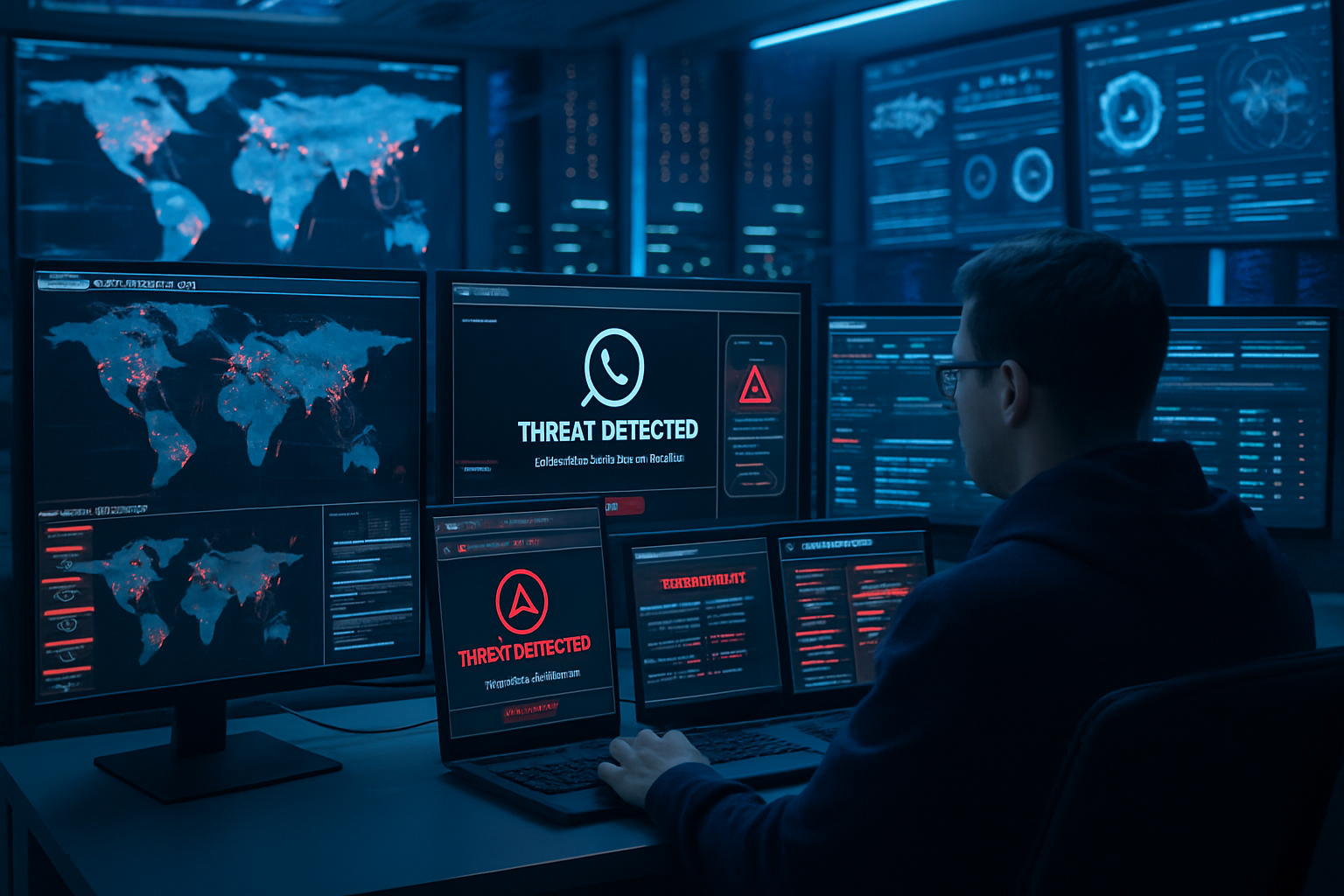
A wave of sophisticated cybersecurity threats is overwhelming international law enforcement as criminal networks exploit artificial intelligence, state-sponsored hackers target encrypted communications, and elaborate scams proliferate across global digital infrastructure, according to reports from multiple European intelligence agencies and law enforcement organizations.
The crisis has reached unprecedented levels as Dutch intelligence agencies issued urgent warnings about Russian state-sponsored hackers conducting coordinated attacks on Signal and WhatsApp accounts used by senior government officials, military personnel, and journalists worldwide. Simultaneously, European police forces report a dramatic surge in AI-enhanced criminal operations targeting vulnerable populations through increasingly sophisticated deception tactics.
Russian State Hackers Target Encrypted Communications
The Dutch General Intelligence and Security Service (AIVD) and Military Intelligence and Security Service (MIVD) issued a joint warning about what they described as a "global cyber campaign" by Russian state hackers specifically targeting end-to-end encrypted messaging platforms used by high-value targets.
The operation represents a significant escalation in Russian digital warfare capabilities, with intelligence analysts noting the hackers likely employ advanced endpoint compromise techniques that access devices before or after the encryption and decryption process, effectively circumventing the security protections that make Signal and WhatsApp attractive to government officials and journalists.
"This coordinated global cyber campaign indicates substantial state resources and planning typical of advanced persistent threat operations," according to Dutch intelligence assessments.
— Dutch Intelligence Services Joint Statement
The timing coincides with Russia's broader digital sovereignty campaign, which included blocking WhatsApp access for over 100 million Russian users in February 2026 while promoting the state-controlled "Max" messenger platform that lacks end-to-end encryption and contains surveillance modules.
WhatsApp "Ghost Pairing" Attacks Proliferate
Italian cybersecurity experts have documented a new sophisticated attack method called "Ghost Pairing" that exploits WhatsApp's device linking feature to gain unauthorized access to user accounts. The scheme begins with spam calls designed to make potential victims more receptive to subsequent fraudulent messages.
The attack leverages the platform's connected devices functionality, allowing criminals to remotely access and control victims' WhatsApp accounts without their knowledge. Security researchers describe it as "one of the most insidious scams currently circulating" due to its exploitation of legitimate platform features for malicious purposes.
AI-Enhanced Criminal Operations
Law enforcement agencies across Europe report criminal networks are increasingly utilizing artificial intelligence to enhance their operations. The Netherlands has launched a comprehensive campaign to combat fake police and helpdesk scams that have reached unprecedented sophistication levels.
Swedish authorities warn about a growing trend of "gift card fraud" where criminals use deceptive emails to impersonate trusted contacts, requesting assistance with purchasing gift cards. The scams exploit emotional manipulation and social engineering tactics enhanced by AI-generated content that appears increasingly authentic.
"Criminals are instructing AI chatbots to function as 'elite hackers' for automated vulnerability detection, script writing, and data theft operations."
— European Cybersecurity Research Consortium
Social Media Platform Manipulation Crisis
Elon Musk's X platform disclosed that it suspended 800 million accounts over a 12-month period as part of ongoing efforts to combat what company officials described as "massive scale" manipulation attempts. The social media company told British Members of Parliament that it faces continual state-backed efforts to hijack platform discussions, with Russia identified as the most prolific state actor, followed by Iran and China.
The revelation highlights the extraordinary scale of coordinated inauthentic behavior on social media platforms, where criminal networks and state actors deploy sophisticated bot networks and fake account infrastructure to manipulate public discourse and spread disinformation.
Infrastructure Vulnerabilities Exploited
The cybersecurity crisis occurs amid what experts describe as a "critical vulnerability window" created by the global semiconductor shortage, which has driven memory chip prices up sixfold and constrained the deployment of advanced security systems until new fabrication facilities come online in 2027.
This infrastructure constraint is being actively exploited by criminal organizations with state-level technological resources who can instantly relocate operations across jurisdictions, making traditional law enforcement responses inadequate against digitally native criminal networks.
International Coordination Challenges
Despite successful operations like the recent takedown of the LeakBase platform - one of the world's largest stolen data trading marketplaces - through coordination between Dutch police, Europol, FBI, and 13 countries, law enforcement agencies struggle with the speed and sophistication of evolving cyber threats.
The challenge is compounded by criminals' ability to exploit jurisdictional limitations and operate with relative impunity across borders. Traditional enforcement mechanisms prove inadequate against organizations that combine advanced technology with international mobility and state-level resources.
Regulatory Response Intensifies
European authorities are implementing unprecedented regulatory frameworks to address the crisis. Spain has introduced the world's first criminal executive liability framework for platform executives, creating personal imprisonment risks for technology company leaders whose platforms facilitate criminal activity.
The European Commission is pursuing Digital Services Act violations against major platforms, with potential penalties reaching six percent of global annual revenue for companies that fail to address "addictive design" features and inadequate content moderation systems.
Global Impact and Democratic Implications
The cybersecurity crisis extends beyond individual privacy concerns to fundamental questions about democratic governance in the digital age. The targeting of encrypted communications used by officials and journalists threatens democratic oversight and press freedom, while the scale of platform manipulation undermines informed public discourse.
Consumer trust erosion is already evident, with companies like South Korean e-commerce platform Coupang experiencing a 3.2% user decline following data breaches. The broader "SaaSpocalypse" phenomenon eliminated hundreds of billions in technology market capitalization as cybersecurity concerns intersect with regulatory uncertainty.
Protection Strategies and Recommendations
Cybersecurity experts recommend comprehensive protection strategies including two-factor authentication, regular software updates, network segmentation, hardware security keys, and incident response protocols specifically designed for state-sponsored attacks. However, they emphasize that individual protective measures alone cannot address the systemic nature of the current crisis.
The situation requires unprecedented international cooperation, sophisticated legal frameworks, platform accountability measures, and transparent democratic oversight mechanisms that balance security needs with privacy rights preservation.
Looking Ahead: A Critical Inflection Point
March 2026 represents what cybersecurity analysts describe as a critical inflection point for global digital governance. The success or failure of democratic institutions in addressing these sophisticated cyber threats while preserving digital rights will establish precedents affecting technology governance for decades.
The stakes extend beyond cybersecurity to the fundamental question of whether democratic societies can maintain their values while protecting citizens from digital threats that transcend traditional boundaries and combine criminal profit motives with state-level technological capabilities.
"We are witnessing the convergence of traditional organized crime with state-sponsored digital capabilities, creating hybrid threats that require evolved defensive strategies and unprecedented international cooperation."
— European Cybersecurity Task Force Assessment
The resolution of this crisis will determine whether digital technologies serve human flourishing and democratic values, or become tools of surveillance and control operating beyond democratic accountability. Success requires balancing technological advancement with democratic governance, individual rights with collective protection, and national sovereignty with international cooperation in an increasingly interconnected but threatened digital environment.