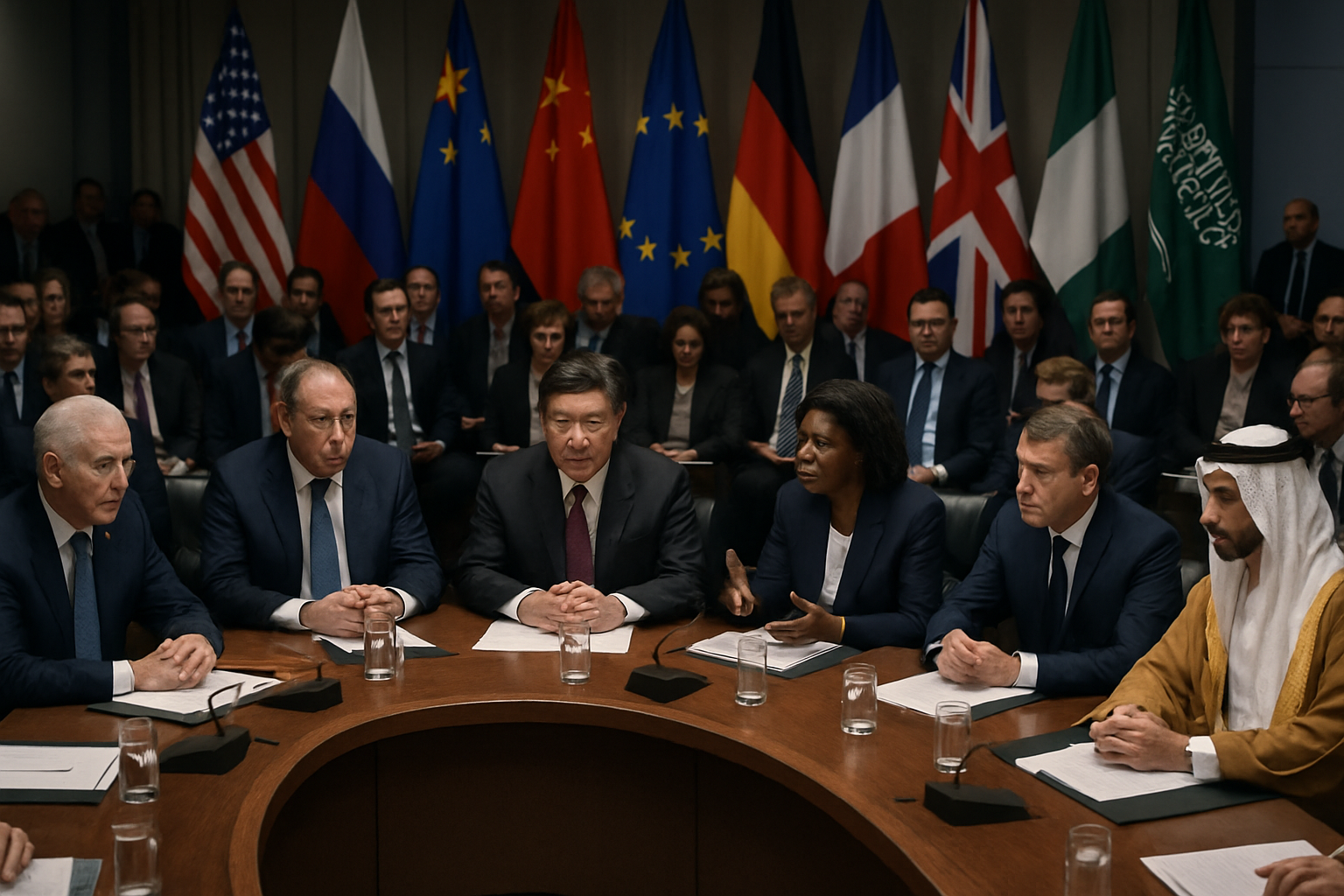
The international community is grappling with the most serious diplomatic crisis since the Cold War, as world leaders issue unprecedented condemnations following the US-Israeli "Operation Epic Fury" strikes against Iran and the confirmed death of Supreme Leader Ali Khamenei on March 1, 2026.
The crisis has exposed deep fractures in the global order, with major powers taking sharply divergent positions on what many are calling a fundamental violation of international law and sovereignty. The reactions span from outright condemnation to cautious support, reflecting the complex geopolitical alignments that define the modern multipolar world.
UN Security Council Emergency Session
The United Nations Security Council convened in emergency session at 22:00 CET following a joint request from France, China, Russia, Colombia, and Bahrain. UN Secretary-General António Guterres delivered a stark warning, declaring the military actions "a serious threat to international peace and security" and cautioning that such "military actions could trigger a chain of events no one can control in the world's most unstable region."
Russian Foreign Minister Sergey Lavrov condemned what he termed "reckless actions by Washington and West Jerusalem," describing them as a direct violation of international law principles. Russia confirmed its readiness to contribute to resolving the Iran situation while demanding the immediate cessation of US-Israeli attacks against what Moscow called a "sovereign UN member state."
Unprecedented Chinese Condemnation
China issued its strongest condemnation of the killing of Iran's Supreme Leader, with the Chinese Foreign Ministry describing the assassination as a "serious violation of Iran's sovereignty and security." Beijing went further, stating that the act represented "an insult to the objectives and principles of the UN Charter and the basic norms of international relations."
In an official statement, the ministry declared that China "strongly opposes and strongly condemns this," while renewing its calls for an "immediate cessation of military operations" across the region. Chinese Foreign Minister Wang Yi told his Russian counterpart Sergei Lavrov that the attacks were "unacceptable" and urged both ceasefire and talks.
Vatican Appeals for Peace
Pope Leo XIV expressed his "deep concern" over the escalation of tensions across the Middle East region, calling for an end to what he described as "the spiral of violence." The Vatican's intervention reflects the global religious community's concern about the humanitarian implications of the conflict's expansion.
The Pope's statement resonated across Latin America, where Venezuelan and other regional outlets emphasized the need to "stop the spiral of violence" that threatens to engulf not just the Middle East but global stability.
European Union's Unified Response
The European Union issued a rare joint statement demanding "maximum restraint" and compliance with international law. EU Commission President Ursula von der Leyen called for stopping Iran's nuclear and missile military programs, while emphasizing the bloc's commitment to diplomatic solutions.
European leaders, including French President Emmanuel Macron and German Chancellor Friedrich Merz, joined with UK Prime Minister Keir Starmer in urging Iran to "seek a negotiated solution." However, the EU notably clarified its non-participation in the US-Israeli strikes while condemning Iranian retaliatory actions.
Regional Coalition Under Strain
The unprecedented regional coalition of Saudi Arabia, UAE, Qatar, and Egypt that had supported diplomatic efforts now faces severe strain as Iranian retaliation targeted member territories. Egyptian President Abdel Fattah el-Sisi condemned attacks on "sisterly Arab countries," warning of "comprehensive chaos" that could engulf the region.
The Gulf states' response highlights the complexity of regional alignments, with traditional US allies finding themselves caught between support for American policy and the reality of Iranian strikes on their territory. The UAE reported one civilian death in Abu Dhabi from missile debris, while Kuwait's international airport was struck by Iranian drones.
British Diplomatic Caution
Britain's Defence Secretary John Healey declined to explicitly back the US-Israeli strikes, stating it was for the United States to set out the legal basis for the Iran operations. This cautious position reflects broader European concerns about the precedent set by unilateral military action against a sovereign state.
While few will mourn what Healey called Khamenei's "evil legacy," the UK's measured response underscores the diplomatic challenges facing traditional allies in supporting actions that may violate international law.
Global South Reactions
Pakistani Prime Minister Shehbaz Sharif expressed "concern over the violation of international norms and the targeting of heads of state/government," joining the Iranian people in "their hour of grief and sorrow." Pakistan's position reflects broader Global South concerns about great power actions that bypass international legal frameworks.
The African Union, through ECOWAS Chairman President Julius Maada Bio of Sierra Leone, expressed "deep concern" about threats to global energy markets and supply chains that could significantly impact African economies dependent on stable energy prices.
Nuclear Governance Crisis
The Iran crisis occurs against the backdrop of a broader nuclear governance breakdown, with the New START treaty having expired on February 5—marking the first time in over 50 years without US-Russia nuclear constraints. China's ongoing nuclear expansion adds another layer of complexity to global nuclear governance.
UN Secretary-General Guterres has warned that nuclear risks are at their "highest in decades," making the Iran situation a critical test of whether diplomatic solutions can still resolve nuclear crises in the 21st century.
Energy and Economic Implications
The crisis has immediate global economic implications, with oil prices rising on concerns about the Strait of Hormuz, through which 40% of global oil transits. Iran has warned that shipping through the strategic waterway is "not allowed," raising fears of supply chain disruptions extending far beyond the Middle East.
Natural gas prices have surged 24% in Europe and 78% in the United States, reflecting market concerns about regional war risks that could disrupt worldwide energy supplies and affect global economic stability.
Aviation Crisis Unprecedented
The diplomatic crisis has translated into the most extensive aviation disruption since COVID-19, with Iran, Iraq, Israel, UAE, and Qatar closing their airspace. Over 18,000 flights have been cancelled worldwide, affecting hundreds of thousands of passengers as major carriers including Emirates, Air France-KLM, and Wizz Air suspended Middle East operations.
Dubai International Airport, the world's busiest, has been completely shut down due to missile damage, highlighting how regional conflicts can have immediate global consequences in our interconnected world.
Humanitarian Concerns
International human rights organizations are demanding investigations into potential Geneva Conventions violations, particularly regarding the tragic attack on a girls' elementary school in Minab, Iran, which killed 53-85 students and staff. Images of children's backpacks and schoolbooks among the rubble have become symbols of the human cost of diplomatic failure.
The humanitarian tragedy has galvanized global civil society, with multiple embassy evacuations ordered across the region as governments scramble to protect their citizens from the expanding conflict.
Constitutional Crisis in Iran
Iran has established a three-member transitional council consisting of President Masoud Pezeshkian, the judiciary head, and a Guardian Council jurist, following constitutional protocols after Khamenei's death. The Assembly of Experts, comprising 88 clerics, faces the challenge of selecting a permanent successor during wartime.
American intelligence sources suggest that a Revolutionary Guards member is likely to be chosen as the next Supreme Leader, indicating potential hardline military influence in Iran's future direction.
Template-Setting Moment
The international response to the Iran crisis represents a template-setting moment for 21st-century diplomacy versus military confrontation in the multipolar era. The rapid breakdown from diplomatic framework to military escalation demonstrates the fragility of modern crisis management mechanisms.
Success in containing the current escalation could provide a diplomatic template for future nuclear disputes, while failure may accelerate military solutions that reshape not just Middle Eastern geopolitics but global approaches to conflict resolution for decades to come.
Looking Forward
As the international community grapples with the most dangerous moment since the Cold War's end, the stakes extend far beyond the immediate Middle East conflict. Regional war prevention, global energy security, nuclear governance credibility, and international law enforcement mechanisms are all being tested simultaneously.
The coming phase will determine whether this crisis remains a contained regional confrontation or evolves into a broader Middle Eastern war with global implications for energy markets, supply chains, and the fundamental principles of international stability that have governed the post-World War II order.
With diplomatic channels strained and military positions hardening, the international community faces its greatest test of multilateral cooperation and crisis management in the modern era.