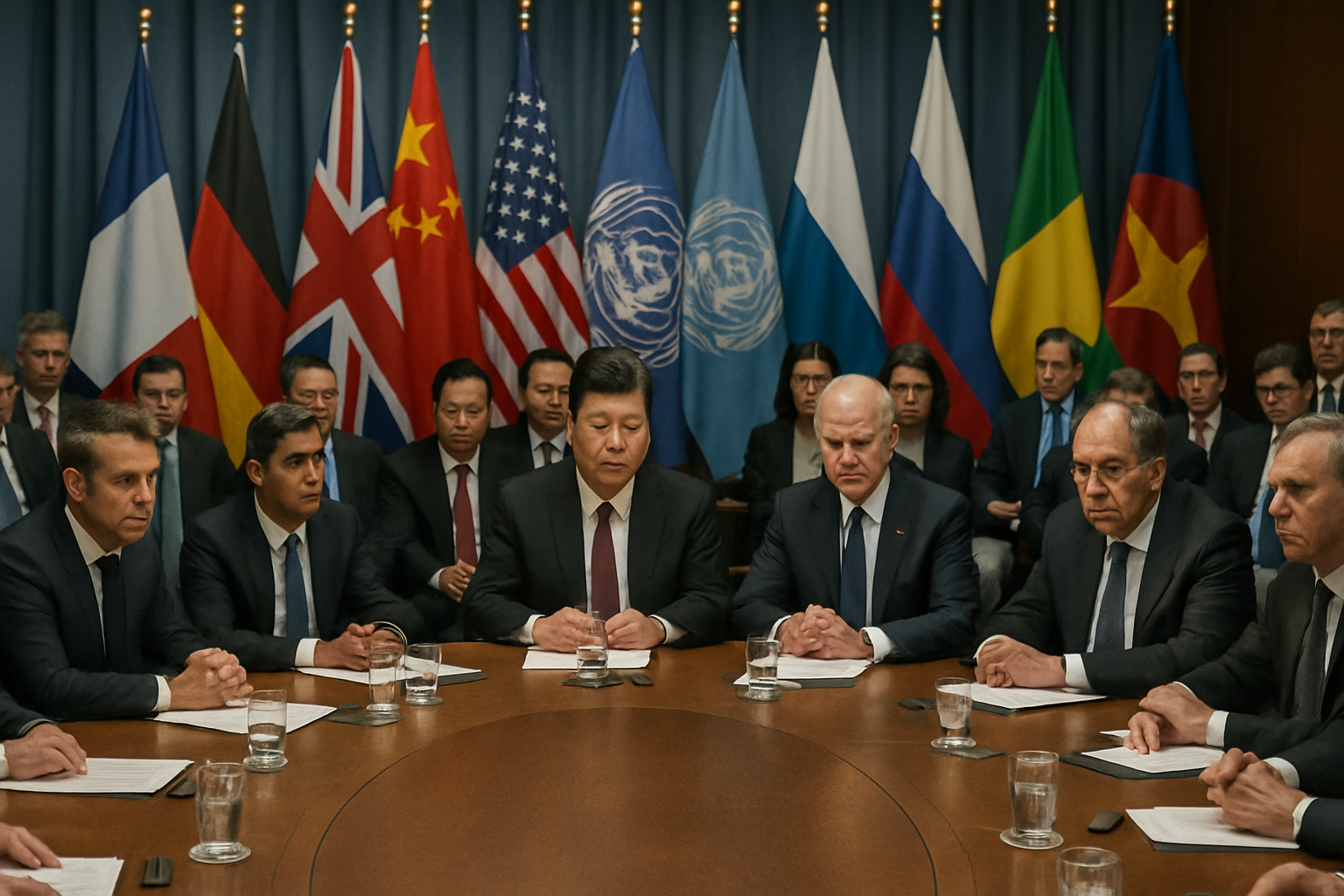
As military tensions in the Middle East reached a critical juncture following the US-Israeli "Operation Epic Fury" and Iran's massive retaliatory strikes, the international community mobilized with unprecedented urgency, triggering emergency diplomatic sessions and widespread calls for immediate de-escalation.
The United Nations Security Council convened an emergency session on Saturday evening following a formal request from France, China, Russia, Colombia, and Bahrain. UN Secretary-General António Guterres delivered a stark warning that the escalating conflict represents a "serious threat to international peace and security," with hostilities rapidly spreading throughout the region.
UN and European Response
"Military actions could trigger a chain of events that no one can control in the world's most unstable region," Guterres warned during the emergency session. The Secretary-General's intervention came as Iranian forces launched coordinated missile and drone attacks across multiple Gulf states, including the UAE, Kuwait, Qatar, and Bahrain, in direct retaliation for the earlier US-Israeli strikes.
European Union leadership, represented by Commission President Ursula von der Leyen and Council President António Costa, issued a joint statement demanding "maximum restraint" from all parties and full compliance with international law. Spain explicitly called for "de-escalation" and "dialogue," while Bulgaria emphasized the EU's "unwavering commitment to safeguarding regional security."
Regional Coalition Under Strain
The crisis has severely tested what had been an unprecedented regional coalition supporting diplomatic solutions. Saudi Arabia, the UAE, Qatar, and Egypt had formed an extraordinary consensus backing nuclear negotiations between the US and Iran, but direct attacks on member territories have strained this unity.
Egyptian President Abdel Fattah el-Sisi condemned the Iranian attacks on "sisterly Arab countries," warning of potential "comprehensive chaos" if the conflict continues to escalate. Saudi Arabia's Crown Prince Mohammed bin Salman received urgent phone calls from German Chancellor Friedrich Merz, Morocco's King Mohammed VI, and Lebanon's Prime Minister Nawaf Salam to coordinate regional responses.
The attacks disrupted what diplomatic sources described as the most promising Middle Eastern consensus for conflict prevention in decades, with Persian Gulf energy security creating shared stakes in maintaining stability.
Global Travel Warnings and Evacuations
The deteriorating security situation prompted a cascade of international travel warnings and embassy evacuations. Ghana's Ministry of Foreign Affairs advised citizens to "suspend all non-essential travel to the Middle East," citing the volatile environment that could lead to sudden airspace closures and strand travelers in combat zones.
Jamaica's Foreign Affairs ministry similarly urged nationals to "avoid traveling to the Middle East" and advised those in the region to "exercise vigilance and shelter in place." Nigeria called for restraint from "warring parties" and urged all sides to "avoid actions likely to intensify hostilities."
European governments issued their strongest warnings yet, with Sweden and Serbia ordering immediate citizen evacuations from Iran citing an "extremely uncertain security situation."
Aviation and Economic Impact
The crisis triggered one of the most extensive aviation disruptions since the COVID-19 pandemic. Iran, Iraq, Israel, the UAE, and Qatar closed their airspace to civilian traffic, with flight tracking systems showing vast empty zones across the Middle East.
Major international carriers suspended operations indefinitely: Emirates and Etihad faced operational crises as Dubai International Airport—the world's busiest—completely shut down. Air France-KLM, Bulgaria Air, and Wizz Air suspended all Middle Eastern routes, affecting hundreds of thousands of passengers worldwide.
Oil markets reacted immediately to concerns over the Strait of Hormuz, through which 40% of global oil transit passes. Energy analysts warned of potential supply chain disruptions extending far beyond the immediate conflict zone.
African Unity and Latin American Concerns
The Economic Community of West African States (ECOWAS), through its Chairman President Julius Maada Bio of Sierra Leone, expressed "deep concern over escalating hostilities in the Gulf region." The organization warned that the conflict poses direct threats to global energy markets, trade routes, and food supply chains critical for African economies.
In Latin America, Mexico's President Claudia Sheinbaum reiterated her nation's historic pacifist stance, declaring that "Mexico will always be a factor of peace." Speaking during a work tour in Culiacán, Sinaloa, she emphasized Mexico's commitment to peaceful conflict resolution.
Bolivia activated "permanent monitoring of the international situation" to protect Bolivian citizens and diplomatic representations abroad, with the Foreign Ministry coordinating enhanced security measures for nationals in affected regions.
Diplomatic History in the Making
The current crisis represents a critical test of multilateral diplomacy in addressing rapidly evolving conflicts. The emergency UN Security Council session marks one of the most significant diplomatic mobilizations since the breakdown of nuclear negotiations between the US and Iran, despite previous progress in achieving what Iranian Foreign Minister Abbas Araghchi had described as "broad agreement on guiding principles."
Russian Foreign Minister Sergey Lavrov condemned what Moscow termed "reckless actions by Washington and West Jerusalem," emphasizing Russia's readiness to contribute to resolving the Iran situation while calling for an immediate cessation of military operations.
The international community now faces the urgent challenge of preventing further escalation while addressing the underlying issues that led to the dramatic collapse of diplomatic efforts. The response will likely serve as a template for future international approaches to nuclear crisis resolution and territorial sovereignty enforcement in the 21st century.
Stakes for Global Stability
Beyond the immediate humanitarian concerns, the crisis carries profound implications for global governance mechanisms. The breakdown of intensive negotiations despite achieving framework progress demonstrates the fragility of modern crisis management in a multipolar era.
Success in containing the current escalation could provide a diplomatic template for future nuclear disputes and strengthen non-proliferation norms globally. However, failure to prevent broader regional conflict may accelerate military solutions over diplomatic approaches, potentially undermining international law credibility and reshaping Middle Eastern geopolitics for decades.
As emergency diplomatic consultations continue through the weekend, the international community remains focused on the immediate imperative: preventing a regional conflict that could destabilize global energy markets and threaten the fundamental principles of international peace and security.