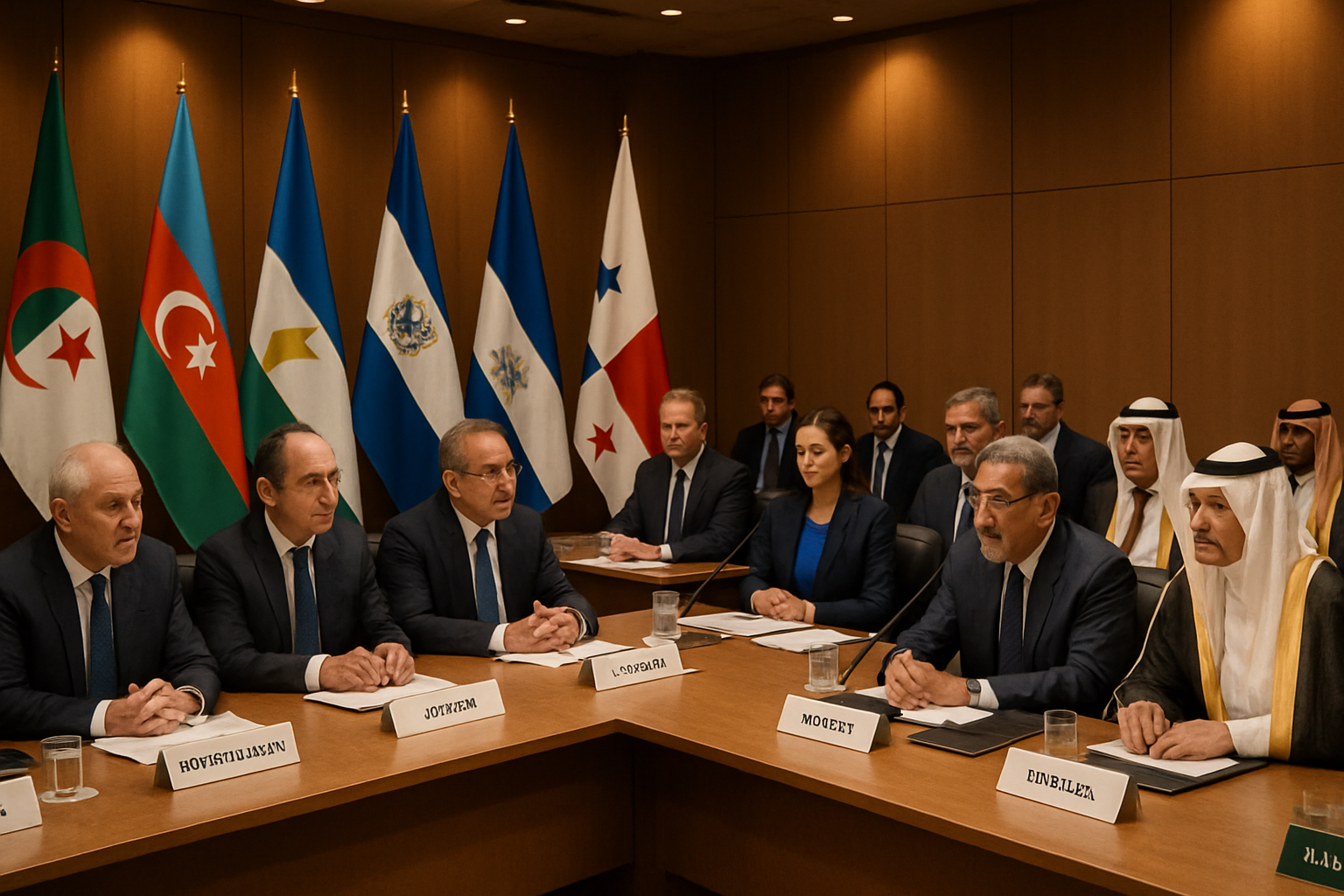
April 2026 has witnessed an unprecedented surge in diplomatic activity across multiple continents, with nations from Algeria to Saudi Arabia engaging in high-level bilateral meetings that signal a fundamental shift toward more flexible, pragmatic international cooperation frameworks.
From the corridors of power in Algiers to the diplomatic quarters of Kuwait City, foreign ministers and senior officials are forging new partnerships that transcend traditional alliance structures, embracing what experts are calling a "diplomatic renaissance" characterized by strategic bilateral cooperation over complex multilateral frameworks.
Algeria Emerges as North African Diplomatic Hub
Algeria has positioned itself at the center of a web of international partnerships, with Foreign Minister Ahmed Attaf hosting a series of crucial bilateral meetings that underscore the nation's growing diplomatic influence. Professor Kamal Raziq, Algeria's Minister of Foreign Trade and Export Promotion, received Christopher Lando, Deputy Secretary of State for the United States, marking a significant step in Algeria-US economic cooperation.
The meeting focused on enhancing economic and commercial cooperation between Algeria and the United States, particularly in promoting trade exchanges and exploring new partnership opportunities between economic operators in both countries. This represents a notable warming in bilateral relations and demonstrates Algeria's strategic positioning as a gateway for American business interests in North Africa.
"Algeria's diplomatic calendar demonstrates the country's commitment to multilateral engagement while maintaining strategic autonomy," observed Mohamed Arkab, Algeria's Minister of Energy and Mines, following his meeting with Bosnia and Herzegovina's Foreign Minister Elmedin Konaković.
— Senior diplomatic source
Prime Minister Nadir Larbaoui's reception of Konaković at the Government Palace further emphasized Algeria's role as a regional mediator, with discussions covering bilateral relations prospects and the potential for strengthened cooperation across multiple sectors. The systematic approach to these meetings suggests Algeria is implementing a comprehensive strategy to diversify its international partnerships while maintaining its traditional non-aligned foreign policy principles.
Azerbaijan's Strategic Diplomatic Positioning
President Ilham Aliyev's communication regarding Czech Prime Minister Andrej Babiš's official visit highlights Azerbaijan's growing importance as an energy coordinator and diplomatic bridge connecting Europe, Asia, and the South Caucasus. The meeting in Gabala represents a significant diplomatic achievement, with Aliyev noting the privilege that this was Babiš's first official visit outside the EU following his election.
Azerbaijan's strategic positioning has been enhanced by substantial international investments, including BP's $3.4 billion Shah Deniz project, which positions the country as a crucial alternative to Russian energy supplies for European markets. This economic foundation provides substantial leverage in diplomatic negotiations and demonstrates how energy diplomacy is becoming increasingly integrated with broader geopolitical strategies.
Cyprus Strengthens European-Asian Diplomatic Links
Foreign Minister Constantinos Kombos's series of meetings with Association of Southeast Asian Nations (ASEAN) counterparts in Brunei represents a significant expansion of Cyprus's diplomatic reach beyond its traditional Mediterranean and European focus. The meetings, held on the sidelines of the EU-ASEAN ministerial meeting, underscore the importance of Southeast Asia as a strategic priority for both Europe and Cyprus.
Kombos emphasized that "Our country remains consistently present, strengthening its diplomatic footprint in a region of particular geopolitical and economic importance." His meetings with officials from Brunei, Laos, and other ASEAN nations demonstrate Cyprus's commitment to expanding its international partnerships despite its relatively small size.
Strategic Positioning in a Multipolar World
The Cyprus initiative reflects a broader trend among smaller and medium-sized nations achieving disproportionate international influence through strategic excellence and authentic engagement. This approach offers alternatives to traditional great-power dynamics while preserving the coordination benefits of multilateral frameworks.
Central American Regional Security Cooperation
El Salvador's conclusion of the multinational exercise "Centam Guardian 2026" represents a significant achievement in regional security cooperation and disaster preparedness. With participation from over 1,200 personnel from El Salvador, Guatemala, Honduras, Costa Rica, Belize, Dominican Republic, and the United States, the exercise focused on strengthening interoperability and coordinated responses to transnational threats.
Defense Minister René Francis Merino Monroy highlighted the exercise's success in transcending purely military objectives to incorporate civil protection and emergency response capabilities. A 36-hour earthquake simulation allowed participants to practice response capabilities and share El Salvador's expertise in disaster management, demonstrating how smaller nations can lead in specialized areas of international cooperation.
This regional cooperation framework provides a template for addressing contemporary security challenges through collaborative approaches that emphasize shared responsibility and mutual support rather than dependency relationships.
Kuwait's Expanding Diplomatic Horizons
Kuwait's diplomatic landscape in April 2026 has been marked by significant bilateral engagements that reflect the country's role as a regional diplomatic hub. Ahmed Al-Jarallah, Dean of Kuwaiti Journalism and Editor-in-Chief of the Arab Times and Al-Seyassah newspapers, held important meetings with both the Ukrainian Ambassador and the Chinese Ambassador, demonstrating Kuwait's ability to maintain relationships across different geopolitical alignments.
The meeting with the Ukrainian Ambassador focused on calls for peace, while discussions with the Chinese Ambassador centered on strong bilateral ties. These engagements illustrate Kuwait's sophisticated diplomatic approach of maintaining dialogue channels with multiple partners while preserving its strategic autonomy.
Panama Addresses Maritime Security Challenges
Panama's advocacy at the United Nations Security Council for guarantees of safety and free transit in global maritime navigation represents a crucial intervention in international maritime law and security. Deputy Foreign Minister Carlos Hoyos addressed the critical situation in the Strait of Hormuz, where geopolitical tensions have created blockades affecting world trade and putting the safety of sailors, crew members, and vessels at risk.
"The disruption of critical shipping lanes has immediate impacts on international trade and global energy security. We cannot allow geopolitical tensions to compromise the fundamental principles of free navigation that underpin the global economy."
— Deputy Foreign Minister Carlos Hoyos
Panama's intervention is particularly significant given the country's strategic importance in global maritime trade through the Panama Canal. The Deputy Foreign Minister's warnings about the increase in detentions of Panamanian-flagged vessels, with specific references to challenges involving China, highlight how maritime disputes can have far-reaching implications for neutral nations whose economies depend on international shipping.
Saudi Arabia's Regional Coordination Role
Saudi Foreign Minister Prince Faisal bin Farhan's telephone consultations with his counterparts from Qatar, Oman, and Egypt demonstrate the Kingdom's active role in regional coordination and crisis management. These high-level discussions focused on the latest regional developments and joint efforts to establish security and support stability in the region.
The coordination with Prime Minister and Foreign Minister of Qatar Sheikh Mohammed bin Abdulrahman bin Jassim Al Thani, Omani Foreign Minister Badr bin Hamad bin Hamoud Al Busaidi, and Egyptian Foreign Minister Dr. Badr Abdel-Aty represents the kind of regional diplomatic coordination that has become increasingly important as traditional Western-led multilateral frameworks face unprecedented challenges.
Innovation in Crisis Management
Saudi Arabia's approach to regional diplomacy reflects broader innovations in crisis management that emphasize rapid coordination among regional powers rather than relying solely on traditional international institutions. This approach has proven effective in addressing immediate security concerns while maintaining diplomatic flexibility.
The Emergence of 21st-Century Diplomatic Patterns
The diplomatic activities observed across these seven nations in April 2026 collectively demonstrate the emergence of sophisticated 21st-century diplomatic patterns characterized by greater flexibility, pragmatism, and innovation. Traditional great power competition is being supplemented by middle power diplomacy, regional cooperation mechanisms, and innovative partnership frameworks that could potentially influence the evolution of international institutions for decades to come.
Economic considerations are increasingly integrated into diplomatic strategies across all these initiatives. Energy cooperation, trade dispute resolution, and development assistance partnerships are being pursued simultaneously with political objectives, creating a more holistic approach to international relations.
Template-Setting Significance
The success of these diverse bilateral initiatives suggests that international relations may be entering a new phase characterized by permanent evolution toward more sophisticated and flexible frameworks rather than temporary crisis adaptation. The emphasis on practical cooperation over ideological alignment offers valuable templates for contemporary diplomatic engagement.
Nations are developing partnerships that focus on concrete cooperation areas while managing broader disagreements through sustained dialogue. This approach builds redundancy into international relationships, reducing dependence on single partnerships while demonstrating that it is possible to preserve sovereignty and democratic values while engaging pragmatically with diverse partners.
Strategic Implications for Global Governance
The diplomatic renaissance evident in April 2026 represents a fundamental evolution in how nations engage in an interconnected yet sovereignty-conscious world. The template-setting potential extends beyond bilateral relationships to questions of global governance, conflict resolution, and sustainable development.
Success in these innovative approaches provides a foundation for addressing contemporary challenges through creative partnership models that can sustain international cooperation for generations. The convergence of political will, technological innovation, and community engagement offers hope that the complex challenges of the 21st century can be addressed through diplomatic innovation rather than military confrontation.
Future Diplomatic Trajectories
The current initiatives may establish important precedents for managing complex international relationships in an increasingly interconnected and politically diverse global environment. The emphasis on sustained commitment and practical results provides a framework for maintaining international cooperation while addressing contemporary governance challenges including climate change, technological disruption, and economic interdependence.
Regional stability is being enhanced through these diplomatic initiatives, which create additional dialogue channels and cooperation frameworks that offer alternatives to military solutions. The success of these efforts will determine whether strengthened bilateral relationships can provide effective models for addressing contemporary challenges while preserving democratic values and sovereignty principles crucial for international stability.
Conclusion: A New Era of Diplomatic Innovation
April 2026 stands as a watershed moment in international relations, marking the emergence of a new era of diplomatic innovation that prioritizes practical cooperation, strategic flexibility, and sustained engagement over rigid ideological alignment. The activities across Algeria, Azerbaijan, Cyprus, El Salvador, Kuwait, Panama, and Saudi Arabia collectively demonstrate that effective 21st-century diplomacy requires both traditional state-to-state engagement and innovative approaches to humanitarian and economic cooperation.
As these partnerships mature and begin delivering concrete results, they may influence broader international cooperation patterns for decades ahead. April 2026 may well be remembered as a turning point where diplomatic innovation successfully began addressing contemporary global challenges through creative bilateral partnership models that serve as foundations for sustainable international cooperation while respecting national priorities and cultural contexts.
The success of these initiatives offers hope that the international community can navigate the complexities of a multipolar world through diplomatic innovation rather than reverting to the military solutions that have characterized much of recent international relations. The template being established by these diverse diplomatic partnerships may well define the future of international cooperation in an increasingly complex and interconnected global environment.