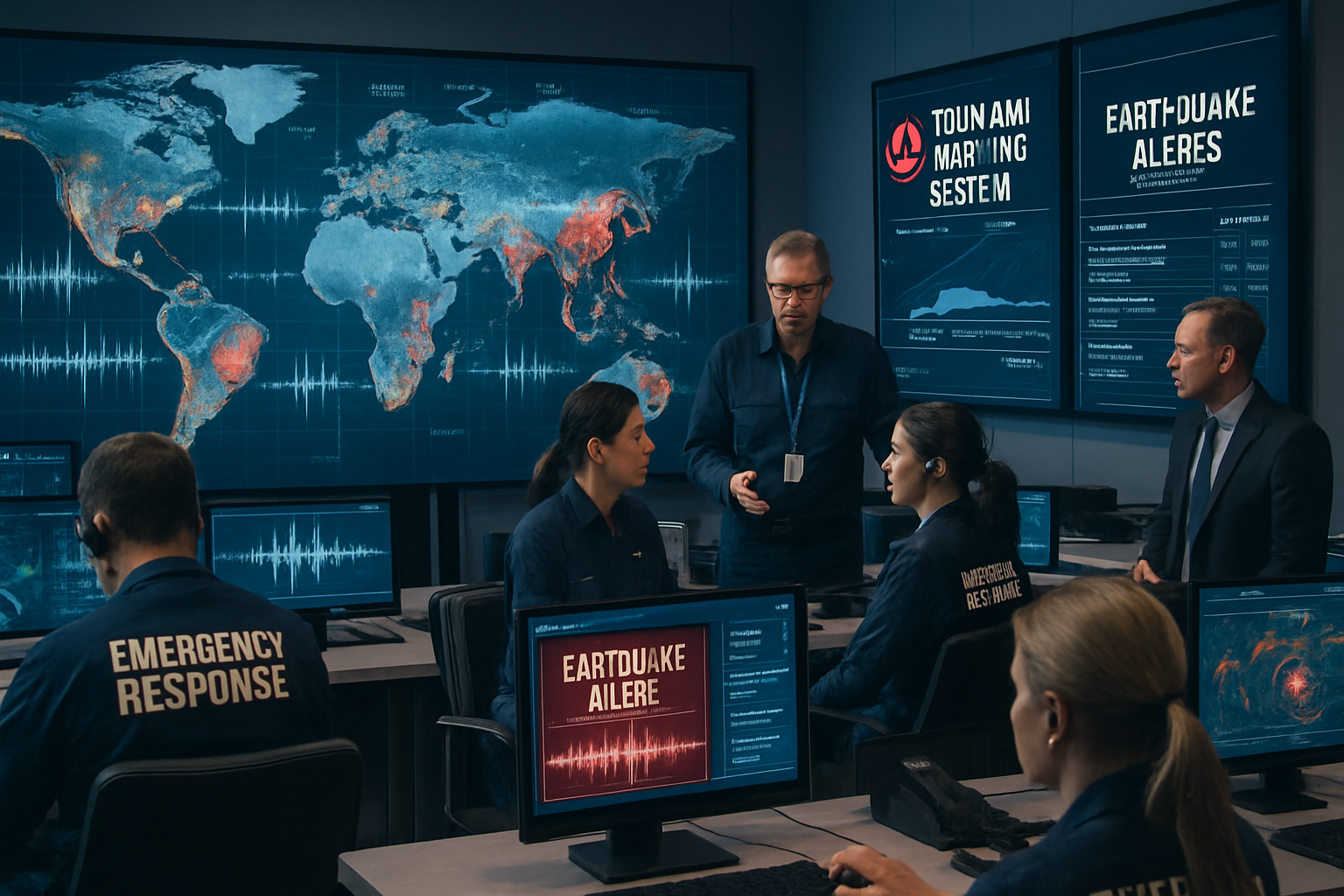
A devastating magnitude 7.8 earthquake that struck the Northern Molucca Sea off Indonesia's coast this week has renewed global focus on earthquake and tsunami preparedness strategies, as countries worldwide grapple with increasingly frequent seismic activity and the urgent need to protect vulnerable populations.
The earthquake, which occurred Thursday at a depth of 10 kilometers near Ternate, Indonesia, triggered tsunami warnings across a 1,000-kilometer radius affecting Indonesia, the Philippines, and Malaysia. While the immediate damage was limited, the event highlighted both the effectiveness of modern warning systems and the persistent vulnerabilities in global disaster preparedness infrastructure.
Advanced Warning Systems Save Lives
The US Tsunami Warning System's rapid response to the Molucca Sea earthquake demonstrated how international cooperation has transformed disaster preparedness since the devastating 2004 Indian Ocean tsunami. Within minutes of the seismic event, coordinated alerts reached coastal communities across Southeast Asia, allowing for immediate evacuation preparations.
"The speed and coordination of the warning system response represents a fundamental improvement in our collective ability to protect vulnerable populations," explains Dr. Sarah Chen, a seismologist at the Pacific Tsunami Warning Center. "What we saw this week was the result of nearly two decades of enhanced international cooperation and technological advancement."
The event occurred within Indonesia's complex tectonic environment, where the Indo-Australian, Eurasian, and Philippine plates interact, creating one of the world's most seismically active regions. The 120-kilometer distance from Ternate, a city with over 205,000 residents, underscored the critical importance of rapid warning systems for densely populated coastal areas.
Romania Challenges Common Earthquake Safety Myths
Simultaneously, Romanian emergency preparedness experts are addressing a different but equally critical aspect of earthquake safety: debunking dangerous myths that persist among the public. Recent guidance from Romanian disaster preparedness authorities emphasizes that many traditional earthquake response techniques are not only ineffective but potentially harmful.
The analysis reveals widespread misconceptions about safe spaces during earthquakes, particularly the belief that doorways provide optimal protection. Engineering assessments demonstrate that modern construction techniques have rendered many traditional safety assumptions obsolete, requiring updated public education campaigns to ensure effective emergency response.
"Many people guide their reactions during earthquakes based on myths that can create a false sense of protection. Understanding what truly constitutes safety in these situations is crucial for saving lives."
— Romanian Emergency Preparedness Authority
The Romanian initiative reflects a broader global trend toward evidence-based disaster preparedness education, moving beyond traditional assumptions to incorporate modern understanding of structural engineering and seismic behavior.
Historical Context and Growing Urgency
The current focus on earthquake and tsunami preparedness occurs against the backdrop of unprecedented global seismic activity throughout 2026. The Pacific Ring of Fire has demonstrated elevated activity patterns, with multiple significant earthquakes affecting regions from Iceland to Afghanistan, exposing vulnerabilities in emergency response systems worldwide.
Recent events include a magnitude 5.8 earthquake in Afghanistan's Hindu Kush region that killed eight people, highlighting the particular vulnerability of traditional housing construction in seismically active areas. The Afghanistan earthquake, which struck during the country's worst humanitarian crisis in 25 years, illustrated how compound disasters can overwhelm already strained emergency response capabilities.
Similarly, a magnitude 7.4 earthquake in Indonesia's Molucca Sea region earlier this year demonstrated the effectiveness of improved building standards and regional cooperation through Pacific tsunami warning systems, resulting in minimal casualties despite the powerful magnitude.
Technological Innovation and International Cooperation
Modern earthquake and tsunami preparedness increasingly relies on sophisticated integration of cutting-edge technology with traditional knowledge systems. Advanced seismic monitoring networks now provide real-time data sharing across international boundaries, enabling rapid threat assessment and coordinated response efforts.
The European-Mediterranean Seismological Centre (EMSC) exemplifies this approach, providing immediate seismic data analysis that supports emergency response coordination across multiple countries. When earthquakes occur in seismically active regions, the rapid data sharing enables authorities to assess tsunami risks and coordinate evacuation procedures within critical time windows.
Estonia's approach demonstrates successful technology-tradition integration, combining traditional geological knowledge with advanced climate monitoring systems. This hybrid approach provides multiple pathways for complex disaster response, recognizing that technological solutions alone are insufficient without community engagement and traditional knowledge systems.
Infrastructure Vulnerabilities and Adaptation Needs
The ongoing assessment of global earthquake preparedness reveals critical infrastructure vulnerabilities, particularly in regions where traditional building methods intersect with increasing seismic activity. Afghanistan's experience illustrates how traditional housing construction, while culturally appropriate and economically accessible, may prove inadequate against seismic forces.
Cross-border impact assessment, such as tremors from Afghanistan earthquakes felt across Pakistan and India, demonstrates the need for regional cooperation in earthquake monitoring and response, despite ongoing political tensions. The compound nature of modern disasters—where multiple emergency types occur simultaneously—challenges traditional sequential response capabilities.
Recovery challenges in earthquake-affected regions are particularly severe when disasters strike areas already experiencing economic constraints or political instability. International cooperation becomes essential, though aid restrictions and limited access can complicate emergency response coordination through national disaster management authorities.
Climate Change and Geological Activity Intersection
Emergency management experts are increasingly recognizing the intersection between climate change and geological activity patterns. The concentration of geological events during periods of climate instability raises questions about Earth system interconnectedness, particularly in regions where Arctic ice loss and ocean temperature changes may alter geological stress patterns.
The Pacific Ring of Fire's elevated activity throughout 2026 occurs during a period of 22 consecutive months of global temperatures exceeding 1.5°C above pre-industrial levels—the longest sustained extreme warming period in recorded human history. While causation remains under scientific investigation, the correlation highlights the need for adaptive monitoring approaches that account for potential climate-geology interactions.
Community-Based Preparedness and Social Media Coordination
Modern disaster preparedness increasingly incorporates community-based approaches that leverage social media and local networks for emergency coordination. The success of community-organized response efforts, such as "Bargara Facebookers" in Australia during recent flooding events, demonstrates how digital platforms can provide essential emergency communication when traditional systems become overwhelmed.
Public education campaigns are evolving beyond traditional top-down approaches to incorporate peer-to-peer knowledge sharing and community-specific preparedness strategies. This evolution recognizes that effective disaster response requires not just institutional coordination but also community resilience and local knowledge systems.
Future Preparedness Strategies
Looking forward, earthquake and tsunami preparedness strategies must adapt to an era of permanent volatility rather than exceptional events. Traditional emergency response frameworks, designed for sequential regional disasters, prove inadequate when multiple regions face simultaneous emergencies.
The "building back better" approach has evolved from an optional enhancement to an essential survival strategy, recognizing that recovery from earthquake and tsunami events must incorporate climate resilience and adaptive infrastructure design. Traditional seasonal patterns that guided disaster preparedness for centuries are becoming increasingly unreliable frameworks.
International cooperation frameworks require fundamental restructuring to address simultaneous global disasters rather than sequential regional events. The success of coordinated response efforts, such as the Pacific tsunami warning systems, provides templates for enhanced cooperation, but the scale and simultaneity of current challenges demand unprecedented coordination.
Strategic Implications for Global Security
The convergence of earthquake and tsunami preparedness challenges with broader climate instability represents a watershed moment for global disaster preparedness. Current conditions may preview routine circumstances in the 2030s without comprehensive climate adaptation investment, making the window for effective action increasingly narrow.
Success in earthquake and tsunami preparedness requires sustained international cooperation, enhanced multi-sector coordination, and financial commitments that recognize environmental protection as essential infrastructure rather than regulatory burden. The tools, knowledge, and cooperation frameworks exist for comprehensive protection, but implementation requires unprecedented speed and coordination.
As geological instability continues across seismically active regions, the effectiveness of preparedness strategies will determine whether communities can maintain resilience against compound disasters. The choice between reactive crisis management and transformative infrastructure adaptation grows increasingly critical as the frequency and intensity of seismic events challenge traditional emergency response capabilities.