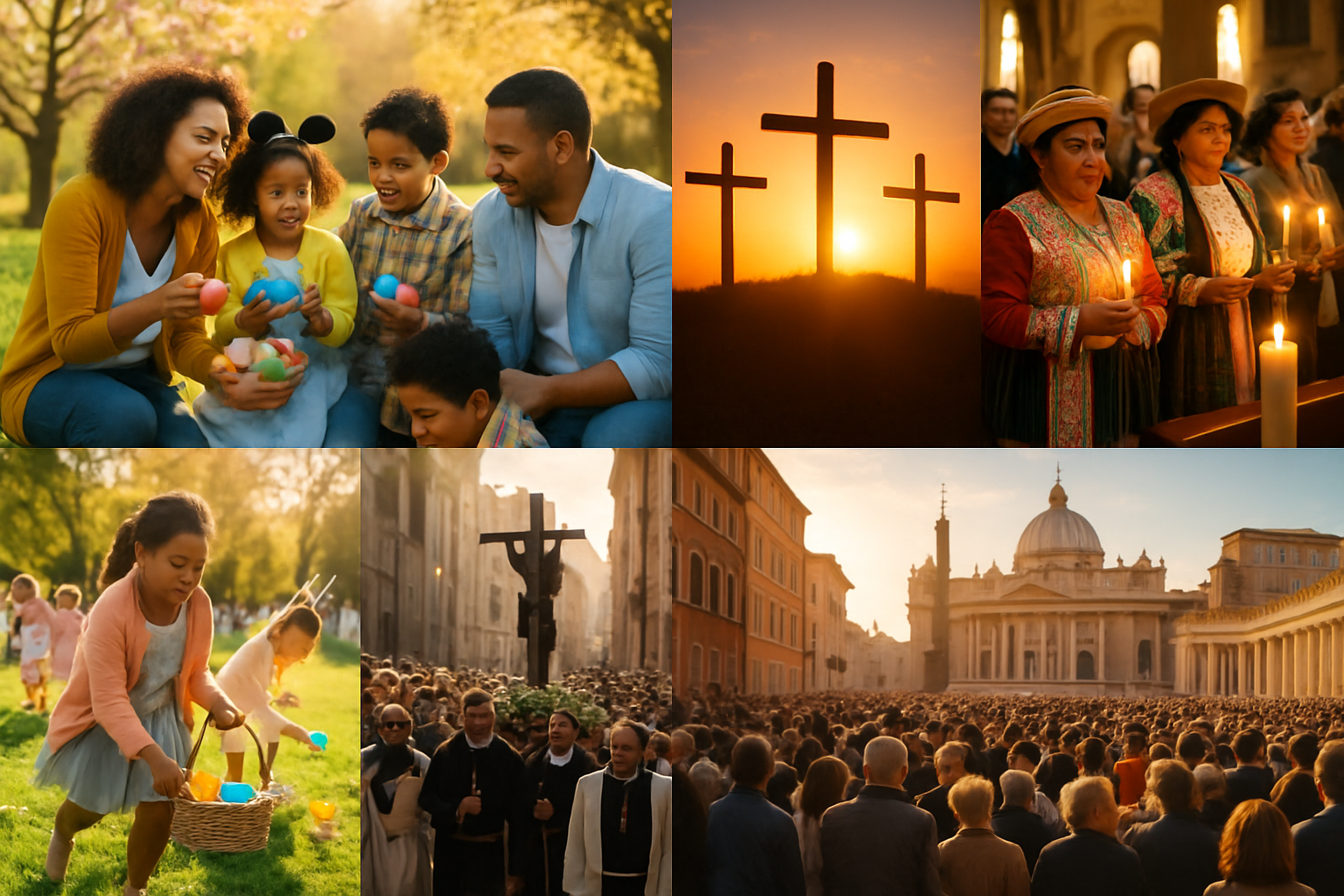
Christians worldwide commemorated Easter 2026 with remarkable unity and cultural diversity, as over 2.4 billion believers celebrated the resurrection of Jesus Christ across six continents, marking one of the most globally coordinated Easter observances in modern history.
From Pope Leo XIV's historic Good Friday procession at Rome's Colosseum to traditional Easter egg hunts in rural villages, the 2026 celebrations demonstrated both the universal appeal of Christianity's most sacred season and the rich tapestry of local customs that define Easter traditions around the world.
Pope Leo XIV Makes Historic Good Friday Gesture
In a gesture not seen for over three decades, Pope Leo XIV personally carried the wooden cross through all 14 stations of the Way of the Cross at Rome's Colosseum on Good Friday, April 3, 2026. This marked the first time since 1994 that a pope had shouldered the cross for the entire Via Crucis ceremony.
"I think it will be an important sign because of what the pope represents, a spiritual leader in the world today, and for this voice, that everyone wants to hear, that says Christ still suffers"
— Vatican Official
The American-born pontiff's decision to carry the cross himself, rather than merely presiding over the ceremony as has been traditional in recent decades, reflected his leadership style of direct spiritual engagement. The ceremony drew 30,000 faithful to the ancient amphitheater, with millions more watching via global broadcasts.
The cross-bearing included special prayers for war orphans and deported immigrant children, connecting the ancient ritual to contemporary global challenges. This followed Pope Leo XIV's strongest condemnation of warfare during Palm Sunday, where he declared that God rejects the prayers of leaders who have "hands full of blood."
Easter Traditions Across Continents
The 2026 Easter celebrations showcased an extraordinary diversity of traditions, each reflecting local culture while maintaining the universal Christian message of hope and renewal.
Spain's Semana Santa
Spain continued its centuries-old Holy Week traditions with elaborate processions throughout the country. As local observers noted, "Easter week is celebrated in Spain like nowhere else on earth, and Spaniards take their Holy Week traditions very seriously, even if some of them - to the outsider - seem a little bit bonkers."
The processions featured traditional religious floats, penitents in distinctive pointed hoods, and community participation that has remained largely unchanged for hundreds of years.
Czech Republic's Complex Relationship
In the Czech Republic, Easter traditions revealed a more complex relationship with the holiday. A recent survey indicated that a majority of Czechs view Easter traditions with ambivalence, with some questioning practices like traditional Easter Monday "pomlázka" customs.
Despite these tensions, the chocolate industry saw significant price increases ahead of the holidays, with Easter figures experiencing surge pricing in Czech supermarkets, reflecting continued commercial importance of the celebration.
Papua New Guinea's Community Focus
In Papua New Guinea, Easter took on a distinctly community-focused character. The village of Tatana was transformed for a Good Friday reenactment, demonstrating how Christian traditions have been adapted to local cultural contexts in the Pacific region.
Hundreds of faithful gathered in Hohola for Stations of the Cross processions, with the "Life in the Spirit Ministry Easter Crusade" emphasizing spiritual reflection over celebration, highlighting personal introspection and renewal that transcends cultural boundaries.
Vatican Preparations and Global Reach
The Vatican's Easter preparations demonstrated the global reach of Catholic traditions. Maltese florist David Grech worked tirelessly in Vatican City, preparing floral arrangements for Easter celebrations at St. Peter's Basilica, representing the international collaboration that makes Vatican ceremonies possible.
Easter at the Vatican began with the Easter Vigil, celebrating Christ's resurrection, followed by Easter Sunday Mass led by the Pope. At noon on Easter Sunday, Pope Leo XIV delivered the traditional "Urbi et Orbi" blessing, sending a message of hope and renewal to both Rome and the wider world.
South Sudan's Peace March
In South Sudan, thousands participated in a Good Friday march for peace, where intensifying fighting between government and opposition forces has raised fears of renewed civil war. The march demonstrated how Easter's message of hope and reconciliation takes on particular urgency in conflict zones.
The peaceful demonstration highlighted Easter's role not just as a religious observance but as a platform for social justice and peace advocacy in regions facing ongoing challenges.
Technology Meets Tradition
The 2026 celebrations successfully integrated modern technology with ancient traditions. Digital platforms enabled global diaspora participation, with virtual Easter services allowing separated families to share in the festivities. Mobile applications provided prayer schedules and scripture readings, while social media facilitated the sharing of Easter greetings across language and cultural barriers.
This technological integration preserved rather than replaced essential community worship elements, demonstrating how traditional spiritual practices can thrive in digital environments while maintaining their authentic cultural meanings.
Economic and Social Impact
Easter 2026 generated significant economic activity across multiple sectors. Traditional Easter shopping boosted retail and hospitality industries globally, with particular growth in cultural tourism as people sought authentic Easter experiences.
The celebrations also prompted enhanced security measures across many regions, with countries deploying additional personnel to ensure peaceful observances during this sacred time.
Interfaith Understanding
The timing of Easter 2026, following the conclusion of Ramadan in March, created unique opportunities for interfaith dialogue and mutual understanding. Both religious seasons emphasized themes of spiritual purification, community solidarity, and hope for renewal, building bridges between different faith communities.
Religious leaders noted this providential timing as an opportunity for mutual learning and shared commitment to compassion and service, transcending religious boundaries while honoring distinctive traditions.
Challenges and Resilience
Despite ongoing global challenges, including conflicts in various regions and economic pressures affecting many communities, Easter 2026 demonstrated the remarkable resilience of religious traditions and community bonds.
From grand cathedral services to simple home gatherings, the essential Easter message remained constant: faith endures, communities persevere, and hope survives even in the most challenging circumstances. The celebrations provided spiritual anchoring and sources of community resilience during uncertain times.
Looking Forward
Easter 2026 established new precedents for international religious cooperation and cultural preservation. The successful integration of ancient traditions with contemporary realities through thoughtful innovation and international coordination offers a template for future religious observances.
The celebrations demonstrated that spiritual traditions can maintain their essential character while adapting to modern circumstances, serving fundamental human needs for meaning, community, and transcendence in an increasingly interconnected world.
As Christians worldwide concluded their Easter observances, the 2026 celebrations will be remembered as a testament to the enduring power of faith traditions to unite diverse communities while celebrating the rich cultural diversity that makes each local celebration unique and meaningful.