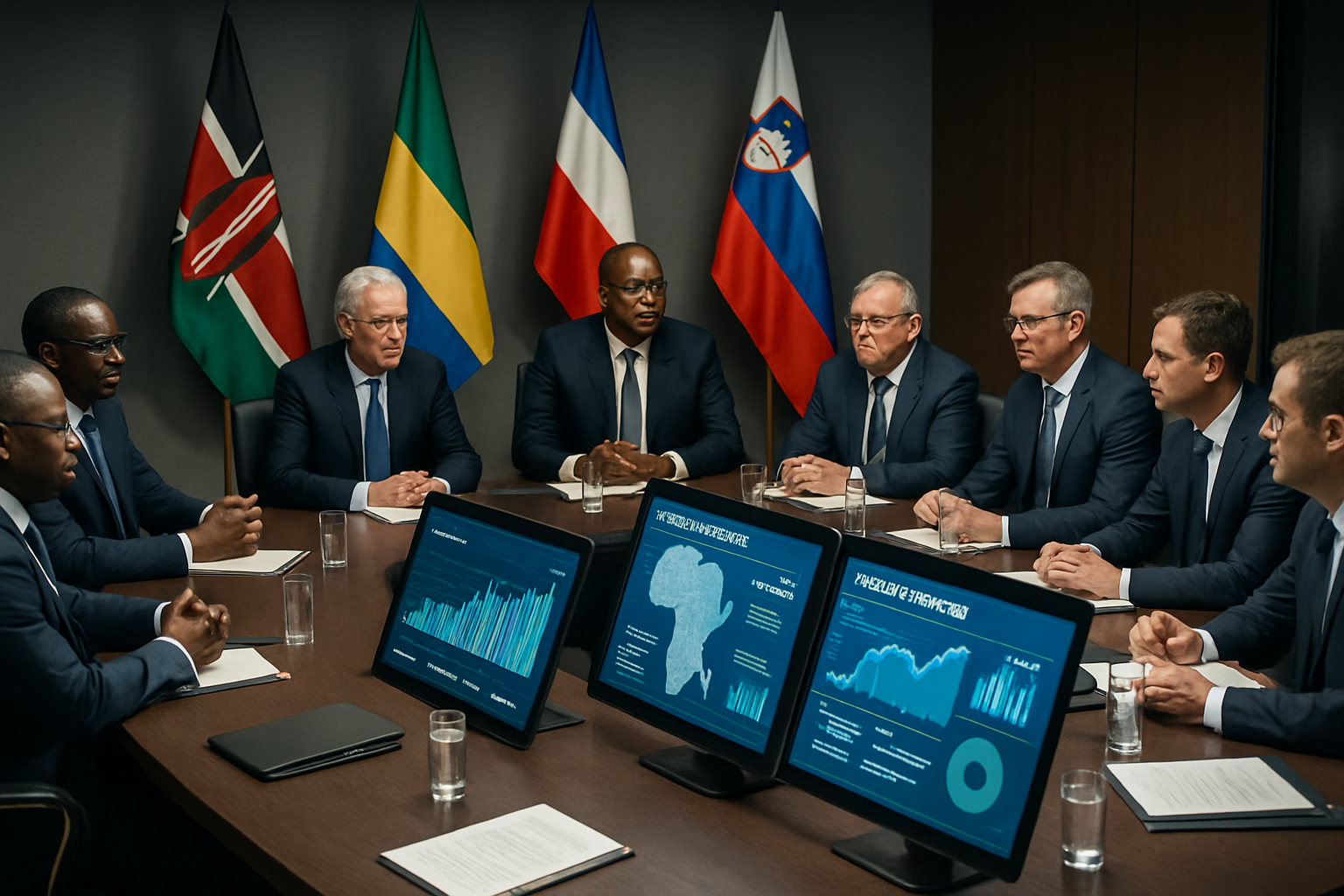
A surge of major economic development initiatives across four continents is reshaping the global business landscape, as nations from Kenya to Slovenia pursue ambitious investment strategies that signal a fundamental shift toward technological sovereignty and strategic international cooperation.
From Kenya's groundbreaking $10 billion AI initiative targeting Italian investors to Gabon's digital sovereignty strategy unveiled at Harvard, April 21, 2026 has emerged as a pivotal moment in international economic relations. These developments, spanning artificial intelligence, biotechnology, and advanced drilling technologies, demonstrate how nations are leveraging targeted investment strategies to position themselves for sustained economic growth.
Kenya Leads African AI Investment Revolution
President William Ruto's courtship of Italian investors centers on Kenya's ambitious AI 10 Billion Initiative, representing one of the most significant technology investment programs launched by an African nation. The initiative positions Kenya as a continental leader in artificial intelligence development, building on the country's established fintech leadership where 43% of fuel sales are now processed through digital payments with same-day settlements.
This technological advancement occurs within the broader context of Kenya's strategic positioning in the African Continental Free Trade Area (AfCFTA), where enhanced digital infrastructure creates opportunities for cross-border digital systems facilitating trillion-dollar trade flows across the continent.
"Kenya's approach demonstrates how emerging markets can leverage strategic partnerships to accelerate technological advancement while maintaining development autonomy."
— Regional Economic Development Expert
Gabon's Digital Sovereignty Strategy at Harvard
At the Africa Development Conference 2026, Gabon presented its comprehensive digital sovereignty strategy to the Harvard academic community, emphasizing the nation's commitment to technological independence while fostering international cooperation. This initiative builds on Gabon's February 2026 breakthrough with the Grand N'Gongui oil field discovery and March's Assala Energy Magoga-1 offshore hydrocarbon discovery.
Gabon's approach reflects a sophisticated understanding of how digital infrastructure can support economic diversification beyond petroleum dependency. The country's strategy integrates modern technology with environmental standards and climate adaptation requirements as standard project components, positioning it as a regional leader in sustainable development.
Continental Context and Regional Integration
Gabon's digital sovereignty initiative occurs within the framework of unprecedented African transformation. The African Finance Corporation reports $29.5 trillion in mineral reserves (20% of the global total), with $8.6 trillion remaining untapped. Seven African countries, including Kenya, participate in the US-EU-Japan Critical Minerals Partnership, challenging China's dominance while China simultaneously offers zero-tariff access to 53 African countries starting May 1, 2026.
European Innovation: Slovakia's Drilling Technology Breakthrough
Slovak company GA Drilling secured €37.3 million in funding while unveiling a revolutionary drilling product targeting billion-dollar revenues. This represents a remarkable transformation for the company, which previously struggled to convert innovative ideas into viable business models but now emerges with a new solution and strategic approach.
The investment reflects broader European innovation trends where constraint-driven development—accelerated by global semiconductor shortages and sixfold memory chip price increases—paradoxically drives more efficient and sustainable technology solutions. Slovakia's success demonstrates how smaller European nations can achieve technological leadership through focused strategic interventions.
Slovenia's Strategic Medical Technology Acquisition
Esco Lifesciences Group's acquisition of Allwin Medical Devices represents a significant consolidation in the global medical technology sector. Allwin Medical will continue operating under its established brand while becoming a key pillar within Esco's Medical portfolio, strengthening the company's global position in reproductive medicine.
The acquisition reinforces Esco's strategy to deliver integrated ART/IVF workflow solutions, combining advanced equipment, time lapse imaging, high-quality consumables, digital traceability, and AI-enabled embryo assessment into a unified platform for fertility clinics worldwide.
"This partnership demonstrates how strategic acquisitions can create synergies that benefit global healthcare delivery while respecting established brand identities."
— XQ Lin, Chairman & CEO of Esco Lifesciences Group
Investment Strategy Evolution and Global Implications
These developments reflect a fundamental evolution in global investment strategies, moving away from broad regional themes toward sophisticated country-specific analysis based on institutional quality, regulatory frameworks, and policy effectiveness. The success of government-backed digital payment systems—from Nigeria's 43% fuel sales digitally processed to Slovakia's €1.3 billion digital euro pilot—demonstrates superior stability compared to volatile cryptocurrency markets that have lost over $2 trillion in value.
Technology Integration and Climate Adaptation
Contemporary projects universally incorporate sophisticated technology integration from the design phase, including real-time monitoring, predictive maintenance, digital payments, and environmental optimization. Climate adaptation has evolved from optional consideration to mandatory requirement, with enhanced drainage, weather-resistant materials, and backup power systems designed for future rather than historical climate conditions.
This occurs against the backdrop of 18 consecutive months of global temperatures exceeding 1.5°C above pre-industrial levels, making climate adaptation an urgent priority for all major infrastructure and investment projects.
Regional Cooperation and Strategic Autonomy
The coordination evident across these diverse initiatives reflects sophisticated international cooperation frameworks. Countries are demonstrating strategic autonomy in managing multiple partnerships—African nations working with both Chinese zero-tariff arrangements and US-EU-Japan mineral partnerships, while European nations balance innovation with regulatory compliance and environmental protection.
Success factors consistently include sustained political commitment beyond electoral cycles, transparent governance frameworks, comprehensive stakeholder engagement, and adaptive management capabilities responding to changing conditions while maintaining policy credibility.
Economic Multiplier Effects
These investments create substantial impacts beyond their immediate sectors through reduced logistics costs, enhanced market access, improved business productivity, and permanent employment in property management, healthcare, value-added processing, and financial services. Kenya's AI initiative alone promises to create thousands of direct technology jobs while establishing the infrastructure for broader digital economy development.
Future Implications and Template Setting
April 2026 represents a potential watershed moment establishing development patterns that could influence global economic trajectories for decades ahead. The evolution from aid recipient to strategic partner status is particularly evident in African nations' capacity for sophisticated international investment management while maintaining sovereignty over development priorities.
The integration of cutting-edge technology with traditional knowledge systems creates frameworks that respect cultural diversity while leveraging global technological capabilities. This approach positions nations as essential contributors to global prosperity, supply chain security, and climate adaptation rather than beneficiaries of international assistance.
Sustainable Development Models
The convergence of technological advancement, environmental awareness, and international cooperation evident in these April developments creates sustainable development models that prioritize innovation alongside institutional stability. Countries investing in institutional capacity, regulatory clarity, and economic diversification demonstrate greater resilience during periods of uncertainty.
These initiatives provide practical templates adaptable to diverse continental contexts, demonstrating that successful economic transformation requires balancing innovation with stability, international cooperation with national sovereignty, and technological advancement with regulatory clarity in an increasingly multipolar global environment.
The strategic significance of these developments extends beyond immediate economic impact, potentially reshaping international architecture for decades by establishing precedents for how nations can achieve sustainable prosperity through sophisticated cooperation frameworks that respect sovereignty while addressing transnational challenges.