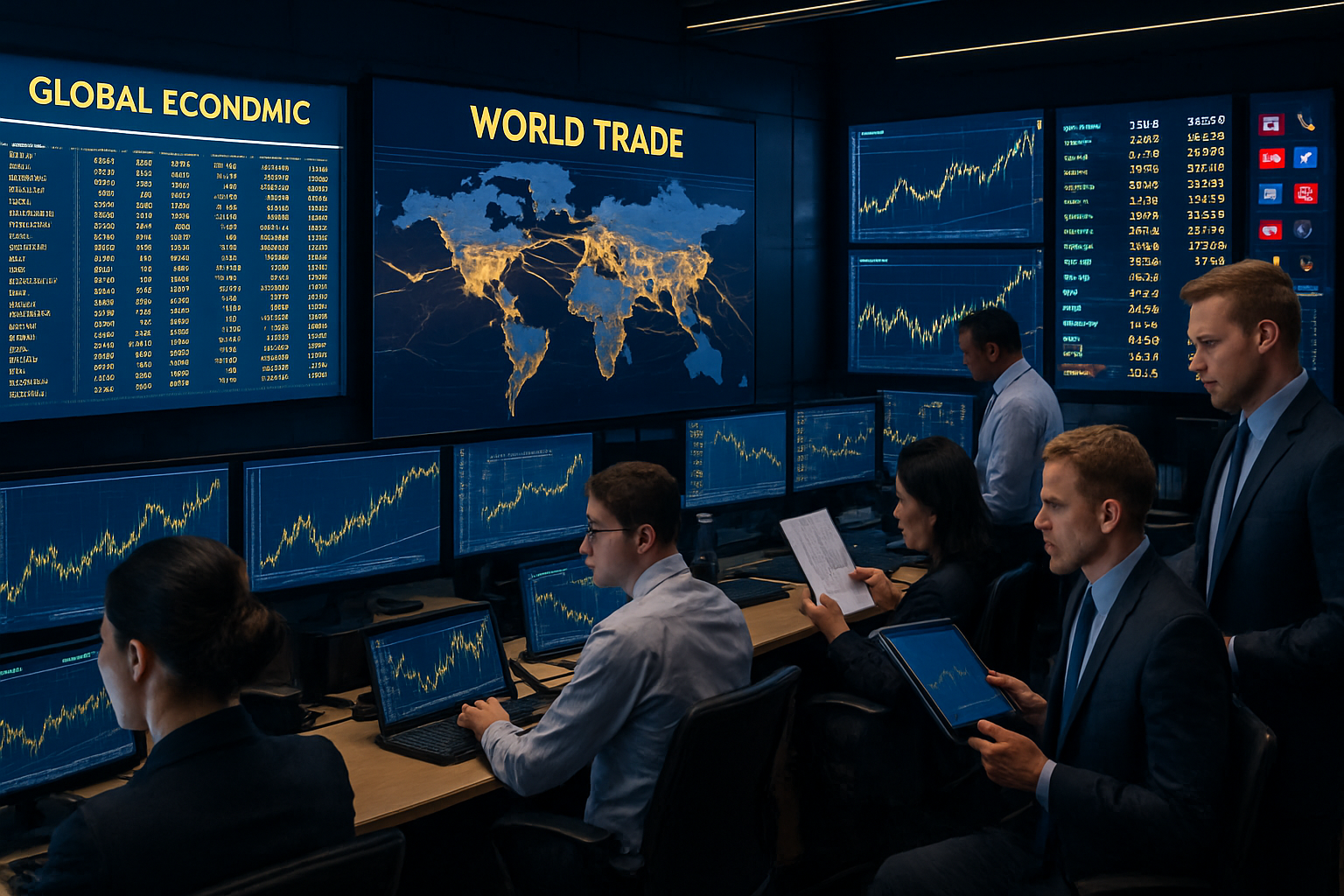
Global economic stability faces its greatest test since the 2008 financial crisis as the International Monetary Fund warns of unprecedented threats to multilateral cooperation, while China's central bank urges stronger international coordination amid widespread trade disruptions caused by the ongoing Middle East conflict affecting critical shipping routes.
The crisis represents a convergence of geopolitical tensions, energy market volatility, and supply chain vulnerabilities that threaten to fundamentally reshape international trade patterns for decades to come.
China Calls for Enhanced Multilateral Framework
People's Bank of China Governor Pan Gongsheng delivered urgent warnings to the International Monetary Fund's 53rd meeting, calling for the organization to "take a clear stand against protectionism and defend multilateralism" as rising unilateral trade restrictions threaten global economic stability.
Pan's statement comes amid escalating trade restrictions and intensified Middle East conflicts that have disrupted energy and food security worldwide. The Chinese central banker emphasized the need for enhanced IMF quota reforms and better surveillance of advanced economies, signaling Beijing's growing concerns about economic governance in an increasingly fragmented global system.
"The International Monetary Fund should take a clear stand against protectionism and defend multilateralism at a time when escalating trade restrictions and an intensified Middle East conflict threaten energy and food security."
— Pan Gongsheng, People's Bank of China Governor
Trade Disruption Spreads Beyond Energy Sector
Malaysia's busiest container port has begun refusing Middle East-bound cargo unless shipping lines can guarantee prompt pickup, marking one of the clearest indicators that the Gulf crisis is expanding beyond oil markets into everyday Asian trade flows.
The disruptions have created cascading effects across regional logistics networks, with wine, spirits, and other time-sensitive goods serving as early indicators of broader supply chain breakdowns. Transit times have increased dramatically while insurance premiums have soared, forcing businesses across Asia to reconsider fundamental trade relationships built over decades.
China's trade data reveals the severity of regional disruption, with imports from Iran plunging 48 percent year-over-year in March while exports to the country dropped 90 percent. Across the broader Middle East, exports to eight Persian Gulf economies fell 57 percent, while imports declined nearly 33 percent.
Asia-Pacific Growth Momentum Weakens
The United Nations' latest Economic and Social Survey of Asia and the Pacific reveals significant economic headwinds, with regional growth momentum slowing to 4.6 percent in 2025 and projected to decline further to 4 percent in 2026. The deterioration stems directly from Middle East conflict fallout weighing on energy prices, supply chains, and external demand.
According to UN-ESCAP analysis, the average economic growth in the region has moderated substantially from 5.3 percent in 2023 to 4.8 percent in 2024 and now 4.6 percent in 2025. The survey recommends that regional countries rely more heavily on domestic and regional demand while carefully managing transitions to clean energy to avoid short-term economic and social disruptions.
Energy Security Drives Regional Innovation
Pakistan's energy landscape exemplifies the broader regional shift toward energy independence amid global supply uncertainties. The country's solar power boom has emerged as a crucial buffer against energy crises, with many Pakistanis no longer viewing energy security as solely the state's responsibility.
The solar expansion represents a broader trend across Asia-Pacific developing countries, where traditional energy dependencies are being reconsidered in favor of more resilient, domestically-controlled alternatives. This transformation has gained unprecedented urgency following the March 2026 energy crisis that exposed dangerous vulnerabilities in global supply chains.
Latin America and Caribbean Face Divergent Impacts
The International Monetary Fund warns that the Middle East war is likely to widen economic differences across Latin America and the Caribbean, providing short-term benefits to oil exporters while worsening prospects for tourism-reliant Caribbean economies and energy-importing Central American countries.
This divergence reflects a broader global pattern where resource-rich nations with diversified energy portfolios demonstrate greater resilience compared to economies dependent on volatile international markets and vulnerable supply routes.
Investment Strategy Evolution
The ongoing crisis has accelerated a fundamental shift in global investment strategies, with portfolio managers moving away from broad regional themes toward country-specific fundamental analysis. Institutional quality, policy consistency, and governance standards have become primary determinants of economic resilience, transcending traditional geographic classifications.
Emerging markets with strong institutional frameworks have consistently outperformed regardless of regional classification, reflecting growing investor sophistication in recognizing that local conditions matter more than traditional geographic or sector-based approaches.

Historical Context and Future Implications
The current crisis draws comparisons to the 1970s energy shocks but with crucial differences reflecting today's interconnected economy and just-in-time supply chains that provide little buffer against disruption. The concentration of strategic chokepoints creates instant global market impacts unlike predictable weather-related disruptions.
The March 2026 energy crisis, which saw oil prices reach $119.50 per barrel for Brent crude and triggered the largest International Energy Agency strategic petroleum reserve release in 50-year history, has established templates for 21st-century crisis management that will influence international cooperation mechanisms for decades.
Central Bank Coordination Under Pressure
Traditional monetary policy tools have proven insufficient against structural geopolitical disruptions, prompting unprecedented coordination between the European Central Bank and Bank of Japan on emergency liquidity measures. This collaboration represents a new paradigm where central banks must balance domestic priorities with global stability requirements.
The limitation of conventional monetary policy during geopolitical crises has forced policymakers to develop innovative approaches combining energy security considerations with financial stability objectives, marking a significant evolution in central banking practices.
Technology Infrastructure as Economic Foundation
Digital transformation has emerged as a critical competitive advantage across affected economies, with robust technological infrastructure proving essential for maintaining economic competitiveness during supply chain disruptions. The global semiconductor shortage has created cost pressures while simultaneously accelerating innovation in efficient solutions leveraging existing infrastructure.
Nations with strong digital foundations have demonstrated greater adaptation capacity, reinforcing the importance of technology infrastructure investment as a cornerstone of modern economic resilience strategies.
Long-term Structural Transformation
The crisis has validated arguments for fundamental restructuring of global economic architecture, reducing over-dependence on geopolitically volatile regions. Supply diversification and renewable energy transitions, while requiring years or decades to implement fully, have gained unprecedented urgency following repeated supply shock demonstrations.
Success factors for economic resilience increasingly center on institutional quality, policy clarity, innovation-stability balance, and international cooperation frameworks that maintain national sovereignty while enabling coordinated responses to global challenges.
"Countries need to rely more on domestic and regional demand, while carefully managing the shift to clean energy to avoid short-term economic and social disruptions."
— UN-ESCAP 2026 Economic Survey
As the global economy navigates this unprecedented confluence of challenges, the choices made in the coming months will determine whether the international system emerges stronger and more resilient, or fragments into competing regional blocs prioritizing security over efficiency. The outcome will shape economic governance mechanisms and international cooperation frameworks for generations to come.