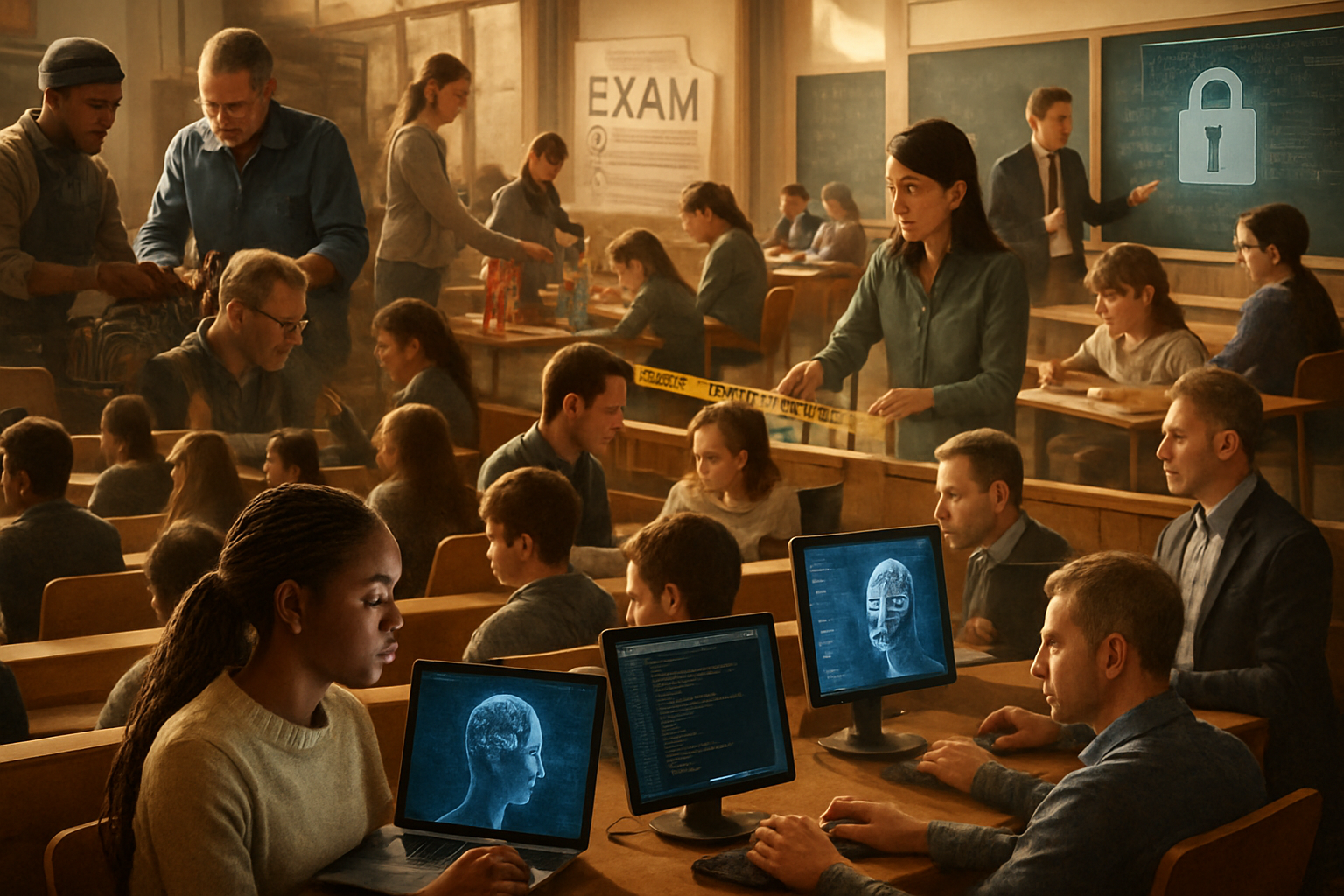
Educational systems across three continents are implementing sweeping reforms to address cybersecurity threats, modernize examination processes, and tackle rising concerns about student safety and violence, marking a critical juncture in global education policy development.
From Denmark's pioneering cybersecurity education initiative to Slovakia's examination modernization and Saint Vincent and the Grenadines' confrontation with school violence, educational institutions worldwide are grappling with unprecedented challenges that demand both technological innovation and fundamental policy reassessment.
Denmark Leads Cybersecurity Education Revolution
Aarhus University has announced the launch of a groundbreaking new educational program specifically designed to combat cybercriminalitet, positioning Denmark at the forefront of cybersecurity education initiatives. The program represents a strategic response to the escalating global cyber threat landscape, where educational institutions increasingly find themselves targets of sophisticated attacks.
The initiative comes amid a broader recognition that traditional cybersecurity approaches are insufficient to address the evolving threat landscape. Danish education officials have emphasized that the program will integrate both theoretical knowledge and practical, hands-on training to prepare students for real-world cyber defense scenarios.
"This program represents our commitment to producing the next generation of cybersecurity professionals who can protect Denmark's digital infrastructure," said a university spokesperson.
— Aarhus University Representative
Slovakia Modernizes National Examination Systems
In Slovakia, thousands of students are experiencing a transformative shift in their educational assessment as the country implements comprehensive reforms to its Maturita examination system. The changes reflect Slovakia's broader commitment to modernizing educational delivery while maintaining rigorous academic standards.
The reform initiative encompasses both structural changes to examination timing and enhanced support systems for students navigating the increasingly complex academic landscape. Slovak education authorities have worked closely with European partners to ensure the changes align with continental standards while respecting local educational traditions.
The timing of these reforms is particularly significant, as they coincide with broader European efforts to harmonize educational standards while preserving national educational sovereignty. Slovakia's approach has drawn attention from neighboring countries considering similar modernization efforts.
Regional Impact and International Cooperation
The Slovak reforms are part of a broader Central European movement toward educational modernization that has seen countries sharing best practices and coordinating policy development. This regional cooperation has proven particularly valuable in addressing common challenges such as teacher shortages, technological integration, and student assessment standardization.
Caribbean Education Crisis: Violence and Safety Concerns
In Saint Vincent and the Grenadines, Education Minister Phillip Jackson has made a stark acknowledgment that reflects a troubling global trend: "Vincy, we have a problem." His candid admission addresses the escalating challenge of school violence that is undermining educational systems across the Caribbean region and beyond.
The minister's statement comes as educational institutions worldwide grapple with unprecedented safety challenges that extend far beyond traditional disciplinary concerns. From cyberbullying to physical violence, schools are confronting threats that require comprehensive, coordinated responses involving educators, law enforcement, mental health professionals, and community leaders.
Recent memory from the global education community reveals that such challenges are not isolated to any single region. The tragic Tumbler Ridge school shooting in February 2026, which claimed eight lives in British Columbia, exposed critical gaps in mental health intervention systems and firearm access protocols. Similarly, educational institutions across Europe, Africa, and Asia have reported increasing incidents of violence that demand immediate policy attention.
Systemic Approaches to School Safety
Education experts emphasize that effective responses to school violence require comprehensive approaches that address root causes rather than simply implementing reactive security measures. This includes enhanced mental health support systems, improved crisis intervention protocols, and community-based prevention programs that have shown success in countries implementing "prevention-first" strategies.
"We cannot build walls high enough to keep violence out of schools if we don't address the underlying factors that contribute to these tragic incidents."
— International Education Safety Expert
Global Context: The 2026 Educational Technology Renaissance
These developments occur within what educational analysts have termed the "2026 Educational Technology Renaissance" – a coordinated international movement toward thoughtful digital tool integration with traditional educational values. Unlike previous waves of educational technology adoption, this renaissance emphasizes human-centered approaches that enhance rather than replace fundamental teacher-student relationships.
Malaysia's achievement of a 97.82% teacher placement rate alongside the world's first AI-integrated Islamic school demonstrates that technological advancement and educational excellence can coexist when properly implemented. Singapore's WonderBot 2.0 heritage education system and Canada's AI teaching assistants provide additional examples of successful technology integration that maintains critical thinking standards.
Infrastructure Challenges and Opportunities
However, the global memory crisis, with semiconductor prices surging sixfold, has created infrastructure bottlenecks that will persist until 2027 when new manufacturing facilities come online. This constraint has paradoxically driven innovation in memory-efficient algorithms and hybrid approaches that combine digital tools with traditional educational methods.
Educational institutions are learning that effective technology integration requires sustained political commitment, comprehensive stakeholder engagement, and careful balance between innovation and educational tradition. The most successful programs demonstrate that technology must serve educational goals rather than replace the human relationships that define authentic learning experiences.
Prevention-First Economics in Education
Countries implementing comprehensive, prevention-focused educational approaches are demonstrating superior economic outcomes through reduced crisis intervention costs, decreased unemployment rates, and improved workforce productivity. These "prevention-first" strategies generate measurable benefits including enhanced international competitiveness through strategic human capital development.
Educational investments are increasingly viewed as strategic infrastructure for 21st-century prosperity rather than simple cost centers. Nations that successfully navigate current educational transformation requirements are positioning themselves as leaders in preparing citizens for complex global challenges while preserving cultural wisdom essential for human flourishing.
International Cooperation and Knowledge Sharing
The educational challenges facing Denmark, Slovakia, and Saint Vincent and the Grenadines reflect universal themes that require coordinated international responses. Successful models demonstrate the importance of bilateral partnerships, multilateral frameworks, and peer-to-peer knowledge sharing networks that enable countries to learn from both successes and failures.
Regional frameworks are emerging that allow smaller nations to access expertise while contributing innovations to global knowledge bases. This distributed cooperation model provides more resilient and culturally responsive approaches than standardized, one-size-fits-all solutions.
Looking Forward: Critical March 2026 Juncture
March 2026 represents a critical juncture in global educational policy development, where the success or failure of current reform initiatives will likely determine educational trajectories for the coming decade. The stakes are enormous, as these decisions will affect global capacity for addressing climate change, technological disruption, and social cohesion through quality educational systems that serve as strategic infrastructure.
The window for effective coordinated action is narrowing as technological change accelerates and global challenges intensify. Success requires unprecedented coordination between governments, educational institutions, private sector partners, and international organizations to ensure that schools become environments for human flourishing rather than sources of psychological damage or physical danger.
The educational transformations underway in these three nations – Denmark's cybersecurity innovation, Slovakia's examination modernization, and Saint Vincent's confrontation with violence – provide valuable templates for other countries facing similar challenges. Their experiences demonstrate that effective educational reform requires thoughtful adaptation of solutions to specific cultural, economic, and social contexts rather than wholesale adoption of external models.
The Path Forward
As educational systems worldwide continue to evolve, the lessons emerging from current reforms emphasize several critical success factors: sustained political commitment that survives electoral cycles, comprehensive stakeholder engagement that includes all members of educational communities, and balanced approaches that preserve human creativity and cultural knowledge while preparing students for an AI-integrated global economy.
The future belongs to educational systems that successfully integrate advanced technologies while maintaining the fundamental human relationships, critical thinking skills, and cultural authenticity that define meaningful education. The current global transformation provides unprecedented opportunities for creating educational systems that serve human potential rather than limiting it, but only if nations can coordinate their efforts and learn from shared experiences.
March 2026 may well be remembered as the moment when global education systems either successfully navigated their greatest transformation since the post-World War II expansion or failed to meet the challenges of the 21st century. The outcomes will resonate for generations to come.