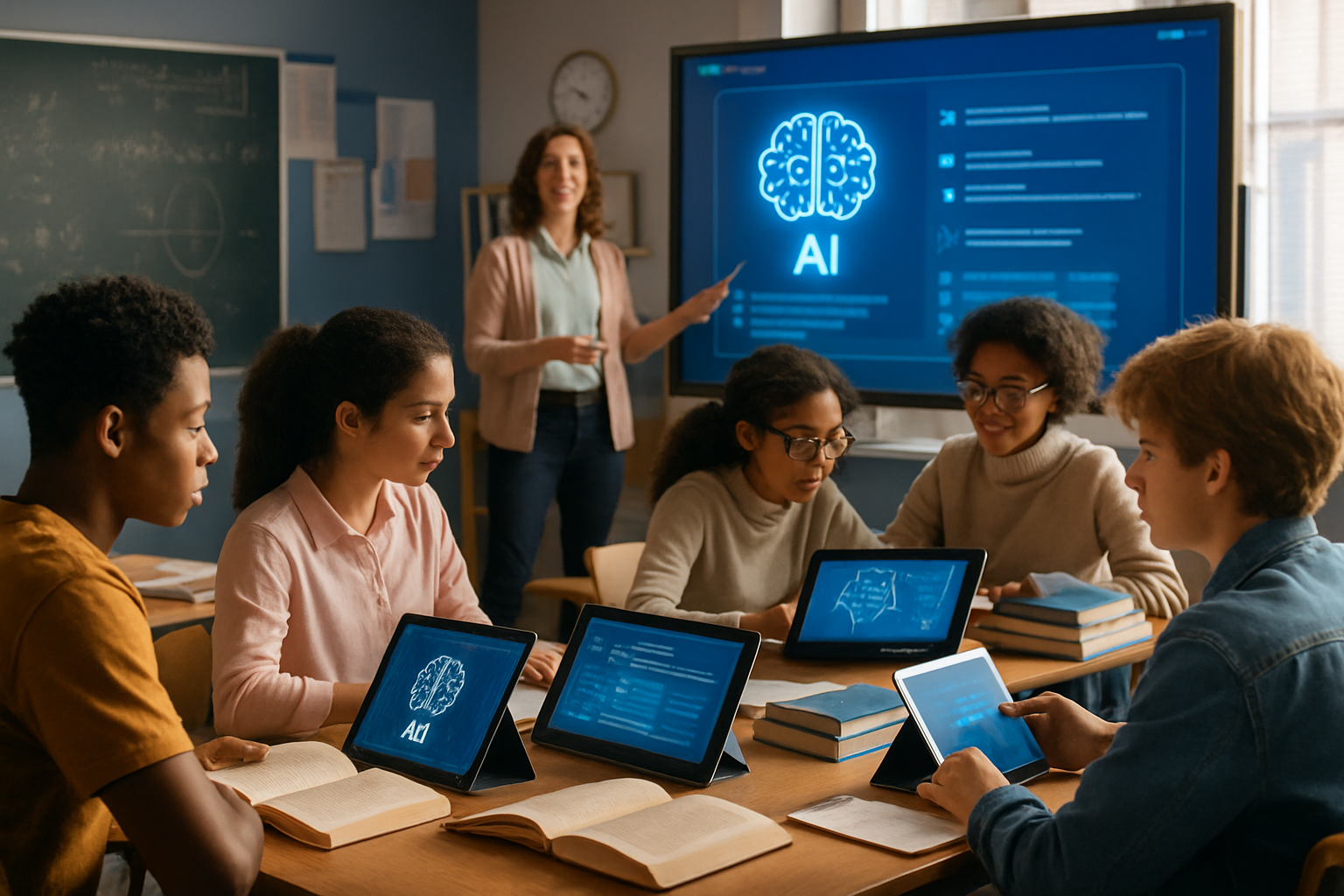
As educators grapple with rapid technological advancement, a global education revolution is transforming classrooms from the Caribbean to Central Europe, marking what experts are calling the "2026 Educational Technology Renaissance" - the most significant transformation in learning since the post-World War II educational expansion.
From Trinidad and Tobago's groundbreaking AI textbook initiative to Austria's proposed educational reforms, nations worldwide are implementing sweeping changes that blend cutting-edge technology with traditional educational values. However, these reforms face unprecedented challenges, including global semiconductor shortages, teacher training gaps, and the urgent need to balance innovation with human-centered learning approaches.
AI Textbooks and Digital Learning: The New Frontier
In a historic move that could reshape education across the Caribbean, Trinidad and Tobago's Education Minister Dr. Michael Dowlath launched the country's first AI-powered digital textbooks for Form One students. The initiative, targeting English and Mathematics, aims to reduce the financial burden on parents while providing personalized learning experiences.
"This initiative will ease the financial burden on parents, reducing the need for costly textbooks," Dr. Dowlath announced at Moruga Secondary School, where Form One students who received government-issued laptops after the Secondary Entrance Assessment (SEA) examination gained access to these revolutionary learning tools.
The AI textbooks represent more than cost savings - they offer adaptive learning capabilities that adjust to individual student pace and comprehension levels. Early reports from pilot programs indicate improved engagement and comprehension rates, particularly among students who struggled with traditional textbook formats.
The Austrian Educational Reform Challenge
Meanwhile, in Austria, Education Minister explained ambitious reforms during a ZiB 2 interview with Armin Wolf, outlining the "Mittlere Reife" (Middle Maturity) qualification system and proposing six-year primary schools. The reforms represent Austria's attempt to modernize its educational structure while maintaining academic rigor.
However, the Austrian approach highlights a critical tension facing education systems globally: how to eliminate outdated curriculum content while introducing necessary new subjects. The minister's question "Welcher Lehrstoff kann weg?" (Which curriculum content can be removed?) reflects the broader challenge of educational modernization without curriculum overload.
Austrian proposals include extending primary education through grade six and implementing new qualification frameworks that better align with European standards. Yet these reforms face political resistance and concerns about rushed implementation without adequate stakeholder consultation.
Digital Citizenship and Smartphone Integration
The smartphone debate represents one of the most contentious aspects of modern educational reform. In Austria, smartphone coach Andrea Buhl-Aigner argues that social media bans express "helplessness" rather than solving underlying problems, emphasizing that "reasonable usage begins much earlier" than secondary school.
Research by Dr. Ran Barzilay from the University of Pennsylvania provides crucial context: early smartphone exposure before age 5 causes persistent sleep disorders, cognitive decline, and weight problems extending into adulthood. With 96% of children aged 10-15 using social media and 70% experiencing harmful content exposure, the stakes are extraordinarily high.
Countries are taking divergent approaches. Some, like Australia, have eliminated 4.7 million teen social media accounts, proving technical feasibility for youth protection. Others, including Malaysia, emphasize parental responsibility campaigns and digital literacy education rather than blanket bans.
"We must teach children appropriate smartphone usage from early childhood, not simply ban devices and hope problems disappear."
— Andrea Buhl-Aigner, Smartphone Coach
The Global Semiconductor Crisis Impact
A major obstacle facing educational technology implementation is the global semiconductor shortage, which has driven memory chip prices up sixfold, affecting major manufacturers like Samsung, SK Hynix, and Micron. This crisis has created infrastructure bottlenecks for technology-dependent educational programs until new manufacturing facilities come online in 2027.
Paradoxically, these constraints are driving innovation toward more efficient, sustainable technology integration approaches. Educational institutions are learning to prioritize enhancement of human learning relationships rather than wholesale replacement of traditional teaching methods.
Malaysia's AI Integration Success Story
Malaysia has emerged as a global leader in educational technology integration, achieving a remarkable 97.82% teacher placement rate while pioneering the world's first AI-integrated Islamic school (SMAN) in Sabah. The program successfully combines artificial intelligence with both naqli (religious) and aqli (academic) learning approaches.
This success demonstrates that technological advancement can coexist with cultural preservation and human-centered educational approaches. Malaysia's model shows how nations can leverage technological innovation while maintaining cultural identity and educational values.
International Cooperation and Knowledge Sharing
The current educational transformation extends beyond individual national efforts. Singapore's WonderBot 2.0 heritage education system and Canada's responsible AI teaching assistants provide complementary models for maintaining critical thinking standards while embracing technological advancement.
Educational cooperation has evolved beyond traditional financial assistance toward comprehensive support including cultural integration, language acquisition, and ongoing development systems. Bilateral partnerships and peer-to-peer knowledge sharing networks are proving more resilient than traditional multilateral approaches, allowing for flexible, culturally responsive strategies while maintaining evidence-based standards.
Venezuela's Educational Crisis Context
The challenges are stark in Venezuela, where expert Carlos Calatrava warns of severe educational deficiencies affecting the next century. In a nation where approximately 3 million children out of 10 million aged 0-17 are not in school, the remaining students generally lack critical thinking skills and long-term planning capabilities.
Venezuela's situation illustrates how political instability and economic crisis can undermine educational progress, creating generational impacts that extend far beyond immediate political concerns. This crisis serves as a cautionary reminder that educational technology solutions require stable institutional foundations and sustained political commitment.
Economic Implications of Educational Investment
Countries implementing comprehensive, prevention-focused educational approaches are demonstrating superior economic outcomes through reduced crisis intervention costs, decreased unemployment, and improved workforce productivity. Educational investments are increasingly viewed as strategic 21st-century infrastructure rather than cost centers.
The economic implications extend beyond immediate educational outcomes. Enhanced community resilience, reduced social service demands, and improved public health outcomes create multiplier effects that benefit entire societies. Countries that successfully balance technological advancement with human development, global competencies with local identity, and innovation with tradition preservation position themselves advantageously for long-term prosperity.
The Critical Juncture of April 2026
Educational policy experts identify April 2026 as a critical juncture that will determine educational trajectories for the coming decade. These decisions will significantly affect global capacity to address climate change, technological disruption, and social cohesion through quality educational systems.
The stakes include preparing students for an AI-integrated global economy while preserving human creativity, critical thinking, and cultural knowledge that define authentic educational excellence. The window for effective coordinated action is narrowing as technological change accelerates and global challenges intensify.
Success Factors for Educational Transformation
Analysis across multiple countries reveals universal success factors for educational transformation:
- Sustained Political Commitment: Reforms must survive beyond electoral cycles
- Comprehensive Stakeholder Engagement: Including educators, students, families, and communities
- Innovation-Tradition Balance: Enhancing rather than replacing fundamental educational values
- Cultural Sensitivity: Local adaptation rather than standardized global solutions
- Adequate Resource Allocation: Long-term sustainability planning
- International Cooperation: Knowledge sharing and technical assistance
Looking Forward: The Future of Education
The future belongs to educational systems that successfully integrate advanced technologies while preserving fundamental human relationships, critical thinking skills, and cultural authenticity that make education meaningful and culturally relevant.
Effective educational transformation requires thoughtful adaptation of technological tools to serve specific cultural, economic, and social needs rather than wholesale replacement of proven educational relationships. Success depends on maintaining human creativity, critical thinking, and cultural knowledge while preparing students for an interconnected global economy that requires both technical competence and cultural authenticity.
"Technology must serve educational goals rather than replace the fundamental human relationships that define authentic learning."
— International Education Research Consensus
The evidence suggests that the most promising educational initiatives prioritize human-centered approaches, treating technology as amplification tools that serve educational objectives rather than ends in themselves. The challenge for educators, policymakers, and communities worldwide is to navigate this transformation wisely, ensuring that the pursuit of technological innovation enhances rather than diminishes the profound human connections that make learning transformative.
As nations continue to experiment with AI-powered learning, digital citizenship education, and hybrid teaching models, the lessons learned from these early adopters will prove invaluable for shaping global educational policy. The success or failure of current reform initiatives will not only determine individual student outcomes but will also establish the foundation for how humanity addresses the complex challenges of the coming decades through education.