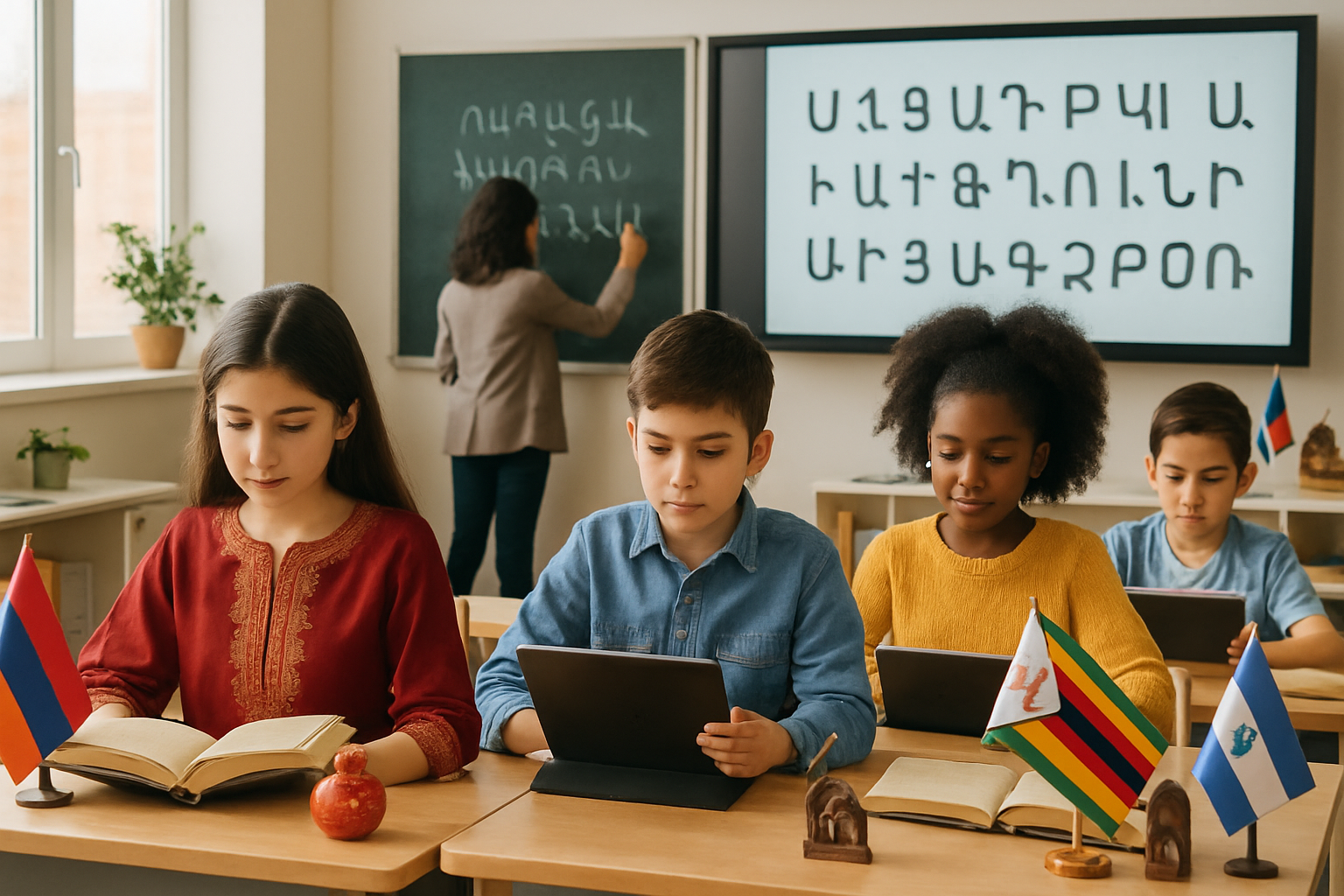
A remarkable convergence of educational and cultural initiatives across Armenia, Nicaragua, and Zimbabwe demonstrates the emergence of a sophisticated global framework where traditional heritage preservation meets cutting-edge pedagogical innovation, representing a fundamental shift in how nations approach 21st-century learning challenges.
This comprehensive analysis of current educational developments reveals coordinated international efforts to address the complex intersection of cultural identity, technological advancement, and economic development through education. The initiatives span from grassroots community programs to national policy frameworks, each offering unique insights into successful approaches for balancing tradition with innovation.
Armenia: Heritage Education Through Community Connection
The Armenian Relief Society's Camp Javakhk 2026 represents a compelling model of diaspora-homeland educational connection that transcends traditional boundaries. Operating in Armenian-populated villages in the Javakhk region of Georgia, the program demonstrates how cultural preservation can be achieved through direct community engagement rather than institutional structures alone.
The camp's approach—bringing Armenian youth from North America to work directly with local children—creates a bidirectional learning experience. Young Armenian-Americans develop deeper connections to their ancestral homeland while providing educational resources to communities that might otherwise be isolated from global Armenian networks. This model addresses a critical challenge facing diaspora communities: maintaining cultural authenticity while remaining globally connected.
"Camp Javakhk remains committed to strengthening ties with Armenians in the region and ensuring they are not forgotten," organizers emphasized, highlighting the program's role in preventing cultural isolation.
— Armenian Relief Society
Simultaneously, Boston Public Schools' innovative curriculum inspired by Armenian Heritage Park demonstrates how immigrant heritage can be integrated into mainstream educational programming. The "Geometry as Public Art: Telling A Story" initiative uses the park's geometric features to explore both mathematical concepts and the immigrant experience, creating educational content that serves multiple learning objectives.
Students write "I AM" poems from the perspective of family members who immigrated to the United States, combining personal narrative with academic learning. This approach transforms abstract geometric concepts into meaningful explorations of family history and cultural identity, demonstrating how heritage education can enhance rather than compete with traditional academic subjects.
Nicaragua: Systematic Teacher Development at Scale
Nicaragua's massive teacher training initiative, involving over 5,000 educators nationwide, represents one of the most comprehensive pedagogical development programs documented in recent years. The program's focus on "strengthening pedagogical practice and promoting educational innovation" addresses fundamental challenges facing educational systems globally: how to maintain teaching quality while adapting to rapidly changing technological and social environments.
This scale of professional development—reaching educators across the entire country simultaneously—suggests a coordinated national approach to educational transformation. Unlike piecemeal reforms that affect individual schools or regions, Nicaragua's initiative demonstrates the potential for systematic change when adequate resources and political commitment align.
The timing of this initiative coincides with global recognition that teacher quality remains the most significant factor in educational outcomes. While many countries struggle with teacher shortages and inadequate professional development, Nicaragua's comprehensive approach provides a potential template for other nations facing similar challenges.
Zimbabwe: Technology as Economic Empowerment Tool
President of Zimbabwe's directive that educational institutions draw inspiration from the country's "rich liberation history" to develop a technology-driven economy represents a sophisticated understanding of how historical identity can fuel contemporary innovation rather than constraining it.
The emphasis on producing young people capable of propelling a "knowledge-driven economy anchored on new technologies and industrialization" reflects a strategic approach to national development that positions education as the primary vehicle for economic transformation. This vision challenges traditional assumptions that cultural preservation and technological advancement exist in tension with each other.
Zimbabwe's approach suggests that historical struggle and cultural identity can provide the foundation for technological innovation rather than obstacles to it. By framing technology education within the context of national liberation, the country creates a narrative that makes modern skills culturally relevant and personally meaningful for students.
Global Context: The 2026 Educational Renaissance
These initiatives occur within what educational researchers are documenting as the "2026 Educational Technology Renaissance"—a global phenomenon characterized by thoughtful integration of digital tools with traditional educational values rather than wholesale replacement of established practices.
Historical analysis reveals similar patterns across multiple countries: Malaysia's AI-integrated Islamic schools, Singapore's WonderBot 2.0 heritage education programs, and Canada's responsible AI teaching assistants all demonstrate approaches that enhance rather than replace human-centered learning.
The current global context includes significant infrastructure challenges, including a persistent memory crisis that has caused semiconductor prices to surge sixfold, affecting educational technology implementation until 2027 when new fabrication facilities come online. Despite these constraints, successful programs consistently demonstrate several common characteristics.
Success Patterns and Implementation Strategies
Analysis of successful educational initiatives reveals several critical success factors that transcend cultural and economic contexts:
- Sustained Political Commitment: Programs that survive leadership changes demonstrate long-term vision and adequate resource allocation
- Community Engagement: Initiatives involving families, traditional knowledge bearers, and local communities show higher success rates
- Cultural Integration: Programs that respect local traditions while embracing helpful innovations achieve better outcomes than standardized approaches
- Teacher Development: Comprehensive professional training remains essential for successful implementation of educational reforms
- International Cooperation: Knowledge sharing and technical assistance enhance individual program effectiveness
The Armenia-Nicaragua-Zimbabwe comparison reveals that effective educational transformation requires balancing multiple priorities simultaneously: technological advancement with cultural preservation, global competencies with local identity, innovation with tradition.
Economic and Social Implications
The economic implications of these educational approaches extend beyond immediate costs to demonstrate measurable benefits including improved community resilience, reduced long-term social service demands, and enhanced international competitiveness through human capital development.
Armenia's heritage education programs create lasting connections between diaspora communities and homeland regions, potentially supporting long-term economic development through increased investment and tourism. Nicaragua's teacher training represents significant human capital investment that could improve educational outcomes across the country for decades. Zimbabwe's technology-focused approach positions the nation for participation in the global digital economy while maintaining cultural authenticity.
Prevention-first approaches demonstrated across these initiatives generate measurable benefits including reduced crisis intervention costs, decreased healthcare expenditures through improved educational outcomes, and enhanced workforce productivity through better-prepared graduates.
Challenges and Adaptive Solutions
Implementation challenges remain significant across all contexts. Infrastructure limitations, funding sustainability, teacher training requirements, and comprehensive stakeholder engagement needs affect programs regardless of their specific focus or cultural context.
However, successful initiatives demonstrate sophisticated adaptive strategies. Armenia's programs leverage diaspora networks to supplement domestic resources. Nicaragua's scale demonstrates the potential for systematic change when adequate political commitment exists. Zimbabwe's historical framing makes contemporary skills culturally relevant and personally meaningful.
These adaptive approaches suggest that effective educational transformation requires contextual adaptation rather than standardized solutions, while maintaining focus on core educational goals that transcend cultural boundaries.
Future Implications and Global Leadership
The initiatives analyzed position these nations as potential leaders in different aspects of educational transformation. Armenia provides insights for countries with significant diaspora populations seeking to maintain cultural connections. Nicaragua demonstrates the potential for comprehensive teacher development at national scale. Zimbabwe offers a model for integrating historical identity with technological advancement.
These approaches contribute to international educational policy discussions by providing practical templates that can be adapted across different cultural and economic contexts while respecting local needs and values.
"Educational institutions must be inspired by the country's rich liberation history to produce young people who will propel a knowledge-driven economy anchored on new technologies."
— Zimbabwe Presidential Statement
February 2026 represents a critical juncture in global educational policy, with successful approaches providing templates for scaling across diverse contexts. The evidence suggests that effective educational transformation requires technology to serve educational goals rather than replace fundamental relationships between teachers, students, and communities.
The window for effective action remains open, but the tools and knowledge demonstrated through these initiatives provide optimism for supporting comprehensive educational development that maintains cultural authenticity while preparing students for an interconnected global economy requiring both technical competence and cultural wisdom.
As these programs mature and demonstrate long-term outcomes, their approaches will likely influence international educational policy discussions and provide templates for other regions seeking to balance technological advancement with cultural preservation, global competencies with local identity, and innovation with tradition in ways that serve both individual development and community resilience.